



 Chat with AI
Exam 2: Economic Models: Trade-Offs and Trade

Exam 1: First Principles183 Questions
Exam 2: Economic Models: Trade-Offs and Trade341 Questions
Exam 3: Supply and Demand230 Questions
Exam 4: Price Controls and Quotas: Meddling With Markets187 Questions
Exam 5: International Trade224 Questions
Exam 6: Macroeconomics: the Big Picture128 Questions
Exam 7: GDP and the CPI: Tracking the Macroeconomy213 Questions
Exam 8: Unemployment and Inflation300 Questions
Exam 9: Long-Run Economic Growth268 Questions
Exam 10: Savings, Investment Spending, and the Financial Syst355 Questions
Exam 11: Income and Expenditure114 Questions
Exam 12: Aggregate Demand and Aggregate Supply308 Questions
Exam 13: Fiscal Policy120 Questions
Exam 14: Money, Banking, and the Federal Reserve System135 Questions
Exam 15: Monetary Policy316 Questions
Exam 16: Inflation, Disinflation, and Deflation194 Questions
Exam 17: Macroeconomics: Events and Ideas283 Questions
Exam 18: International Macroeconomics411 Questions
Select questions type


Assume that Colombia gives up three motorcycles for each ton of coffee it produces, while Bolivia gives up seven motorcycles for each ton of coffee it produces. Colombia has a comparative advantage in _____ production and should specialize in _____.
(Multiple Choice)
4.9/5  (89)
(89) Which office of the U.S. government is a major employer of economists?
(Multiple Choice)
4.8/5 (82)
(82) Suppose Indiana produces only steel and corn, with fixed amounts of land, labor, and capital resources. Which scenario BEST sets the stage for economic growth?
(Multiple Choice)
4.8/5 (75)
(75) Nations can gain from trade with other nations, even if they are less productive in all industries than the nations with which they trade.
(True/False)
5.0/5 (76)
(76) Coworkers Yvonne and Rodney are washing dishes and sweeping the floors of the store. They know that to finish both tasks as quickly as possible, each of them should focus on just one task, but they don't know who should do what. Yvonne and Rodney should determine which one:
(Multiple Choice)
4.9/5 (95)
(95) Use the following to answer questions:  -(Figure: Seasonally Adjusted Unemployment Rate) Use Figure: Seasonally Adjusted Unemployment Rate. The distance between each labeled point on the horizontal axis is one year, and the distance between each labeled point on the vertical axis is one percentage point of unemployment. Using this graph, the unemployment rate was at its lowest point (in the time window) shown in _____ and at its highest point (in the time window shown) in _____.
 (Multiple Choice)
4.9/5 (82)
(82) The circular-flow diagram illustrates how households _____ goods and services and _____ factors of production.
(Multiple Choice)
4.8/5 (73)
(73) Use the following to answer questions:
\\  -(Table: Comparative Advantage I) Use Table: Comparative Advantage I. Sweden has an absolute advantage in producing:
 (Multiple Choice)
4.8/5 (78)
(78) Mark and Julie are going to sell brownies and cookies for their third annual fundraiser bake sale. In one day, Mark can make 40 brownies or 20 cookies, and Julie can make 15 brownies or 15 cookies. With specialization, _____ brownies and _____ cookies will be made in one day.
(Multiple Choice)
4.7/5 (69)
(69) Use the following to answer questions: 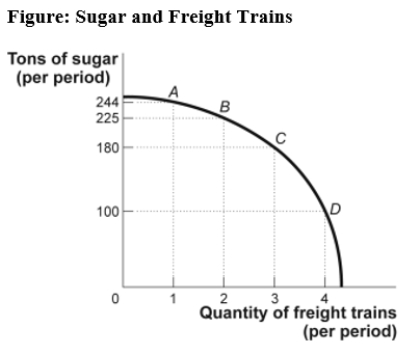 \\
-(Figure: Sugar and Freight Trains) Use Figure: Sugar and Freight Trains. Suppose the economy is operating at point C. The opportunity cost of producing the fourth freight train would be:
\\
-(Figure: Sugar and Freight Trains) Use Figure: Sugar and Freight Trains. Suppose the economy is operating at point C. The opportunity cost of producing the fourth freight train would be: (Multiple Choice)
4.8/5 (80)
(80) If Mary accepts a job as a nurse, she has sold a factor of production in the factor market.
(True/False)
4.9/5 (92)
(92) Use the following to answer questions:
\\  -(Figure: Comparative Advantage) Use Figure: Comparative Advantage. Eastland has a comparative advantage in producing:
 (Multiple Choice)
4.7/5 (76)
(76) The U.S. production possibility frontier will _____ if there is a large influx of working-age immigrants.
(Multiple Choice)
4.9/5 (68)
(68) The relation between two variables that move in opposite directions is said to be:
(Multiple Choice)
4.9/5 (83)
(83) If a production possibility frontier is a straight line, it tells us that the opportunity cost of producing one more unit of good X is:
(Multiple Choice)
4.8/5 (87)
(87) If the United States is more productive than Mexico in all lines of production, then the United States cannot benefit from trade with Mexico.
(True/False)
4.8/5 (67)
(67) If the opportunity cost of manufacturing automobiles is lower in the United States than in Britain and the opportunity cost of manufacturing airplanes is higher in the United States than in Britain, then the United States will:
(Multiple Choice)
4.9/5 (75)
(75) 
Filters
- Essay(0)
- Multiple Choice(0)
- Short Answer(0)
- True False(0)
- Matching(0)