



 Chat with AI
Exam 2: Economic Models: Trade-Offs and Trade

Exam 1: First Principles183 Questions
Exam 2: Economic Models: Trade-Offs and Trade341 Questions
Exam 3: Supply and Demand230 Questions
Exam 4: Price Controls and Quotas: Meddling With Markets187 Questions
Exam 5: International Trade224 Questions
Exam 6: Macroeconomics: the Big Picture128 Questions
Exam 7: GDP and the CPI: Tracking the Macroeconomy213 Questions
Exam 8: Unemployment and Inflation300 Questions
Exam 9: Long-Run Economic Growth268 Questions
Exam 10: Savings, Investment Spending, and the Financial Syst355 Questions
Exam 11: Income and Expenditure114 Questions
Exam 12: Aggregate Demand and Aggregate Supply308 Questions
Exam 13: Fiscal Policy120 Questions
Exam 14: Money, Banking, and the Federal Reserve System135 Questions
Exam 15: Monetary Policy316 Questions
Exam 16: Inflation, Disinflation, and Deflation194 Questions
Exam 17: Macroeconomics: Events and Ideas283 Questions
Exam 18: International Macroeconomics411 Questions
Select questions type


Trade takes the form of _____ when people directly exchange goods they have for goods they want.
(Multiple Choice)
4.9/5  (70)
(70) The relation between two variables that move in the same direction is said to be:
(Multiple Choice)
4.9/5 (86)
(86) Use the following to answer questions:
\\ 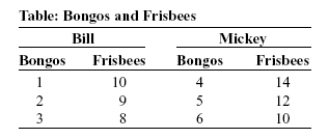 -(Table: Bongos and Frisbees) Use Table: Bongos and Frisbees. Bill and Mickey make bongos and Frisbees. Who has the comparative advantage in producing Frisbees?
 (Multiple Choice)
4.9/5 (73)
(73) If an economy is producing at a point on its production possibilities frontier, it is:
(Multiple Choice)
4.8/5 (91)
(91) The effect of a natural disaster can be shown by a(n) _____ the production possibility frontier.
(Multiple Choice)
4.9/5 (90)
(90) Use the following to answer questions:
\\  -(Figure: Strawberries and Submarines) Use Figure: Strawberries and Submarines. Suppose the economy is operating at point G. This implies that:
 (Multiple Choice)
4.9/5 (68)
(68) Use the following to answer questions:
\\  -(Figure: Production Possibility Frontier for Tealand) Use Figure: Production Possibility Frontier for Tealand. Tealand can produce at point E only if:
 (Multiple Choice)
4.7/5 (80)
(80) Use the following to answer questions:
\\ 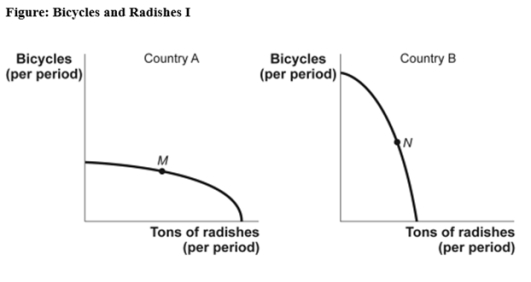 -(Figure: Bicycles and Radishes I) Use Figure: Bicycles and Radishes I. The figure shows production possibility frontiers for two countries that produce only radishes and bicycles. The axes of the two graphs are measured in equivalent units. Country A is operating at point M, and country B is operating at point N. Suppose country A discovers a new technology that greatly increases its ability to produce bicycles but has no effect on its ability to produce radishes. This would:
 (Multiple Choice)
4.9/5 (75)
(75) The value of a mortgage-backed security is tied to the interest on the national debt paid by the Federal Reserve.
(True/False)
4.9/5 (74)
(74) In the circular-flow diagram, an organization that produces goods or services for sale is a:
(Multiple Choice)
5.0/5 (78)
(78) Economists usually assume that production is subject to increasing opportunity costs because:
(Multiple Choice)
4.8/5 (80)
(80) The basis of the circular-flow diagram is that the money flowing into each sector or market is equal to the money that flows out.
(True/False)
4.8/5 (78)
(78) A _____ graph shows how the value of one or more variables has changed over some period.
(Multiple Choice)
4.9/5 (66)
(66) The circular-flow diagram illustrates how firms _____ goods and services and _____ factors of production.
(Multiple Choice)
4.8/5 (84)
(84) As long as people have different _____, everyone has a comparative advantage in something.
(Multiple Choice)
4.9/5 (85)
(85) Use the following to answer questions:
\\  -(Table: Comparative Advantage I) Use Table: Comparative Advantage I. The opportunity cost of producing 1 box of cell phones for Finland is _____ box(es) of herring.
 (Multiple Choice)
4.9/5 (83)
(83) In movement along a production possibility frontier, the opportunity cost to society of getting more of one good:
(Multiple Choice)
4.8/5 (67)
(67) 
Filters
- Essay(0)
- Multiple Choice(0)
- Short Answer(0)
- True False(0)
- Matching(0)