



 Chat with AI
Exam 2: Economic Models: Trade-Offs and Trade

Exam 1: First Principles183 Questions
Exam 2: Economic Models: Trade-Offs and Trade341 Questions
Exam 3: Supply and Demand230 Questions
Exam 4: Price Controls and Quotas: Meddling With Markets187 Questions
Exam 5: International Trade224 Questions
Exam 6: Macroeconomics: the Big Picture128 Questions
Exam 7: GDP and the CPI: Tracking the Macroeconomy213 Questions
Exam 8: Unemployment and Inflation300 Questions
Exam 9: Long-Run Economic Growth268 Questions
Exam 10: Savings, Investment Spending, and the Financial Syst355 Questions
Exam 11: Income and Expenditure114 Questions
Exam 12: Aggregate Demand and Aggregate Supply308 Questions
Exam 13: Fiscal Policy120 Questions
Exam 14: Money, Banking, and the Federal Reserve System135 Questions
Exam 15: Monetary Policy316 Questions
Exam 16: Inflation, Disinflation, and Deflation194 Questions
Exam 17: Macroeconomics: Events and Ideas283 Questions
Exam 18: International Macroeconomics411 Questions
Select questions type


Economic models that make unrealistic assumptions may be useful in analyzing some economic problems.
(True/False)
5.0/5  (95)
(95) In building models, economists avoid making any assumptions that might leave out any aspect of reality.
(True/False)
5.0/5 (67)
(67) Which statement is positive? Which statement is normative? I. The federal minimum wage in 2016 was $7.25 an hour.
II) The minimum wage should be high enough that families will not live in poverty.
(Multiple Choice)
4.8/5 (86)
(86) Use the following to answer questions:
\\  -(Figure: Strawberries and Submarines II) Use Figure: Strawberries and Submarines II. Suppose the economy is operating at point B. Achieving production at point F would require that the economy:
 (Multiple Choice)
4.9/5 (74)
(74) The fact that two variables always move together over time:
(Multiple Choice)
4.8/5 (71)
(71) An economic model is a simplified version of reality that is used to analyze real-world economic situations.
(True/False)
4.7/5 (78)
(78) Use the following to answer questions:
\\ 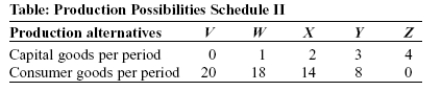 -(Table: Production Possibilities Schedule II) Use Table: Production Possibilities Schedule II. If the economy is producing at alternative X, the opportunity cost of producing at Y instead of X is _____ units of consumer goods per period.
 (Multiple Choice)
4.8/5 (75)
(75) Use the following to answer questions:
\\ 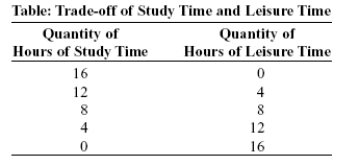 -(Table: Trade-off of Study Time and Leisure Time) Use Table: Trade-off of Study Time and Leisure Time. A student sleeps 8 hours per day and divides the remaining time between study and leisure time. The table shows the combinations of study and leisure time that can be produced in the 16 waking hours of each day. Suppose this student is studying 4 hours and spending 10 hours doing leisure activities. This point is:
 (Multiple Choice)
4.9/5 (84)
(84) "The current unemployment rate of 9% is too high" is a _____ statement.
(Multiple Choice)
4.7/5 (92)
(92) Economists generally believe that a country should specialize in the production of a good or service if the:
(Multiple Choice)
4.9/5 (78)
(78) If they spend all night writing computer programs, Laurence can write 10 programs, and Carrie Anne can write 5. If they spend all night making sunglasses, Laurence can make 6 pairs, and Carrie Anne can make 4. Given this information and supposing Laurence and Carrie Anne have constant opportunity costs, we know that _____ has an absolute advantage in _____.
(Multiple Choice)
4.9/5 (91)
(91) On any given production possibility frontier, we see the minimum quantity of one good that can be produced for any given production of the other.
(True/False)
4.8/5 (77)
(77) Use the following to answer questions:
\\  -(Figure: Production Possibility Frontier) Use Figure: Production Possibilities Frontier. The combination of cars and computers at point H:
 (Multiple Choice)
4.8/5 (88)
(88) 
Filters
- Essay(0)
- Multiple Choice(0)
- Short Answer(0)
- True False(0)
- Matching(0)