



 Chat with AI
Exam 9: Long-Run Economic Growth

Exam 1: First Principles183 Questions
Exam 2: Economic Models: Trade-Offs and Trade341 Questions
Exam 3: Supply and Demand230 Questions
Exam 4: Price Controls and Quotas: Meddling With Markets187 Questions
Exam 5: International Trade224 Questions
Exam 6: Macroeconomics: the Big Picture128 Questions
Exam 7: GDP and the CPI: Tracking the Macroeconomy213 Questions
Exam 8: Unemployment and Inflation300 Questions
Exam 9: Long-Run Economic Growth268 Questions
Exam 10: Savings, Investment Spending, and the Financial Syst355 Questions
Exam 11: Income and Expenditure114 Questions
Exam 12: Aggregate Demand and Aggregate Supply308 Questions
Exam 13: Fiscal Policy120 Questions
Exam 14: Money, Banking, and the Federal Reserve System135 Questions
Exam 15: Monetary Policy316 Questions
Exam 16: Inflation, Disinflation, and Deflation194 Questions
Exam 17: Macroeconomics: Events and Ideas283 Questions
Exam 18: International Macroeconomics411 Questions
Select questions type


A negative externality is a good or a service that the government or a private business provides to a foreign country.
(True/False)
4.7/5  (79)
(79) The main source of Kuwait's wealth is _____, while the main source of Germany's wealth is _____.
(Multiple Choice)
4.7/5 (97)
(97) Suppose that a panel of economists predicts that a nation's real GDP per capita will have an average annual growth rate of 2%. According to the rule of 70, how many years will it take for this nation's real GDP per capita to double?
(Multiple Choice)
5.0/5 (76)
(76) The rule of 70 states that a variable's approximate doubling time equals:
(Multiple Choice)
4.9/5 (97)
(97) Because the gap in real GDP per capita between Western Europe, North America, and parts of Asia is widening, the convergence hypothesis is wrong.
(True/False)
4.9/5 (89)
(89) If an economy doubles its growth rate in per capita GDP over 14 years, then the growth rate in per capita GDP averaged 5% per year.
(True/False)
4.7/5 (79)
(79) Suppose that real GDP per capita of the United States is $32,000 and its growth rate is 2% per year and that real GDP per capita of China is $4,000, and its annual growth rate is 7%. How long will it take real GDP per capita of the United States to double?
(Multiple Choice)
5.0/5 (81)
(81) The aggregate production function measures productivity as:
(Multiple Choice)
4.8/5 (75)
(75) Use the following to answer questions: 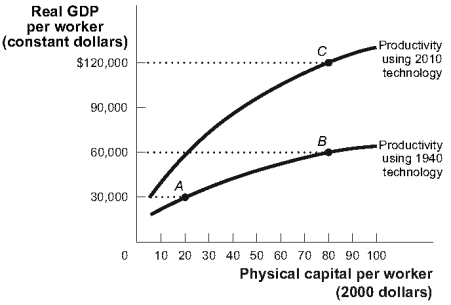 -(Figure: Technological Progress and Productivity Growth) Use Figure: Technological Progress and Productivity Growth. Which change in real GDP is MOST likely to have resulted from an increase in the quality (as well as quantity) of public health measures?
 (Multiple Choice)
4.8/5 (80)
(80) Among the public goods important for economic growth is/are:
(Multiple Choice)
4.9/5 (71)
(71) A negative externality is a cost that individuals or firms impose on others without having to pay compensation.
(True/False)
4.9/5 (77)
(77) Among the factors that are important for economic growth are:
(Multiple Choice)
4.9/5 (79)
(79) The economy has grown by 4% per year over the past 30 years. During the same period, the labor force has grown by 1% per year and the quantity of physical capital has grown by 5% per year. Each 1% increase in physical capital per worker is estimated to increase productivity by 0.4%. Assume that human capital has not changed during the past 30 years. How much has technological progress contributed as a percentage of productivity growth?
(Multiple Choice)
4.8/5 (76)
(76) 
Filters
- Essay(0)
- Multiple Choice(0)
- Short Answer(0)
- True False(0)
- Matching(0)