



 Chat with AI
Exam 9: Long-Run Economic Growth

Exam 1: First Principles183 Questions
Exam 2: Economic Models: Trade-Offs and Trade341 Questions
Exam 3: Supply and Demand230 Questions
Exam 4: Price Controls and Quotas: Meddling With Markets187 Questions
Exam 5: International Trade224 Questions
Exam 6: Macroeconomics: the Big Picture128 Questions
Exam 7: GDP and the CPI: Tracking the Macroeconomy213 Questions
Exam 8: Unemployment and Inflation300 Questions
Exam 9: Long-Run Economic Growth268 Questions
Exam 10: Savings, Investment Spending, and the Financial Syst355 Questions
Exam 11: Income and Expenditure114 Questions
Exam 12: Aggregate Demand and Aggregate Supply308 Questions
Exam 13: Fiscal Policy120 Questions
Exam 14: Money, Banking, and the Federal Reserve System135 Questions
Exam 15: Monetary Policy316 Questions
Exam 16: Inflation, Disinflation, and Deflation194 Questions
Exam 17: Macroeconomics: Events and Ideas283 Questions
Exam 18: International Macroeconomics411 Questions
Select questions type


India is growing at a rate of 9% per year, and its real GDP per capita is about $3,500, while the United States is growing at a rate of 3% per year, and its real GDP per capita is about $47,000. How long will it take India to double its real GDP per capita?
(Multiple Choice)
4.9/5  (80)
(80) If real GDP per capita grows at 5% per year consistently over time, how many years will it take for it to double?
(Multiple Choice)
4.8/5 (77)
(77) Economic growth in sub-Saharan Africa has been dismal. Which factor is NOT a reason for Africa's problem?
(Multiple Choice)
4.9/5 (98)
(98) In 1820, Mexico had a somewhat higher real GDP per capita than did Japan, but today Japan's is higher than Mexico's.
(True/False)
4.9/5 (98)
(98) Ireland's recent economic growth and improving living standard are NOT due to:
(Multiple Choice)
5.0/5 (72)
(72) In Techland, from 1980 to 2010, holding technology and human capital fixed, increasing physical capital per worker from $25,000 to $100,000 would have led to a doubling of real GDP per worker, from $40,000 to $80,000. However, not only did physical capital per worker increase from $25,000 to $100,000, but technological progress shifted the productivity curve upward so that real GDP per worker actually increased from $40,000 to $320,000. What share of the annual growth rate of real GDP per capita was attributable to higher total factor productivity?
(Multiple Choice)
4.9/5 (68)
(68) Suppose that real GDP per capita of the United States is $32,000 and its growth rate is 2% per year and that real GDP per capita of China is $4,000, and its annual growth rate is 7%. How long will it take China's real GDP per capita to double?
(Multiple Choice)
4.9/5 (88)
(88) In 2015, the United States spent 38% of its GDP on investment, while China spent only 16% of its GDP on investment.
(True/False)
4.9/5 (80)
(80) The role of the government can explain growth differences among countries. A government action that does NOT contribute to growth is:
(Multiple Choice)
4.8/5 (76)
(76) Long-run economic growth depends almost entirely on rising productivity.
(True/False)
4.8/5 (78)
(78) Malthus's predictions have proved to be false because the negative effects on productivity of population growth have been outweighed by advances in technology and increases in both human and physical capital.
(True/False)
4.8/5 (74)
(74) Use the following to answer questions: 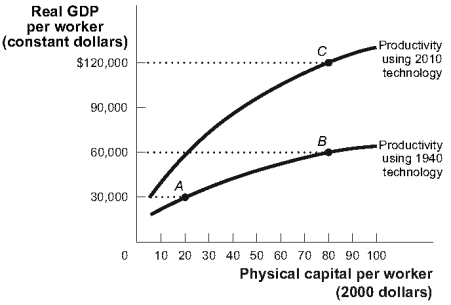 -(Figure: Technological Progress and Productivity Growth) Use Figure: Technological Progress and Productivity Growth. Which change in real GDP is MOST likely to have resulted from a gradual decline in property rights because of excessive government intervention?
 (Multiple Choice)
4.8/5 (70)
(70) Which item can properly be called a part of infrastructure?
(Multiple Choice)
4.9/5 (76)
(76) 
Filters
- Essay(0)
- Multiple Choice(0)
- Short Answer(0)
- True False(0)
- Matching(0)