



 Chat with AI
Exam 9: Long-Run Economic Growth

Exam 1: First Principles183 Questions
Exam 2: Economic Models: Trade-Offs and Trade341 Questions
Exam 3: Supply and Demand230 Questions
Exam 4: Price Controls and Quotas: Meddling With Markets187 Questions
Exam 5: International Trade224 Questions
Exam 6: Macroeconomics: the Big Picture128 Questions
Exam 7: GDP and the CPI: Tracking the Macroeconomy213 Questions
Exam 8: Unemployment and Inflation300 Questions
Exam 9: Long-Run Economic Growth268 Questions
Exam 10: Savings, Investment Spending, and the Financial Syst355 Questions
Exam 11: Income and Expenditure114 Questions
Exam 12: Aggregate Demand and Aggregate Supply308 Questions
Exam 13: Fiscal Policy120 Questions
Exam 14: Money, Banking, and the Federal Reserve System135 Questions
Exam 15: Monetary Policy316 Questions
Exam 16: Inflation, Disinflation, and Deflation194 Questions
Exam 17: Macroeconomics: Events and Ideas283 Questions
Exam 18: International Macroeconomics411 Questions
Select questions type


The three main reasons that the average U.S. worker today produces far more than his or her counterpart did a century ago are more physical capital, more human capital, and a great deal of technological progress.
(True/False)
4.8/5  (83)
(83) Written in 1972, the book that argued that long-run economic growth was not sustainable because of limited supplies of natural resources was called:
(Multiple Choice)
4.8/5 (83)
(83) Use the following to answer questions:  -(Table: Kenya's Economy in 2010) Use Table: Kenya's Economy in 2010. Aggregate output per capita at the beginning of 2010 was:
 (Multiple Choice)
4.9/5 (74)
(74) The MOST important driver for economic growth appears to be:
(Multiple Choice)
4.9/5 (81)
(81) Which sector is responsible for MOST of the growth in the United States during the 1990s?
(Multiple Choice)
4.7/5 (84)
(84) The aggregate production function exhibits diminishing returns to labor but not to physical capital.
(True/False)
4.8/5 (70)
(70) According to the convergence hypothesis, differences in GDP per capita among countries tend to narrow over time because countries that start with a lower real GDP per capita tend to have higher growth rates.
(True/False)
4.9/5 (90)
(90) Throughout the twentieth century, nations in Latin America had disappointing growth rates primarily due to:
(Multiple Choice)
4.9/5 (79)
(79) A country's growth rate strongly depends on how it has invested in its physical capital. Generally, countries that have used _____ as a source of their capital investment have exhibited the highest growth rate.
(Multiple Choice)
4.7/5 (79)
(79) Economists are optimistic that growth can continue in the face of resource scarcity because:
(Multiple Choice)
4.9/5 (72)
(72) If output is growing at 5% annually, how many years will it take for output to quadruple?
(Multiple Choice)
4.8/5 (93)
(93) Use the following to answer questions:
-(Table: Kenya's Economy in 2010) Use Table: Kenya's Economy in 2010. Aggregate output per capita at the end of 2010, assuming no changes in the price level, was:
-(Table: Kenya's Economy in 2010) Use Table: Kenya's Economy in 2010. Aggregate output per capita at the end of 2010, assuming no changes in the price level, was: (Multiple Choice)
4.9/5 (77)
(77) According to the convergence hypothesis, differences in real GDP per capita among countries tends to narrow over time because countries that start with a _____ real GDP per capita tend to have _____ growth rates.
(Multiple Choice)
4.9/5 (72)
(72) Diminishing returns to physical capital means that, when the amount of human capital per worker and the state of technology are held fixed, each increase in the amount of physical capital per worker leads to:
(Multiple Choice)
4.9/5 (74)
(74) Use the following to answer questions: 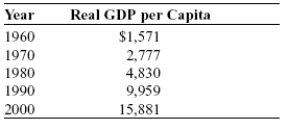 -(Table: South Korea's Real GDP per Capita) Use Table: South Korea's Real GDP per Capita. As a percentage of real GDP per capita in 1960, approximately how much did South Korea produce in 2000?
 (Multiple Choice)
4.8/5 (84)
(84) In 1820, Mexico had a higher real GDP per capita than did Japan, but today Japan's real GDP per capita is higher than is Mexico's because Japan's real GDP per capita has grown at _____, and Mexico's real GDP per capita has grown at _____.
(Multiple Choice)
4.9/5 (81)
(81) Since the 1960s, nations like South Korea have been a part of the so-called East Asian economic miracle because:
(Multiple Choice)
4.8/5 (81)
(81) 
Filters
- Essay(0)
- Multiple Choice(0)
- Short Answer(0)
- True False(0)
- Matching(0)