



 Chat with AI
Exam 9: Long-Run Economic Growth

Exam 1: First Principles183 Questions
Exam 2: Economic Models: Trade-Offs and Trade341 Questions
Exam 3: Supply and Demand230 Questions
Exam 4: Price Controls and Quotas: Meddling With Markets187 Questions
Exam 5: International Trade224 Questions
Exam 6: Macroeconomics: the Big Picture128 Questions
Exam 7: GDP and the CPI: Tracking the Macroeconomy213 Questions
Exam 8: Unemployment and Inflation300 Questions
Exam 9: Long-Run Economic Growth268 Questions
Exam 10: Savings, Investment Spending, and the Financial Syst355 Questions
Exam 11: Income and Expenditure114 Questions
Exam 12: Aggregate Demand and Aggregate Supply308 Questions
Exam 13: Fiscal Policy120 Questions
Exam 14: Money, Banking, and the Federal Reserve System135 Questions
Exam 15: Monetary Policy316 Questions
Exam 16: Inflation, Disinflation, and Deflation194 Questions
Exam 17: Macroeconomics: Events and Ideas283 Questions
Exam 18: International Macroeconomics411 Questions
Select questions type


Total factor productivity is the amount of output that can be achieved with a given amount of factor inputs.
(True/False)
4.9/5  (81)
(81) Diminishing returns to physical capital implies that, when the human capital per worker and the state of technology remain fixed, each successive increase in physical capital leads to _____ productivity.
(Multiple Choice)
5.0/5 (75)
(75) As a limit to economic growth, environmental problems are more difficult to solve than resource problems because:
(Multiple Choice)
4.8/5 (85)
(85) In the book The Limits to Growth, The Club of Rome argued that:
(Multiple Choice)
4.9/5 (86)
(86) If an economy has a real GDP per capita growth rate of 2%, it will take 14 years for GDP per capita to double.
(True/False)
5.0/5 (81)
(81) According to Jeff Sachs of Columbia University, Africa is politically unstable because it is poor and not the other way around.
(True/False)
4.9/5 (84)
(84) Economies with high growth rates tend to be those that have:
(Multiple Choice)
4.7/5 (81)
(81) The formula for the rule of 70, where n is number of years and r is growth rate, is expressed as:
(Multiple Choice)
4.8/5 (78)
(78) Investment in human capital causes _____________the aggregate production function.
(Multiple Choice)
4.8/5 (66)
(66) Between 1980 and 1994, real per capita GDP in sub-Saharan Africa:
(Multiple Choice)
4.8/5 (78)
(78) High rates of savings and investment and a lack of consumption spending have contributed to the recent stagnant economic growth in Latin America.
(True/False)
4.8/5 (86)
(86) A rise in real GDP that is the same as the rate of population growth leaves the average standard of living unchanged.
(True/False)
4.9/5 (76)
(76) The main reason South Korea has grown so rapidly is that, because it was so poor:
(Multiple Choice)
4.9/5 (74)
(74) Growth accounting estimates the contribution to economic growth of each factor in the aggregate production function.
(True/False)
4.9/5 (77)
(77) Use the following to answer questions: 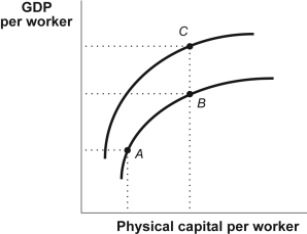 -(Figure: Productivity) Use Figure: Productivity. An improvement in technology with everything else remaining unchanged is shown on the diagram as a movement from:
 (Multiple Choice)
4.9/5 (73)
(73) In the 1980s, which factor contributed to slow growth in Latin America countries?
(Multiple Choice)
4.9/5 (76)
(76) Which factor is the MOST widely accepted measure of economic growth over time?
(Multiple Choice)
4.8/5 (75)
(75) Which country had the FASTEST growth rate of real GDP per capita between 1980 and 2015?
(Multiple Choice)
4.8/5 (78)
(78) 
Filters
- Essay(0)
- Multiple Choice(0)
- Short Answer(0)
- True False(0)
- Matching(0)