



 Chat with AI
Exam 9: Long-Run Economic Growth

Exam 1: First Principles183 Questions
Exam 2: Economic Models: Trade-Offs and Trade341 Questions
Exam 3: Supply and Demand230 Questions
Exam 4: Price Controls and Quotas: Meddling With Markets187 Questions
Exam 5: International Trade224 Questions
Exam 6: Macroeconomics: the Big Picture128 Questions
Exam 7: GDP and the CPI: Tracking the Macroeconomy213 Questions
Exam 8: Unemployment and Inflation300 Questions
Exam 9: Long-Run Economic Growth268 Questions
Exam 10: Savings, Investment Spending, and the Financial Syst355 Questions
Exam 11: Income and Expenditure114 Questions
Exam 12: Aggregate Demand and Aggregate Supply308 Questions
Exam 13: Fiscal Policy120 Questions
Exam 14: Money, Banking, and the Federal Reserve System135 Questions
Exam 15: Monetary Policy316 Questions
Exam 16: Inflation, Disinflation, and Deflation194 Questions
Exam 17: Macroeconomics: Events and Ideas283 Questions
Exam 18: International Macroeconomics411 Questions
Select questions type


Malthus's predictions have proved to be true, and they explain why U.S. productivity growth slowed between the 1970s and the mid-1990s.
(True/False)
4.8/5  (74)
(74) It took India more than 40 years to exhibit high economic growth after it gained independence from British rule in 1947. This faster rate of growth resulted from:
(Multiple Choice)
4.8/5 (86)
(86) To find the approximate number of years it takes the economy to double:
(Multiple Choice)
4.8/5 (59)
(59) Use the following to answer questions: 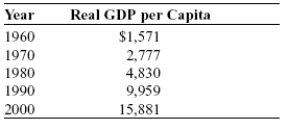 -(Table: South Korea's Real GDP per Capita) Use Table: South Korea's Real GDP per Capita. As a percentage of real GDP per capita in 2000, approximately how much did South Korea produce in 1960?
 (Multiple Choice)
4.8/5 (85)
(85) Economists believe that the BEST way to stimulate investment in physical capital is to encourage:
(Multiple Choice)
5.0/5 (90)
(90) Having achieved sustained rapid growth, Chile is an exception to the disappointing slow economic growth among most other Latin American nations.
(True/False)
4.7/5 (89)
(89) The economy has grown by 4% per year over the past 30 years. During the same period, the labor force has grown by 1% per year and the quantity of physical capital has grown by 5% per year. Each 1% increase in physical capital per worker is estimated to increase productivity by 0.4%. Assume that human capital has not changed during the past 30 years. How fast has physical capital per worker grown?
(Multiple Choice)
4.8/5 (85)
(85) Which country had the LOWEST growth rate of real GDP per capita between 1980 and 2015?
(Multiple Choice)
4.8/5 (75)
(75) From 2010 to 2011, nation A's real GDP increased from $100 billion to $106 billion and its population grew from 50 million to 51 million. As a result, real GDP per capita _____ because real GDP rose _____ than the population.
(Multiple Choice)
4.9/5 (90)
(90) Physical capital consists of man-made resources like machines and buildings.
(True/False)
4.7/5 (67)
(67) According to Thomas Malthus's work, which statement is TRUE?
(Multiple Choice)
4.7/5 (91)
(91) Today, China is the fastest-growing major economy, and it also:
(Multiple Choice)
4.7/5 (80)
(80) Use the following to answer questions: 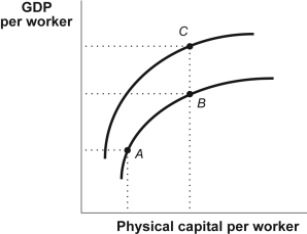 -(Figure: Productivity) Use Figure: Productivity. An increase in physical capital per worker with everything else remaining unchanged is shown on the diagram as a movement from:
 (Multiple Choice)
4.8/5 (87)
(87) According to the convergence hypothesis, the richest countries have the fastest growth rate of real GDP per capita.
(True/False)
4.8/5 (74)
(74) In 1820, Mexico had a higher real GDP per capita than did Japan. Yet now Japan is one of the richest countries in the world and Mexico is poor. Japan's high rate of economic growth can likely NOT be explained by a high:
(Multiple Choice)
4.8/5 (84)
(84) Which factor is NOT necessary for convergence between two countries?
(Multiple Choice)
4.9/5 (89)
(89) More than 50% of the world's population lives in countries whose population is poorer than the United States population was a century ago.
(True/False)
4.7/5 (80)
(80) An increase in the amount of physical capital per worker _____, while technological progress _____.
(Multiple Choice)
4.8/5 (88)
(88) China has much higher rate of growth than the United States, but the average Chinese household is _____ a typical U.S. household. China's real GDP per capita is _____ that of the United States.
(Multiple Choice)
4.8/5 (91)
(91) 
Filters
- Essay(0)
- Multiple Choice(0)
- Short Answer(0)
- True False(0)
- Matching(0)