



 Chat with AI
Exam 8: Joint and Movement

Exam 1: The Human Organism140 Questions
Exam 2: The Chemical Basis of Life207 Questions
Exam 3: Cell Biology230 Questions
Exam 4: Tissues208 Questions
Exam 5: Integumentary System175 Questions
Exam 6: Skeletal System: Bones and Bone Tissue178 Questions
Exam 7: Skeletal System: Gross Anatomy179 Questions
Exam 8: Joint and Movement149 Questions
Exam 9: Muscular System: Histology and Physiology231 Questions
Exam 10: Muscular System: Gross Anatomy168 Questions
Exam 11: Functional Organization of Nervous Tissue192 Questions
Exam 12: Spinal Cord and Spinal Nerves141 Questions
Exam 13: Brain and Cranial Nerves176 Questions
Exam 14: Integration of Nervous System Functions149 Questions
Exam 15: The Special Senses220 Questions
Exam 16: Autonomic Nervous System120 Questions
Exam 17: Functional Organization of the Endocrine System90 Questions
Exam 18: Endocrine Glands183 Questions
Exam 19: Cardiovascular System: Blood151 Questions
Exam 20: Cardiovascular System: the Heart167 Questions
Exam 21: Cardiovascular System: Blood Vessels and Circulation226 Questions
Exam 22: Lymphatic System and Immunity193 Questions
Exam 23: Respiratory System182 Questions
Exam 24: Digestive System249 Questions
Exam 25: Nutrition, Metabolism, and Temperature Regulation190 Questions
Exam 26: Urinary System170 Questions
Exam 27: Water, Electrolyte, and Acid-Base Balance109 Questions
Exam 28: Reproductive System169 Questions
Exam 29: Development, Growth, Aging, and Genetics197 Questions
Select questions type


The type of movement between carpal bones is described as ________.
(Multiple Choice)
4.7/5  (71)
(71) The joint between a tooth and the mandibular alveolus is an example of a ________.
(Multiple Choice)
5.0/5 (83)
(83) The type of movements where one linear part of the body bends relative to another part would be ________ movements.
(Multiple Choice)
4.7/5 (87)
(87) Jasmine trips and tries to break her fall by putting her hand to the ground. The doctor informs her she has injured the ________ joints in her wrist.
(Multiple Choice)
4.9/5 (66)
(66) The inability to produce the fluid that keeps most joints moist indicates a disorder of the
(Multiple Choice)
4.8/5 (75)
(75) 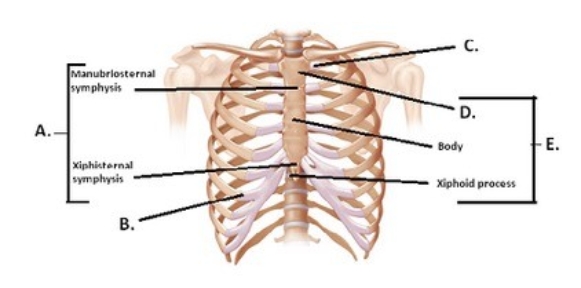 -The figure illustrates the joints and bones of the rib cage. What does "A" represent?
 (Multiple Choice)
4.9/5 (86)
(86) Which of the following influence the range of motion of a joint?
(Multiple Choice)
4.9/5 (73)
(73) Synovial joints are different from both fibrous and cartilaginous joints because synovial joints
(Multiple Choice)
4.7/5 (84)
(84)
-The figure illustrates the joints and bones of the rib cage. What does "E" represent?
-The figure illustrates the joints and bones of the rib cage. What does "E" represent? (Multiple Choice)
5.0/5 (56)
(56) Harry is told he has structural damage to his dentoalveolar joint. Where specifically is the problem area?
(Multiple Choice)
4.9/5 (81)
(81) Raising your hand and placing it on the shoulder of a person standing in front of you, requires ________ of the shoulder.
(Multiple Choice)
4.9/5 (86)
(86) 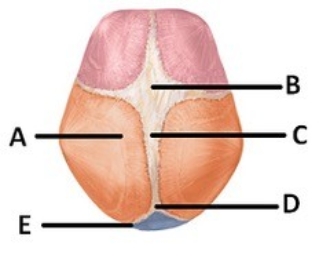 -The figure illustrates bones, fontanels, and sutures on the fetal skull. What does "D" represent?
 (Multiple Choice)
4.8/5 (94)
(94) Returning the thumb to the anatomical position after touching the little finger is ________.
(Multiple Choice)
4.8/5 (70)
(70) 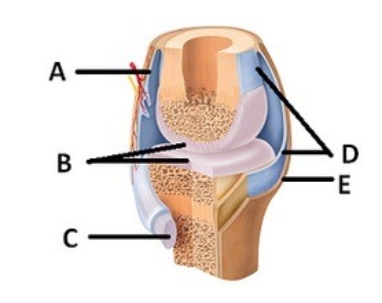 -What does structure "B" represent on the diagram?
Suppose you cup your hands to hold some water. To limit the amount of leaking through your hands, this action would most likely require ________.
(Multiple Choice)
4.7/5 (90)
(90) The cubital or elbow joint is an example of a ________ joint.
(Multiple Choice)
4.9/5 (75)
(75) 
Filters
- Essay(0)
- Multiple Choice(0)
- Short Answer(0)
- True False(0)
- Matching(0)