



 Chat with AI
Exam 13: Brain and Cranial Nerves

Exam 1: The Human Organism140 Questions
Exam 2: The Chemical Basis of Life207 Questions
Exam 3: Cell Biology230 Questions
Exam 4: Tissues208 Questions
Exam 5: Integumentary System175 Questions
Exam 6: Skeletal System: Bones and Bone Tissue178 Questions
Exam 7: Skeletal System: Gross Anatomy179 Questions
Exam 8: Joint and Movement149 Questions
Exam 9: Muscular System: Histology and Physiology231 Questions
Exam 10: Muscular System: Gross Anatomy168 Questions
Exam 11: Functional Organization of Nervous Tissue192 Questions
Exam 12: Spinal Cord and Spinal Nerves141 Questions
Exam 13: Brain and Cranial Nerves176 Questions
Exam 14: Integration of Nervous System Functions149 Questions
Exam 15: The Special Senses220 Questions
Exam 16: Autonomic Nervous System120 Questions
Exam 17: Functional Organization of the Endocrine System90 Questions
Exam 18: Endocrine Glands183 Questions
Exam 19: Cardiovascular System: Blood151 Questions
Exam 20: Cardiovascular System: the Heart167 Questions
Exam 21: Cardiovascular System: Blood Vessels and Circulation226 Questions
Exam 22: Lymphatic System and Immunity193 Questions
Exam 23: Respiratory System182 Questions
Exam 24: Digestive System249 Questions
Exam 25: Nutrition, Metabolism, and Temperature Regulation190 Questions
Exam 26: Urinary System170 Questions
Exam 27: Water, Electrolyte, and Acid-Base Balance109 Questions
Exam 28: Reproductive System169 Questions
Exam 29: Development, Growth, Aging, and Genetics197 Questions
Select questions type


Match the description with the correct lobe of the cerebrum.
-Frontal lobe
(Multiple Choice)
4.8/5  (78)
(78) 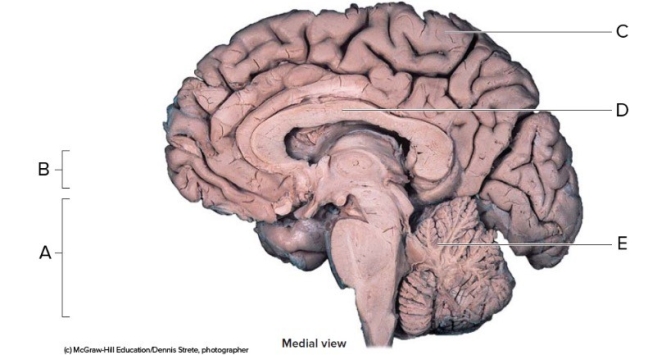 -This is a midsagittal section of the right half of the brain. What does "D" represent?
 (Multiple Choice)
4.9/5 (84)
(84) Loss of equilibrium and motor coordination would most likely be related to a lesion in which structure?
(Multiple Choice)
4.8/5 (75)
(75) The habenula and pineal body are both found in the ________.
(Multiple Choice)
4.8/5 (73)
(73) 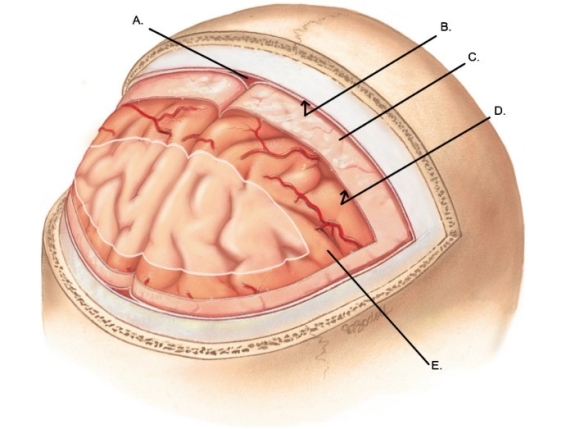 -What does "E" represent on the diagram of the skull and brain?
 (Multiple Choice)
4.8/5 (79)
(79) From the list, indicate three types of molecules that are permeable to the blood-brain barrier. (Check all that apply.)
(Multiple Choice)
4.9/5 (100)
(100) Which type of white fibers connect areas of the cerebral cortex in the same hemisphere?
(Multiple Choice)
4.7/5 (61)
(61) The gray matter on the outer surface of the cerebrum is called the ________.
(Multiple Choice)
4.9/5 (97)
(97) The portion of the cerebellum that is involved in balance and eye movements is the ________.
(Multiple Choice)
4.9/5 (69)
(69) The embryonic structure that gives rise to the structures of the central nervous system is called the ________.
(Multiple Choice)
5.0/5 (83)
(83) Which of the following would help to determine if the oculomotor nerve was damaged?
(Multiple Choice)
4.8/5 (79)
(79) A group of functionally related nuclei within the cerebrum, diencephalon, and midbrain are called the ________.
(Multiple Choice)
4.8/5 (80)
(80) Which area of the brain contains areas that initiates REM sleep?
(Multiple Choice)
4.8/5 (71)
(71) Afferent fibers terminating in the hypothalamus provide input from the
(Multiple Choice)
4.9/5 (70)
(70) Most sensory input that ascends through the spinal cord and brainstem projects to the ________.
(Multiple Choice)
4.7/5 (69)
(69) 
Filters
- Essay(0)
- Multiple Choice(0)
- Short Answer(0)
- True False(0)
- Matching(0)