



 Chat with AI
Exam 11: Biodiversity and Conservation Biology

Exam 1: Science and Sustainability: an Introduction to Environmental Science45 Questions
Exam 2: Earths Physical Systems: Matter, Energy, and Geology49 Questions
Exam 3: Evolution, Biodiversity, and Population Ecology46 Questions
Exam 4: Species Interactions and Community Ecology53 Questions
Exam 5: Environmental Systems and Ecosystem Ecology47 Questions
Exam 6: Ethics, Economics, and Sustainable Development47 Questions
Exam 7: Environmental Policy: Making Decisions and Solving Problems48 Questions
Exam 8: Human Population55 Questions
Exam 9: Soil and Agriculture50 Questions
Exam 10: Agriculture, Biotechnology, and the Future of Food49 Questions
Exam 11: Biodiversity and Conservation Biology45 Questions
Exam 12: Forests, Forest Management, and Protected Areas45 Questions
Exam 13: The Urban Environment: Creating Sustainable Cities50 Questions
Exam 14: Environmental Health and Toxicology53 Questions
Exam 15: Freshwater Systems and Resources48 Questions
Exam 16: Marine and Coastal Systems and Resources54 Questions
Exam 17: Atmospheric Science, Air Quality, and Pollution Control45 Questions
Exam 18: Global Climate Change49 Questions
Exam 19: Fossil Fuels, Their Impacts, and Energy Conservation46 Questions
Exam 20: Conventional Energy Alternatives55 Questions
Exam 21: New Renewable Energy Alternatives48 Questions
Exam 22: Managing Our Waste48 Questions
Exam 23: Minerals and Mining35 Questions
Exam 24: Sustainable Solutions47 Questions
Select questions type


European rabbits were introduced into Australia and quickly spread, reproduced, and became a terrible pest. They eat up to $600 million worth of food and pasture crops annually, and have damaged the populations of many native plants and the populations of animals that eat the plants. Twice in the past 50 years, rabbit diseases have been introduced to try to control the population, with some success. This is a case where _______________
(Multiple Choice)
4.7/5  (63)
(63) The wood thrush makes its nest in woodlands in the northern and eastern United States. As patches of woods become smaller, increasing numbers of wood thrush nests have eggs laid in them by the brown- headed cowbird. Cowbirds live in open fields and are nest parasites; the female cowbird flies up to an unattended nest, quickly lays an egg in it, and leaves the host parents to raise their "adopted" young. Wood thrushes are decreasing in numbers because ________________
(Multiple Choice)
4.9/5 (70)
(70) 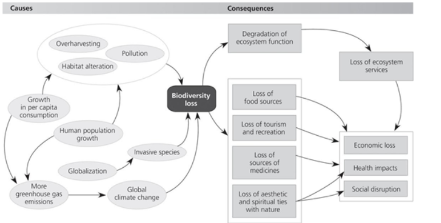 Use the accompanying figure to answer the following question.
-Both ____________ and ____________ can change global species diversity?
Use the accompanying figure to answer the following question.
-Both ____________ and ____________ can change global species diversity? (Multiple Choice)
4.7/5 (80)
(80) A species of lizard has gone extinct. All of the following may have contributed to this extinction except ____________
(Multiple Choice)
4.9/5 (79)
(79) 
Filters
- Essay(0)
- Multiple Choice(0)
- Short Answer(0)
- True False(0)
- Matching(0)