



 Chat with AI
Exam 8: Human Population


Malthus was responsible for ______________

 (82)
 Verified
C
How does poverty and affluence affect the environment?
(74) VerifiedPoverty sometimes results in environmental degradation. Because poor families need natural resources to survive, destructive farming techniques, deforestation, and hunting may become prevalent in poor areas. On the other hand, poor cultures may be regarded as more environmentally aware because they live closer to the land and are more appreciative of its fragility. They have a vested interest in sustainable resource use. Affluence may be associated with more environmental awareness because more affluent people are not preoccupied with meeting their basic needs. However, affluence can be destructive.
Developed nations presently consume massive and unprecedented levels of natural resources. Affluence encourages wastefulness and lack of concern for nature due to the desire to acquire more and more material possessions and the fact that wealthier people tend to live in urban areas.
Which of the following is not one of the world's top five most populous nations?
(90) VerifiedE
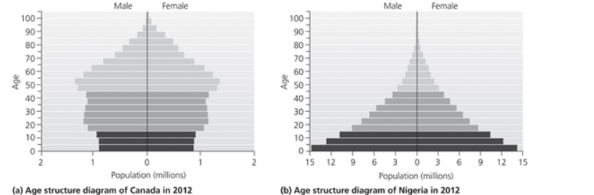 Use the accompanying figure to answer the following question.
-Not surprisingly, the nation with the highest rate of contraceptive use (84%) is ______________
Use the accompanying figure to answer the following question.
-Not surprisingly, the nation with the highest rate of contraceptive use (84%) is ______________ (85) Approximately 120 boys born for every 100 girls born in this country
(87) Read the following scenario and answer the questions below.
Population growth is at the root of many serious environmental problems. From the ancient Babylonians thousands of years ago, to Thomas Malthus hundreds of years ago, to present day neo- Malthusians, humans seem to possess an awareness of Earth's limitations in the face of growing populations. Today, our ability to accurately quantify, monitor, and control population growth is very sophisticated. We can measure growth and make predictions about world growth with mathematical and computer models. Can we prevent disaster?
-Because of the success of China's population control programs,_____________________.
(80) The most serious problem caused by population growth is ______________
(77) The world population growth rate is currently at approximately _________________%.
(76) The richest one- fifth of the world's population possesses approximately ______________ times the income of the poorest one- fifth, and the richest one- fifth uses over 86% of the world's resources.
(80) Explain human population growth in terms of carrying capacity. How does this differ from organisms that exist in natural ecosystems? Explain how population growth for human populations is a problem.
(75) Demographically speaking, the effects of AIDS are most significant because _________________
(70) Which of the following best describes the human population from early times to the present?
(73) According to the IPAT model, which of the following would most likely reduce the environmental impact of a society?
(90) 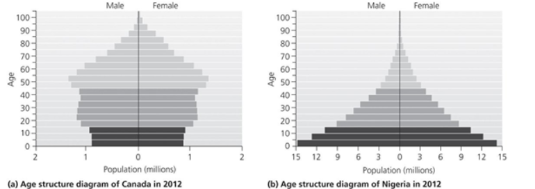 Use the accompanying figure to answer the following question.
-A graph of world population growth over the past 500 years most closely resembled the letter _________________
Use the accompanying figure to answer the following question.
-A graph of world population growth over the past 500 years most closely resembled the letter _________________ (94) Briefly explain why Helmut Haberl's research group in Austria selected to measure the percent harvest of net primary productivity as an indicator of human population growth on the surrounding environment.
(90) The Cornucopian view held by many economists suggests that resource depletion due to greater numbers of people ______________
(98) What three- factor model is used for representing the impact on environment? What is a fourth factor that could be added to this? Give a simple explanation for each factor and describe what it means in terms of human impacts on the environment.
(70) 
Filters
- Essay(0)
- Multiple Choice(0)
- Short Answer(0)
- True False(0)
- Matching(0)