



 Chat with AI
Exam 14: Environmental Health and Toxicology


Briefly explain dose- response analysis.

 (64)
 Verified
The dose- response analysis allows scientists to quantify the toxicity of a given substance by measuring how much effect a toxicant produces at different doses or how many animals are affected by different doses of the toxic agent. Dose is the amount of toxicant the test animal receives, and the response is the type or magnitude of negative effects the animal exhibits as a result.
Infectious disease accounts for _____________% of deaths globally.
(82) VerifiedE
What are epidemiological studies, and what is their value? Are there any disadvantages to epidemiological studies?
(81) VerifiedThey involve large- scale comparisons among groups of people, usually contrasting a group known to have been exposed to a toxicant with a group that has not. They allow for the risk of exposure to a toxicant to be determined. They are realistic, but a long time is required for the results of the studies to be determined. Furthermore, they do not address future effects of new products. Results of epidemiological studies must be interpreted cautiously because many factors affect health, and results do not determine cause and effect; they only measure statistical association.
Substances that cause harm by affecting the immune system include _____________
(69) The European Union's experience with polybrominated diphenyl ethers (PBDEs)has shown that ____________.
(71) Studies of endocrine disruptors have shown that they are closely associated with all of the following except _____________
(80) The book Our Stolen Future was important because it ____________.
(79) Read the following scenario and answer the question below.
Mercury is a heavy metal that occurs naturally in minerals and rocks. Release of mercury from natural sources has been relatively constant over time. However, anthropogenic release of mercury has increased significantly in recent years primarily due to increased fossil fuel mining and combustion. Mercury that is released into the air eventually ends up in soils or surface water. Once in water, microbes convert mercury into methyl mercury, which is absorbed quickly and concentrated in the tissues of predatory fish such as shark and swordfish. Large fish typically concentrate more mercury than small fish.
People who eat fish with high methyl mercury concentrations can show tremors, deafness, muscle incoordination, and attention deficits. Pregnant women and children are especially sensitive to methyl mercury's toxic effects. Learning disabilities and developmental delays are common in children who have been exposed to significant levels of methyl mercury.
-Synergistic effects of toxicants _____________.
(63) Aquatic animals such as fish and frogs are especially good indicators of pollution because _____________.
(87) Neurotoxin that magnifies within food webs; typically found in polluted bodies of water; it poisoned thousands of people when it was dumped into a Japanese bay; people who ate contaminated fish from the waters exhibited convulsions, slurred speech, loss of muscle control, and sudden fits of laughter; some people died
(88) FIFRA (Federal Insecticide, Fungicide, and Rodenticide Act) ____________.
(80) According to a 2002 study by scientists at the National Water- Quality Assessment Program (NAWQA), ____________% of U.S. streams contain traces of wastewater contaminants.
(83) Explain risk assessment and risk management. Discuss how risk management combines science and other social factors.
(73) ____________ is/are biodegradable and known to have (a)short persistence time(s).
(66) Read the following scenario and answer the question below.
Mercury is a heavy metal that occurs naturally in minerals and rocks. Release of mercury from natural sources has been relatively constant over time. However, anthropogenic release of mercury has increased significantly in recent years primarily due to increased fossil fuel mining and combustion. Mercury that is released into the air eventually ends up in soils or surface water. Once in water, microbes convert mercury into methyl mercury, which is absorbed quickly and concentrated in the tissues of predatory fish such as shark and swordfish. Large fish typically concentrate more mercury than small fish.
People who eat fish with high methyl mercury concentrations can show tremors, deafness, muscle incoordination, and attention deficits. Pregnant women and children are especially sensitive to methyl mercury's toxic effects. Learning disabilities and developmental delays are common in children who have been exposed to significant levels of methyl mercury.
-The ____________ registers and regulates pesticides in the United States.
(72) 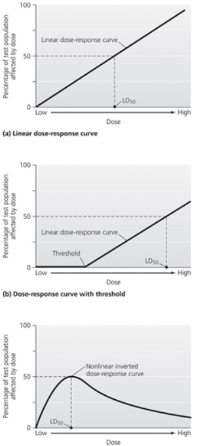 Use the accompanying figures to answer the following question.
-The flat line at the left in (b)probably represents _____________.
Use the accompanying figures to answer the following question.
-The flat line at the left in (b)probably represents _____________. (87) Read the following scenario and answer the question below.
Mercury is a heavy metal that occurs naturally in minerals and rocks. Release of mercury from natural sources has been relatively constant over time. However, anthropogenic release of mercury has increased significantly in recent years primarily due to increased fossil fuel mining and combustion. Mercury that is released into the air eventually ends up in soils or surface water. Once in water, microbes convert mercury into methyl mercury, which is absorbed quickly and concentrated in the tissues of predatory fish such as shark and swordfish. Large fish typically concentrate more mercury than small fish.
People who eat fish with high methyl mercury concentrations can show tremors, deafness, muscle incoordination, and attention deficits. Pregnant women and children are especially sensitive to methyl mercury's toxic effects. Learning disabilities and developmental delays are common in children who have been exposed to significant levels of methyl mercury.
-Which of the following U.S. agencies is primarily responsible for addressing issues regarding mercury pollution?
(83) Read the following scenario and answer the question below.
Mercury is a heavy metal that occurs naturally in minerals and rocks. Release of mercury from natural sources has been relatively constant over time. However, anthropogenic release of mercury has increased significantly in recent years primarily due to increased fossil fuel mining and combustion. Mercury that is released into the air eventually ends up in soils or surface water. Once in water, microbes convert mercury into methyl mercury, which is absorbed quickly and concentrated in the tissues of predatory fish such as shark and swordfish. Large fish typically concentrate more mercury than small fish.
People who eat fish with high methyl mercury concentrations can show tremors, deafness, muscle incoordination, and attention deficits. Pregnant women and children are especially sensitive to methyl mercury's toxic effects. Learning disabilities and developmental delays are common in children who have been exposed to significant levels of methyl mercury.
-Concentrations of methyl mercury are higher in large fish than in their prey and in the air. This is best described as ____________.
(70) 
Filters
- Essay(0)
- Multiple Choice(0)
- Short Answer(0)
- True False(0)
- Matching(0)