



 Chat with AI
Exam 22: Managing Our Waste


___________ represent(s)the largest source of unregulated hazardous waste.

 (87)
 Verified
A
What are the benefits and drawbacks of incinerating trash? How have these problems been dealt with in most developed countries?
(78) VerifiedIncinerating waste reduces its weight by up to 75% and its volume by up to 90%. Most North American incinerators today also generate electricity in a process called waste-to-- energy (WTE). The remaining ash is generally shipped to landfills. Although high-temperature incineration can destroy certain pollutants such as PCBs, it does not always eliminate all toxins. Combustion actually can create new hazardous chemicals. Particulates, acids, dioxins, and heavy metals may be contained in incinerator smoke. Early incinerators did not include mechanisms for mitigating air pollution, and many citizens still fear the health effects of released incinerator gases. Most developed nations now regulate incinerator emissions and some have banned incineration outright. Scrubbers have been installed in some incinerators to remove hazardous combustion by-products and neutralize acidic gases. Baghouse filters have been installed to reduce particulate emissions. Most incinerators are required to test their emissions to ensure that discarded ash meets safety standards.
The EPA is charged with cleaning up brownfields, which are ___________
(81) VerifiedD
In general, buying in bulk is environmentally friendly because it ___________
(80) Read the following scenario and answer the questions below.
The prevalence of "throwaway mentalities" and increased packaging have amplified the consumption of paper and plastic in our society. Disposable plates, cups, and utensils are convenient, sanitary, and inexpensive, and packaging preserves freshness, prevents breakage, protects against tampering, provides information to consumers, and allows shipment of products over long distances. However, paper and plastic do not degrade readily in sanitary landfills. Garbologist William Rathje found legible newspapers in landfills decades after disposal. Because trees used to make virgin paper and petrochemicals used to make plastics may soon become depleted, source reduction is the best solution to the waste dilemma. Denmark has banned the use of nonrefillable beverage containers, and McDonald's restaurants in Austria and Sweden have been using biodegradable, compostable cutlery. Recycling has value as well, as long as the recycling loop is closed and people purchase recycled items. Bottle bills and municipal curbside collection provide recycling incentives. Paper recycling is profitable if waste is properly sorted. All kinds of paper and cardboard are recyclable. Food and paperboard
(non- corrugated thin coated board)can contaminate collections, however, reducing their value. After processing, paper and cardboard are used to make paper towels and paperboard for packaging cereal, shoes, and toys. Decapped, washed, and flattened plastic is recycled into carpets, pillows, and new bottles. Although low-density polyethylene (LDPE), from which grocery bags are made, is the most widely used plastic, beverage bottle polyethylene terephthalate, or PET(E), and high
-density polyethylene, or HDPE, are the most widely recycled plastics. Containers from toxic substances such as motor oil, pesticides, and solvents are not usually accepted with collected plastic because of contamination. Methods to reuse and recycle polystyrene are in development, although presently, Styrofoam is not collected with other plastics and is considered a contaminant as well.
- ___________ are wastepaper contaminants that can decrease the value of collected paper and cardboard.
(86) In 2007, San Francisco became the first U.S. city to ban ____________
(76) Decomposition in a landfill will happen faster if there is more ____________
(82) Match the following.
A)syringes, hospital gowns, and diapers
B)radioactive materials
C)yard debris
D)paper
E)glass
F)pesticide precursors
G)food scraps
H)plastic
I)metals
-Waste component from the Islip, New York, barge that was rejected by North Carolina, Louisiana, and Mexico in 1987, so it was returned to New York
(91) There are three main disposal methods for hazardous waste. One is landfills. Describe how hazardous waste landfills differ from ordinary sanitary landfills. Briefly discuss the other two ways that hazardous waste is contained.
(70) Which of the following represent the categories of hazardous waste?
(78) Use the accompanying figure to answer the following questions.
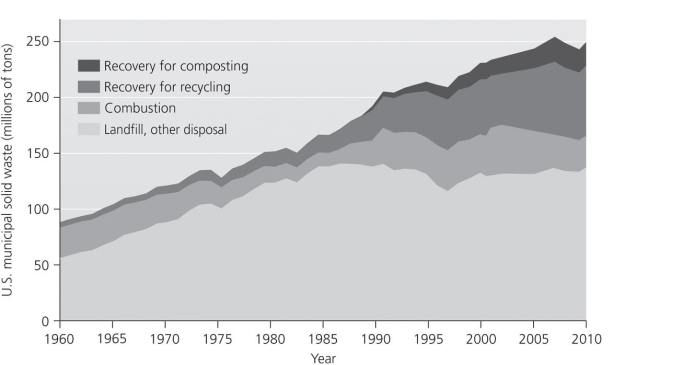 -From the 1960s to the present, the trend has been that ___________ over time.
 (68) If reducing waste can increase efficiency, why is the output of industrial waste still so great? What is the application of industrial ecology and life- cycle analysis to these problems?
(91) What are the three basic steps in the recycling loop? What is the step that needs the most attention if the recycling loop is going to work?
(83) 
Filters
- Essay(0)
- Multiple Choice(0)
- Short Answer(0)
- True False(0)
- Matching(0)