



 Chat with AI
Exam 8: Human Population

Exam 1: Science and Sustainability: an Introduction to Environmental Science45 Questions
Exam 2: Earths Physical Systems: Matter, Energy, and Geology49 Questions
Exam 3: Evolution, Biodiversity, and Population Ecology46 Questions
Exam 4: Species Interactions and Community Ecology53 Questions
Exam 5: Environmental Systems and Ecosystem Ecology47 Questions
Exam 6: Ethics, Economics, and Sustainable Development47 Questions
Exam 7: Environmental Policy: Making Decisions and Solving Problems48 Questions
Exam 8: Human Population55 Questions
Exam 9: Soil and Agriculture50 Questions
Exam 10: Agriculture, Biotechnology, and the Future of Food49 Questions
Exam 11: Biodiversity and Conservation Biology45 Questions
Exam 12: Forests, Forest Management, and Protected Areas45 Questions
Exam 13: The Urban Environment: Creating Sustainable Cities50 Questions
Exam 14: Environmental Health and Toxicology53 Questions
Exam 15: Freshwater Systems and Resources48 Questions
Exam 16: Marine and Coastal Systems and Resources54 Questions
Exam 17: Atmospheric Science, Air Quality, and Pollution Control45 Questions
Exam 18: Global Climate Change49 Questions
Exam 19: Fossil Fuels, Their Impacts, and Energy Conservation46 Questions
Exam 20: Conventional Energy Alternatives55 Questions
Exam 21: New Renewable Energy Alternatives48 Questions
Exam 22: Managing Our Waste48 Questions
Exam 23: Minerals and Mining35 Questions
Exam 24: Sustainable Solutions47 Questions
Select questions type


Read the following scenario and answer the question below.
Population growth is at the root of many serious environmental problems. From the ancient Babylonians thousands of years ago, to Thomas Malthus hundreds of years ago, to present day neo- Malthusians, humans seem to possess an awareness of Earth's limitations in the face of growing populations. Today, our ability to accurately quantify, monitor, and control population growth is very sophisticated. We can measure growth and make predictions about world growth with mathematical and computer models. Can we prevent disaster?
-Helmut Haberl and colleagues have compiled data on _____________ as a measure of how human population growth impacts Earth's natural resources and ecosystem services.
(Multiple Choice)
4.9/5  (80)
(80) A population that is not growing will have a TFR of ______________
(Multiple Choice)
5.0/5 (72)
(72) _________________ is the world's most populous nation, home to _________________ of the people living on Earth.
(Multiple Choice)
4.8/5 (84)
(84) Which statement most accurately describes the population control efforts in China?
(Multiple Choice)
4.9/5 (76)
(76) 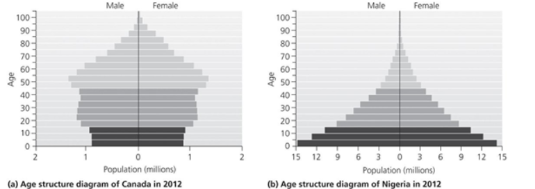 Use the accompanying figure to answer the following question.
-Life expectancy in parts of southern Africa ______________
Use the accompanying figure to answer the following question.
-Life expectancy in parts of southern Africa ______________ (Multiple Choice)
4.9/5 (96)
(96) The current global human population is approximately _________________
(Multiple Choice)
4.9/5 (93)
(93) Read the following scenario and answer the question below.
Population growth is at the root of many serious environmental problems. From the ancient Babylonians thousands of years ago, to Thomas Malthus hundreds of years ago, to present day neo- Malthusians, humans seem to possess an awareness of Earth's limitations in the face of growing populations. Today, our ability to accurately quantify, monitor, and control population growth is very sophisticated. We can measure growth and make predictions about world growth with mathematical and computer models. Can we prevent disaster?
-If there is _____________, a country's population growth rate will increase.
(Multiple Choice)
4.9/5 (87)
(87) Recent research suggests that _________________ has/have contributed to the large drop in fertility rates in Brazil over the past several decades.
(Multiple Choice)
4.9/5 (76)
(76) If global fertility rates remain at 2005- 2010 levels, the United Nations predicts that world population will be approximately ______________ billion in 2050.
(Multiple Choice)
4.9/5 (70)
(70)
Use the accompanying figure to answer the following question.
-If a population roughly doubles in the course of 50 years, its growth rate would be close to _________________%.
Use the accompanying figure to answer the following question.
-If a population roughly doubles in the course of 50 years, its growth rate would be close to _________________%. (Multiple Choice)
4.9/5 (68)
(68) The annual global growth rate of the human population peaked in the ______________ and has been declining ever since.
(Multiple Choice)
4.9/5 (91)
(91) In the demographic transition model, the highest population growth rate in a country is likely to occur during ______________
(Multiple Choice)
4.8/5 (80)
(80) According to the IPAT model, technology that enhances our acquisition of minerals, fossil fuels, timber, and ocean fish ______________
(Multiple Choice)
4.9/5 (65)
(65) The total fertility rate among Italian women in 2010 was 1.4, whereas it was nearly 4.5 for women in the African country of Ivory Coast. What do these numbers mean? How are they likely to relate to the actual number of children per woman in each country and why? How are they likely to change in the future?
(Essay)
4.9/5 (78)
(78) Read the following scenario and answer the question below.
Population growth is at the root of many serious environmental problems. From the ancient Babylonians thousands of years ago, to Thomas Malthus hundreds of years ago, to present day neo- Malthusians, humans seem to possess an awareness of Earth's limitations in the face of growing populations. Today, our ability to accurately quantify, monitor, and control population growth is very sophisticated. We can measure growth and make predictions about world growth with mathematical and computer models. Can we prevent disaster?
-Aside from contraception, what can humans do to control population growth's negative effects on the environment?
(Multiple Choice)
4.8/5 (84)
(84) The transitional stage in Frank Notestein's demographic model is initiated by ______________
(Multiple Choice)
4.8/5 (92)
(92) 
Filters
- Essay(0)
- Multiple Choice(0)
- Short Answer(0)
- True False(0)
- Matching(0)