



 Chat with AI
Exam 18: Global Climate Change

Exam 1: Science and Sustainability: an Introduction to Environmental Science45 Questions
Exam 2: Earths Physical Systems: Matter, Energy, and Geology49 Questions
Exam 3: Evolution, Biodiversity, and Population Ecology46 Questions
Exam 4: Species Interactions and Community Ecology53 Questions
Exam 5: Environmental Systems and Ecosystem Ecology47 Questions
Exam 6: Ethics, Economics, and Sustainable Development47 Questions
Exam 7: Environmental Policy: Making Decisions and Solving Problems48 Questions
Exam 8: Human Population55 Questions
Exam 9: Soil and Agriculture50 Questions
Exam 10: Agriculture, Biotechnology, and the Future of Food49 Questions
Exam 11: Biodiversity and Conservation Biology45 Questions
Exam 12: Forests, Forest Management, and Protected Areas45 Questions
Exam 13: The Urban Environment: Creating Sustainable Cities50 Questions
Exam 14: Environmental Health and Toxicology53 Questions
Exam 15: Freshwater Systems and Resources48 Questions
Exam 16: Marine and Coastal Systems and Resources54 Questions
Exam 17: Atmospheric Science, Air Quality, and Pollution Control45 Questions
Exam 18: Global Climate Change49 Questions
Exam 19: Fossil Fuels, Their Impacts, and Energy Conservation46 Questions
Exam 20: Conventional Energy Alternatives55 Questions
Exam 21: New Renewable Energy Alternatives48 Questions
Exam 22: Managing Our Waste48 Questions
Exam 23: Minerals and Mining35 Questions
Exam 24: Sustainable Solutions47 Questions
Select questions type


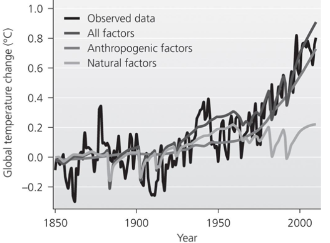 Use the accompanying figure to answer the following question.
-One factor contributing to U.S. resistance to legal intervention regarding global climate change is _______________.
Use the accompanying figure to answer the following question.
-One factor contributing to U.S. resistance to legal intervention regarding global climate change is _______________. (Multiple Choice)
4.8/5  (89)
(89) Tuvalu and the Maldives are in the international spotlight because they ____________
(Multiple Choice)
4.8/5 (76)
(76) Read the following scenario and answer the question below.
The Intergovernmental Panel on Climate Change reported that physical, biological, and economic evidence exists confirming global climate change due to human-produced greenhouse gases. Although the United States emits most of Earth's carbon dioxide, its policies do not reflect concern over its environmental effects. The United States failed to ratify the Kyoto Protocol, an international agreement signed by other developed nations to reduce carbon dioxide emissions. Requested voluntary reductions of carbon dioxide emissions have not been effective in reducing greenhouse gases. Revisions to the 1970 Clean Air Act, called the "Clear Skies Initiative," were proposed to limit mercury, nitric oxides, and sulfur oxide emissions from power plants. Nicknamed by Robert F. Kennedy, Jr., as the "Clear Lies Initiative," this proposal did not specifically address emission of carbon dioxide, and its loopholes excluded older power plants from having to modernize, seemingly supporting pollutive industries with political influence. Environmentalists are arguing for immediate action, including stricter laws to limit power plant carbon dioxide emissions and subsidies for renewable energy. They favor "portfolio standards," requiring electric companies to provide clean energy alternatives to consumers and "green tags," "wind certificates," and "green pricing" to support the use of alternative fuels.
-Why do environmentalists and scientists advocate immediate action, including stricter laws to limit power plant carbon dioxide emissions and subsidies for renewable energy?
(Multiple Choice)
4.8/5 (92)
(92) The Earth's atmosphere can cause global warming because _____________.
(Multiple Choice)
4.9/5 (87)
(87) Describe how freshwater ecosystems face challenges of global climate change. Give an example from the text.
(Essay)
4.8/5 (80)
(80)
Use the accompanying figure to answer the following question.
-Milankovitch cycles _______________
Use the accompanying figure to answer the following question.
-Milankovitch cycles _______________ (Multiple Choice)
4.7/5 (68)
(68)
Use the accompanying figure to answer the following question.
-The greenhouse effect involves warming of Earth's surface and the _______________.
Use the accompanying figure to answer the following question.
-The greenhouse effect involves warming of Earth's surface and the _______________. (Multiple Choice)
4.8/5 (86)
(86) Predominant greenhouse gas produced by burning fossil fuels
(Multiple Choice)
4.7/5 (81)
(81) The Intergovernmental Panel on Climate Change is an international panel that _______________.
(Multiple Choice)
4.8/5 (78)
(78) How certain are scientists that humans are causing global climate change? Describe the language used by scientists and some of the particular climate trends they have identified as changing. If the scientific community is convinced of the evidence, why is there still debate?
(Essay)
4.8/5 (89)
(89) Recent research indicates that the variation in solar output _______________
(Multiple Choice)
4.9/5 (85)
(85) By- product of feedlots, chemical manufacturing, and fertilizer use
(Multiple Choice)
4.9/5 (69)
(69) Read the following scenario and answer the question below.
The Intergovernmental Panel on Climate Change reported that physical, biological, and economic evidence exists confirming global climate change due to human-produced greenhouse gases. Although the United States emits most of Earth's carbon dioxide, its policies do not reflect concern over its environmental effects. The United States failed to ratify the Kyoto Protocol, an international agreement signed by other developed nations to reduce carbon dioxide emissions. Requested voluntary reductions of carbon dioxide emissions have not been effective in reducing greenhouse gases. Revisions to the 1970 Clean Air Act, called the "Clear Skies Initiative," were proposed to limit mercury, nitric oxides, and sulfur oxide emissions from power plants. Nicknamed by Robert F. Kennedy, Jr., as the "Clear Lies Initiative," this proposal did not specifically address emission of carbon dioxide, and its loopholes excluded older power plants from having to modernize, seemingly supporting pollutive industries with political influence. Environmentalists are arguing for immediate action, including stricter laws to limit power plant carbon dioxide emissions and subsidies for renewable energy. They favor "portfolio standards," requiring electric companies to provide clean energy alternatives to consumers and "green tags," "wind certificates," and "green pricing" to support the use of alternative fuels.
-Of the following greenhouse gases, which one has experienced the greatest percentage increase since 1750?
(Multiple Choice)
4.8/5 (86)
(86)
Use the accompanying figure to answer the following question.
-The largest source of anthropogenic greenhouse gases in the United States is , followed by ___________
Use the accompanying figure to answer the following question.
-The largest source of anthropogenic greenhouse gases in the United States is , followed by ___________ (Multiple Choice)
4.9/5 (69)
(69) Why is the concept of radiative forcing critical to understanding the causes of global climate change?
(Essay)
4.9/5 (78)
(78)
Use the accompanying figure to answer the following question.
-Impacts of global warming include all of the following except _______________.
Use the accompanying figure to answer the following question.
-Impacts of global warming include all of the following except _______________. (Multiple Choice)
4.8/5 (84)
(84) Stratospheric greenhouse gas that absorbs the sun's incoming short-wave radiation
(Multiple Choice)
4.8/5 (78)
(78) Briefly explain why water vapor may either contribute to or slow global warming.
(Essay)
4.8/5 (81)
(81) 
Filters
- Essay(0)
- Multiple Choice(0)
- Short Answer(0)
- True False(0)
- Matching(0)