



 Chat with AI
Exam 9: Soil and Agriculture

Exam 1: Science and Sustainability: an Introduction to Environmental Science45 Questions
Exam 2: Earths Physical Systems: Matter, Energy, and Geology49 Questions
Exam 3: Evolution, Biodiversity, and Population Ecology46 Questions
Exam 4: Species Interactions and Community Ecology53 Questions
Exam 5: Environmental Systems and Ecosystem Ecology47 Questions
Exam 6: Ethics, Economics, and Sustainable Development47 Questions
Exam 7: Environmental Policy: Making Decisions and Solving Problems48 Questions
Exam 8: Human Population55 Questions
Exam 9: Soil and Agriculture50 Questions
Exam 10: Agriculture, Biotechnology, and the Future of Food49 Questions
Exam 11: Biodiversity and Conservation Biology45 Questions
Exam 12: Forests, Forest Management, and Protected Areas45 Questions
Exam 13: The Urban Environment: Creating Sustainable Cities50 Questions
Exam 14: Environmental Health and Toxicology53 Questions
Exam 15: Freshwater Systems and Resources48 Questions
Exam 16: Marine and Coastal Systems and Resources54 Questions
Exam 17: Atmospheric Science, Air Quality, and Pollution Control45 Questions
Exam 18: Global Climate Change49 Questions
Exam 19: Fossil Fuels, Their Impacts, and Energy Conservation46 Questions
Exam 20: Conventional Energy Alternatives55 Questions
Exam 21: New Renewable Energy Alternatives48 Questions
Exam 22: Managing Our Waste48 Questions
Exam 23: Minerals and Mining35 Questions
Exam 24: Sustainable Solutions47 Questions
Select questions type


The breakdown of large rocks into smaller pieces is _______________.
(Multiple Choice)
4.8/5  (96)
(96) Read the following scenario and answer the questions below.
Early People and Agricultural Beginnings
Long ago, two sisters were talking as they returned from their morning trip to collect mushrooms, seeds, berries, and green leaves for the day's meals. The younger woman was watching the progress of a small rabbit as it hopped across the path and toward the clan's trash midden (refuse heap), where broken tools (made of bone, stone, or shell)were tossed, and where discarded food was thrown. She noticed the rabbit stop and begin nibbling at the many new, green shoots sprouting across one side of the midden. She walked over to look, and she saw that some of last year's discarded dried fruits were growing. Surprised and interested, she called her sister over to discuss this find.
-This is the story of a group whose food _____________
(Multiple Choice)
4.9/5 (77)
(77) Compaction of soil in a garden harms plants by _______________
(Multiple Choice)
4.7/5 (81)
(81) Read the following scenario and answer the question below.
Early People and Agricultural Beginnings
Long ago, two sisters were talking as they returned from their morning trip to collect mushrooms, seeds, berries, and green leaves for the day's meals. The younger woman was watching the progress of a small rabbit as it hopped across the path and toward the clan's trash midden (refuse heap), where broken tools (made of bone, stone, or shell)were tossed, and where discarded food was thrown. She noticed the rabbit stop and begin nibbling at the many new, green shoots sprouting across one side of the midden. She walked over to look, and she saw that some of last year's discarded dried fruits were growing. Surprised and interested, she called her sister over to discuss this find.
-Twenty years have passed since the young woman first noticed seeds sprouting in the midden. Which of the following could now be true?
(Multiple Choice)
4.9/5 (71)
(71) Read the following scenario and answer the question below.
Early People and Agricultural Beginnings
Long ago, two sisters were talking as they returned from their morning trip to collect mushrooms, seeds, berries, and green leaves for the day's meals. The younger woman was watching the progress of a small rabbit as it hopped across the path and toward the clan's trash midden (refuse heap), where broken tools (made of bone, stone, or shell)were tossed, and where discarded food was thrown. She noticed the rabbit stop and begin nibbling at the many new, green shoots sprouting across one side of the midden. She walked over to look, and she saw that some of last year's discarded dried fruits were growing. Surprised and interested, she called her sister over to discuss this find.
-These people likely lived _________________
(Multiple Choice)
4.8/5 (88)
(88) The results of the overapplication of fertilization can include _______________.
(Multiple Choice)
4.7/5 (95)
(95) Briefly describe the successes of the Malpai Borderlands restoration project.
(Essay)
4.7/5 (93)
(93) 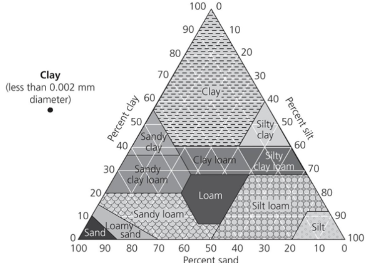 Use the accompanying figure to answer the following question.
-The O horizon is _____________
Use the accompanying figure to answer the following question.
-The O horizon is _____________ (Multiple Choice)
4.9/5 (84)
(84) Read the following scenario and answer the question below.
Early People and Agricultural Beginnings
Long ago, two sisters were talking as they returned from their morning trip to collect mushrooms, seeds, berries, and green leaves for the day's meals. The younger woman was watching the progress of a small rabbit as it hopped across the path and toward the clan's trash midden (refuse heap), where broken tools (made of bone, stone, or shell)were tossed, and where discarded food was thrown. She noticed the rabbit stop and begin nibbling at the many new, green shoots sprouting across one side of the midden. She walked over to look, and she saw that some of last year's discarded dried fruits were growing. Surprised and interested, she called her sister over to discuss this find.
-Two thousand years after our story began, it is likely that _______________
(Multiple Choice)
4.8/5 (75)
(75) We lose 5 to 7 million hectares of productive cropland per year to _______________
(Multiple Choice)
4.7/5 (93)
(93) The lesson learned by Arliss and Todd Nielsen on their Iowa farm is that _______________
(Multiple Choice)
4.8/5 (78)
(78) More than half the _______________ in the United States and Canada has/have been lost to urban and agricultural development, but the recent _______________ subsidizes landowners to restore or protect remaining areas.
(Multiple Choice)
4.7/5 (82)
(82) Irrigation can result in the salinization of soils because _______________
(Multiple Choice)
4.9/5 (87)
(87) _______________ is the buildup of salts in soils as a result of overirrigation.
(Multiple Choice)
4.8/5 (75)
(75) 
Filters
- Essay(0)
- Multiple Choice(0)
- Short Answer(0)
- True False(0)
- Matching(0)