



 Chat with AI
Exam 11: Designing, Conducting, Analyzing, and Interpreting Experiments With More Than Two Groups

Exam 1: Psychological Research and the Research Methods Course25 Questions
Exam 2: Developing a Good Research Idea and Conducting an Ethical Project87 Questions
Exam 3: Qualitative Research Methods83 Questions
Exam 4: Nonexperimental Methods: Descriptive Methods, Correlational Studies, Ex Post Facto Studies, Surveys and Questionnaires, Sampling, and Basic Research Strategies131 Questions
Exam 5: Using the Scientific Method in Psychology68 Questions
Exam 6: Conducting a Good Experiment I: Variables and Control99 Questions
Exam 7: Conducting a Good Experiment Ii: Final Considerations, Unanticipated Influences, and Cross-Cultural Issues105 Questions
Exam 8: Internal and External Validity118 Questions
Exam 9: Using Statistics to Answer Questions158 Questions
Exam 10: Designing, Conducting, Analyzing, and Interpreting Experiments With Two Groups130 Questions
Exam 11: Designing, Conducting, Analyzing, and Interpreting Experiments With More Than Two Groups152 Questions
Exam 12: Designing, Conducting, Analyzing, and Interpreting Experiments With Multiple Independent Variables211 Questions
Exam 13: Alternative Research Designs178 Questions
Exam 14: Writing and Assembling an Apa-Format Research Report150 Questions
Select questions type


In the following study, participants were randomly assigned to receive humanistic therapy, psychodynamic therapy, or behavioral therapy for their depression. Six months after therapy ended, participants' levels of depression were rated on a Likert scale from 1 (not at all depressed) to 15 (extremely depressed).
GROUP N MEAN STD DEV STD ERROR 1 (humanistic) 10 5.40 2.17 0.69 2 (psychodynamic) 10 7.50 2.84 0.90 3 (behavioral) 10 5.60 3.13 0.99
ONEWAY ANOVA: THERAPY bY DEPRESSION
SUM OF MEAN SOURCE SQUARES DF SQUARES F RATIO PROB. BETWEEN GROUPS 26.87 2 13.73 1.78 .187 WTHIN GROUPS 203.30 27 7.53 TOTAL 230.17 29
POST HOC TEST: Tukey-HSD with significance level .05
* Indicates significant differences shown for pairings
G G G r r r p p p 1 2 3
Mean THERAPY 5.40 Grp 1 7.50 Grp 2 5.60 Grp 3
-Is this a two-group design or a multiple-group design? How do you know?
(Essay)
4.7/5  (80)
(80) Questions refer to Table 11-2. In this study, 10 children completed a survey regarding their impressions of smokers at age 8 and then again at age 10 and 12. Scores could range from 1 (extreme negative impression of smokers) to 20 (extreme positive impression of smokers).
Table 11-2
GROUP MEAN STD DEV STD ERROR 1 (AGE 8) 10 9.70 5.89 1.86 2 (AGE 10) 10 10.40 5.58 1.76 3 (AGE 12) 10 11.80 5.94 1.88
ONEWAY ANOVA: SMOKING by AGE (CORR SAMP)
SUM OF MEAN SOURCE SQUARES DF SQUARES F RATIO PROB. AGE 22.87 2 11.43 6.76 .006 SUBJECTS 879.63 9 97.74 34.71 .000 WITHIN CELLS 30.47 18 1.69 TOTAL 932.97 29
POST HOC TEST: Tukey-HSD with significance level .05
* Indicates significant differences shown for pairings
1 2 3
Mean 9.70 Grp 1 10.40 Grp 2 11.80 Grp 3
-Consult Table 11-2. What kind of research design is this?
(Multiple Choice)
4.9/5 (82)
(82) Questions refer to Table 11-2. In this study, 10 children completed a survey regarding their impressions of smokers at age 8 and then again at age 10 and 12. Scores could range from 1 (extreme negative impression of smokers) to 20 (extreme positive impression of smokers).
Table 11-2
GROUP MEAN STD DEV STD ERROR 1 (AGE 8) 10 9.70 5.89 1.86 2 (AGE 10) 10 10.40 5.58 1.76 3 (AGE 12) 10 11.80 5.94 1.88
ONEWAY ANOVA: SMOKING by AGE (CORR SAMP)
SUM OF MEAN SOURCE SQUARES DF SQUARES F RATIO PROB. AGE 22.87 2 11.43 6.76 .006 SUBJECTS 879.63 9 97.74 34.71 .000 WITHIN CELLS 30.47 18 1.69 TOTAL 932.97 29
POST HOC TEST: Tukey-HSD with significance level .05
* Indicates significant differences shown for pairings
1 2 3
Mean 9.70 Grp 1 10.40 Grp 2 11.80 Grp 3
-Consult Table 11-1. Why are the degrees of freedom between groups equal to 2?
(Multiple Choice)
4.7/5 (72)
(72) Questions refer to Table 11-2. In this study, 10 children completed a survey regarding their impressions of smokers at age 8 and then again at age 10 and 12. Scores could range from 1 (extreme negative impression of smokers) to 20 (extreme positive impression of smokers).
Table 11-2
GROUP MEAN STD DEV STD ERROR 1 (AGE 8) 10 9.70 5.89 1.86 2 (AGE 10) 10 10.40 5.58 1.76 3 (AGE 12) 10 11.80 5.94 1.88
ONEWAY ANOVA: SMOKING by AGE (CORR SAMP)
SUM OF MEAN SOURCE SQUARES DF SQUARES F RATIO PROB. AGE 22.87 2 11.43 6.76 .006 SUBJECTS 879.63 9 97.74 34.71 .000 WITHIN CELLS 30.47 18 1.69 TOTAL 932.97 29
POST HOC TEST: Tukey-HSD with significance level .05
* Indicates significant differences shown for pairings
1 2 3
Mean 9.70 Grp 1 10.40 Grp 2 11.80 Grp 3
-Consult Table 11-1. What kind of research design is this?
(Multiple Choice)
4.8/5 (83)
(83) What does it mean for an experiment to be confounded? Describe an example of a confounded experiment using multiple groups.
(Essay)
4.9/5 (78)
(78) In the following study, participants were randomly assigned to receive humanistic therapy, psychodynamic therapy, or behavioral therapy for their depression. Six months after therapy ended, participants' levels of depression were rated on a Likert scale from 1 (not at all depressed) to 15 (extremely depressed).
GROUP N MEAN STD DEV STD ERROR 1 (humanistic) 10 5.40 2.17 0.69 2 (psychodynamic) 10 7.50 2.84 0.90 3 (behavioral) 10 5.60 3.13 0.99
ONEWAY ANOVA: THERAPY bY DEPRESSION
SUM OF MEAN SOURCE SQUARES DF SQUARES F RATIO PROB. BETWEEN GROUPS 26.87 2 13.73 1.78 .187 WTHIN GROUPS 203.30 27 7.53 TOTAL 230.17 29
POST HOC TEST: Tukey-HSD with significance level .05
* Indicates significant differences shown for pairings
G G G r r r p p p 1 2 3
Mean THERAPY 5.40 Grp 1 7.50 Grp 2 5.60 Grp 3
-What is the independent variable in this study?
(Essay)
4.8/5 (83)
(83) The belief that explanations of phenomena should remain simple until the simple explanations are no longer valid is known as the
(Multiple Choice)
4.8/5 (82)
(82) According to your text, "You find a research idea when you identify a gap in the current knowledge base…" . What was the gap in the knowledge base, according to the authors?
(Essay)
4.9/5 (86)
(86) On average, when error variability _________, the statistical value _________.
(Multiple Choice)
4.7/5 (83)
(83) Courtney conducts a study in which she randomly assigns some rats to receive a high dose of alcohol, other rats to receive a low dose of alcohol, and a final group receives no alcohol. She measures the time it takes them to learn a new maze. Courtney's study represents a(n) __________ and her statistical technique for analyzing the data should be a ___________.
(Multiple Choice)
4.9/5 (92)
(92) Suppose you obtain the following distribution in an experiment: 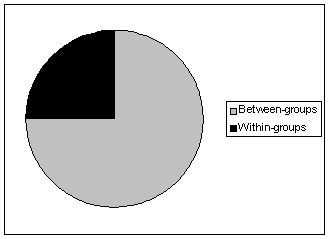 Based on this distribution, you should conclude that the F ratio is _______ and _______.
 (Multiple Choice)
4.9/5 (73)
(73) Compare and contrast the multiple-independent-groups-design and the multiple-correlated-groups design. What are the advantages and disadvantages of each?
(Essay)
4.8/5 (66)
(66) Larry conducts an experiment with three groups: (1) writing about traumatic events, (2) writing about happy events, and (3) writing about neutral events. Larry then measures the number of visits each participant makes to the health center over the next six months. Larry gives the participants a pretest regarding their health visits prior to the study so that he can create sets of participants who are equivalent on that variable. Participants are randomly assigned to condition from each set. Larry has used _________ sets.
(Multiple Choice)
4.7/5 (78)
(78) A researcher was interested in determining the effectiveness of humanistic therapy for alleviating depression. He administered a depression inventory to a sample of clients with depression on three occasions: before therapy started, two months after therapy began, and four months into therapy. Depression scores could range from 1 (not at all depressed) to 15 (extremely depressed).
GROUP MEAN STD DEV STD ERROR 1 (Time 1) 10 13.50 1.58 0.50 2 (Time 2) 10 9.40 2.88 0.91 3 (Time 3) 10 7.30 4.06 1.28
SUM OF MEAN SOURCE SQUARES DF SQUARES F RATIO PROB. TIME 198.87 2 99.43 18.43 .000 SUBJECTS 147.88 9 16.43 185.04 .000 WITHIN CELLS 97.13 18 5.40 TOTAL 443.88 29
POST HOC TEST: Tukey-HSD with significance level .05
* Indicates significant differences shown for pairings
G G G r r r p p p 1 2 3
Mean TIME 13.50 Grp 1 9.40 Grp 2 7.30 Grp 3
-Why is a probability value of .000 slightly misleading?
(Essay)
4.9/5 (83)
(83) What kind of definitions do researchers use when planning their experiments?
(Multiple Choice)
4.8/5 (87)
(87) If each participant in an experiment has an equal chance of being in any of the groups, then the researcher has used __________ assignment.
(Multiple Choice)
4.8/5 (80)
(80) When you assign your participants to multiple groups randomly, you analyze your data using a _____________ ANOVA.
(Multiple Choice)
4.8/5 (81)
(81) ________-groups variability represents the variation in the DV that is due to the IV, and ________-groups variability represents the variation in the DV that is due to such factors as individual differences and errors in measurement.
(Multiple Choice)
4.8/5 (79)
(79) A researcher was interested in determining the effectiveness of humanistic therapy for alleviating depression. He administered a depression inventory to a sample of clients with depression on three occasions: before therapy started, two months after therapy began, and four months into therapy. Depression scores could range from 1 (not at all depressed) to 15 (extremely depressed).
GROUP MEAN STD DEV STD ERROR 1 (Time 1) 10 13.50 1.58 0.50 2 (Time 2) 10 9.40 2.88 0.91 3 (Time 3) 10 7.30 4.06 1.28
SUM OF MEAN SOURCE SQUARES DF SQUARES F RATIO PROB. TIME 198.87 2 99.43 18.43 .000 SUBJECTS 147.88 9 16.43 185.04 .000 WITHIN CELLS 97.13 18 5.40 TOTAL 443.88 29
POST HOC TEST: Tukey-HSD with significance level .05
* Indicates significant differences shown for pairings
G G G r r r p p p 1 2 3
Mean TIME 13.50 Grp 1 9.40 Grp 2 7.30 Grp 3
-What is the independent variable in this study?
(Essay)
4.8/5 (82)
(82) 
Filters
- Essay(0)
- Multiple Choice(0)
- Short Answer(0)
- True False(0)
- Matching(0)