



 Chat with AI
Exam 24: Aggregate Demand and Aggregate Supply Analysis

Exam 1: Economics: Foundations and Models459 Questions
Exam 2: Trade-Offs, Comparative Advantage, and the Market System492 Questions
Exam 3: Where Prices Come From: the Interaction of Demand and Supply476 Questions
Exam 4: Economic Efficiency, Government Price Setting, and Taxes420 Questions
Exam 5: Externalities, Environmental Policy, and Public Goods262 Questions
Exam 6: Elasticity: the Responsiveness of Demand and Supply293 Questions
Exam 7: The Economics of Health Care337 Questions
Exam 8: Firms, the Stock Market, and Corporate Governance512 Questions
Exam 9: Comparative Advantage and the Gains From International Trade377 Questions
Exam 10: Consumer Choice and Behavioral Economics304 Questions
Exam 11: Technology, Production, and Costs326 Questions
Exam 12: Firms in Perfectly Competitive Markets296 Questions
Exam 13: Monopolistic Competition: the Competitive Model in a More Realistic Setting272 Questions
Exam 14: Oligopoly: Firms in Less Competitive Markets256 Questions
Exam 15: Monopoly and Antitrust Policy279 Questions
Exam 16: Pricing Strategy258 Questions
Exam 17: The Markets for Labor and Other Factors of Production279 Questions
Exam 18: Public Choice, Taxes, and the Distribution of Income258 Questions
Exam 19: Gdp: Measuring Total Production and Income260 Questions
Exam 20: Unemployment and Inflation290 Questions
Exam 21: Economic Growth, the Financial System, and Business Cycles251 Questions
Exam 22: Long-Run Economic Growth: Sources and Policies261 Questions
Exam 23: Aggregate Expenditure and Output in the Short Run305 Questions
Exam 24: Aggregate Demand and Aggregate Supply Analysis286 Questions
Exam 25: Money, Banks, and the Federal Reserve System278 Questions
Exam 26: Monetary Policy280 Questions
Exam 27: Fiscal Policy313 Questions
Exam 28: Inflation, Unemployment, and Federal Reserve Policy257 Questions
Exam 29: Macroeconomics in an Open Economy277 Questions
Exam 30: The International Financial System258 Questions
Select questions type


Article Summary
For reasons including overproduction in the United States, a decrease in global demand, and limited production cuts by OPEC, the price of oil continued to fall during 2017. The falling prices have led OPEC to institute further cuts in oil production, but this effort has been thwarted by OPEC member Libya, whose production increased to 855,000 barrels a day, roughly triple its daily output from the previous year. Libya has Africa's largest oil reserves, but political unrest and militia blockades have severely restricted output in recent years. Due to political instability, OPEC had excluded Libya, Nigeria, and Iran from its agreement to cut production in 2016, but now all three countries have increased production. According to Michael Lynch, president of Strategic Energy and Economic Research, "A lot of experts figured things were so unstable in Libya and politics were so opaque that they did not want to factor in more supply from there. OPEC has been wounded. It gets back to the problem that OPEC has a lot of members in bad shape, making it difficult for them to call on everybody to make sacrifices equally. So they excluded those three and now it's come back to bite them." In late May, OPEC announced an extension to its cutback agreement, but in the month that followed, oil prices fell 16 percent. The same month, Libya announced plans to increase oil production to 1.5 million barrels a day by the end of 2018, and to 2.2 million barrels a day by 2023.
-Refer to the Article Summary. The unexpected increase in the supply of oil mentioned in the article summary resulted in a decrease in the price of oil. When the price of oil falls unexpectedly due to a supply shock, the equilibrium price level ________ and the unemployment rate ________ in the short run.
(Multiple Choice)
4.9/5  (76)
(76) Figure 24-3  -Refer to Figure 24-3. Suppose the economy is at point A. If the economy experiences a negative supply shock, where will the eventual short-run equilibrium be?
 (Multiple Choice)
4.9/5 (73)
(73) Figure 24-2  -Refer to Figure 24-2. Ceteris paribus, a decrease in the expected future price level would be represented by a movement from
 (Multiple Choice)
4.8/5 (87)
(87) The automatic mechanism ________ the price level in the case of ________ and ________ the price level in the case of ________.
(Multiple Choice)
4.8/5 (92)
(92) In 2005, Hurricane Katrina destroyed oil and natural gas refining capacity in the Gulf of Mexico. This subsequently drove up natural gas, gasoline, and heating oil prices. As a result, this should
(Multiple Choice)
4.8/5 (80)
(80) Using aggregate demand and aggregate supply, explain what happens in the short run if the Federal Reserve raises interest rates in the economy. Be sure to detail what happens to aggregate demand, the price level, the level of GDP, and unemployment. Assume that the economy is at full employment before the interest rate increase.
(Essay)
4.8/5 (75)
(75) In the dynamic aggregated demand and aggregate supply model, inflation occurs if
(Multiple Choice)
4.8/5 (84)
(84) The recession of 2007-2009 made many consumers pessimistic about their future incomes. How does this increased pessimism affect the aggregate demand curve?
(Multiple Choice)
4.8/5 (67)
(67) Because of the slope of the aggregate demand curve, we can say that
(Multiple Choice)
5.0/5 (84)
(84) Proponents of the ________ model argue that the short-run supply curve is vertical.
(Multiple Choice)
4.9/5 (85)
(85) Figure 24-1 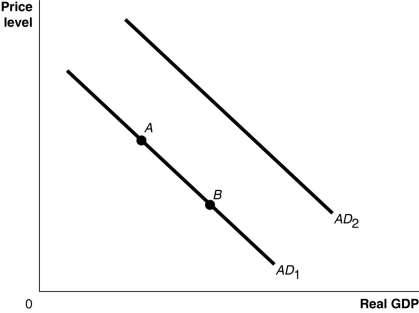 -Refer to Figure 24-1. Ceteris paribus, a decrease in the value of the domestic currency relative to foreign currencies would be represented by a movement from
 (Multiple Choice)
4.8/5 (81)
(81) Figure 24-1
-Refer to Figure 24-1. Ceteris paribus, an increase in households' expectations of their future income would be represented by a movement from
-Refer to Figure 24-1. Ceteris paribus, an increase in households' expectations of their future income would be represented by a movement from (Multiple Choice)
4.9/5 (80)
(80) If the short-run aggregate supply increases by less than the long-run aggregate supply, then, at the short-run equilibrium
(Multiple Choice)
4.8/5 (79)
(79) Figure 24-1
-Refer to Figure 24-1. Ceteris paribus, a decrease in personal income taxes would be represented by a movement from
-Refer to Figure 24-1. Ceteris paribus, a decrease in personal income taxes would be represented by a movement from (Multiple Choice)
4.8/5 (81)
(81) New Keynesian macroeconomic theory emphasizes the role of "sticky" prices in the economy.
(True/False)
4.8/5 (75)
(75) Changes in ________ do not affect the level of aggregate supply in the long run.
(Multiple Choice)
4.9/5 (92)
(92) 
Filters
- Essay(0)
- Multiple Choice(0)
- Short Answer(0)
- True False(0)
- Matching(0)