



 Chat with AI
Exam 24: Aggregate Demand and Aggregate Supply Analysis

Exam 1: Economics: Foundations and Models459 Questions
Exam 2: Trade-Offs, Comparative Advantage, and the Market System492 Questions
Exam 3: Where Prices Come From: the Interaction of Demand and Supply476 Questions
Exam 4: Economic Efficiency, Government Price Setting, and Taxes420 Questions
Exam 5: Externalities, Environmental Policy, and Public Goods262 Questions
Exam 6: Elasticity: the Responsiveness of Demand and Supply293 Questions
Exam 7: The Economics of Health Care337 Questions
Exam 8: Firms, the Stock Market, and Corporate Governance512 Questions
Exam 9: Comparative Advantage and the Gains From International Trade377 Questions
Exam 10: Consumer Choice and Behavioral Economics304 Questions
Exam 11: Technology, Production, and Costs326 Questions
Exam 12: Firms in Perfectly Competitive Markets296 Questions
Exam 13: Monopolistic Competition: the Competitive Model in a More Realistic Setting272 Questions
Exam 14: Oligopoly: Firms in Less Competitive Markets256 Questions
Exam 15: Monopoly and Antitrust Policy279 Questions
Exam 16: Pricing Strategy258 Questions
Exam 17: The Markets for Labor and Other Factors of Production279 Questions
Exam 18: Public Choice, Taxes, and the Distribution of Income258 Questions
Exam 19: Gdp: Measuring Total Production and Income260 Questions
Exam 20: Unemployment and Inflation290 Questions
Exam 21: Economic Growth, the Financial System, and Business Cycles251 Questions
Exam 22: Long-Run Economic Growth: Sources and Policies261 Questions
Exam 23: Aggregate Expenditure and Output in the Short Run305 Questions
Exam 24: Aggregate Demand and Aggregate Supply Analysis286 Questions
Exam 25: Money, Banks, and the Federal Reserve System278 Questions
Exam 26: Monetary Policy280 Questions
Exam 27: Fiscal Policy313 Questions
Exam 28: Inflation, Unemployment, and Federal Reserve Policy257 Questions
Exam 29: Macroeconomics in an Open Economy277 Questions
Exam 30: The International Financial System258 Questions
Select questions type


Figure 24-2  -Refer to Figure 24-2. Ceteris paribus, a decrease in the size of the labor force would be represented by a movement from
 (Multiple Choice)
4.8/5  (81)
(81) Figure 24-2
-Refer to Figure 24-2. Ceteris paribus, an increase in the number of workers and firms adjusting to having previously overestimated the price level would be represented by a movement from
-Refer to Figure 24-2. Ceteris paribus, an increase in the number of workers and firms adjusting to having previously overestimated the price level would be represented by a movement from (Multiple Choice)
4.8/5 (77)
(77) The basic aggregate demand and aggregate supply curve model helps explain ________ fluctuations in real GDP and the price level.
(Multiple Choice)
4.9/5 (71)
(71) When the price level rises from 110 to 115, the aggregate level of GDP supplied rises from $80 billion to $120 billion. This ________ relationship represents the ________ relationship between the quantity of real GDP firms are willing to supply and the price level.
(Multiple Choice)
4.8/5 (75)
(75) According to Marx, which of the following factors of production did not contribute anything of value to production?
(Multiple Choice)
4.9/5 (91)
(91) What is a supply shock, and why might a supply shock lead to stagflation?
(Essay)
4.9/5 (80)
(80) Monetarists believe that the quantity of money should be increased at an increasing rate.
(True/False)
5.0/5 (74)
(74) Figure 24-1 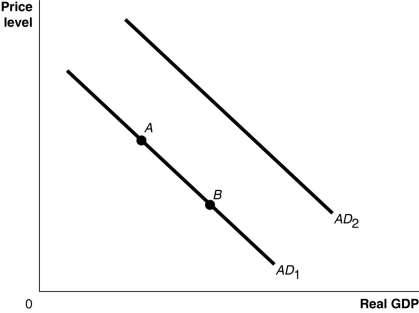 -Refer to Figure 24-1. Ceteris paribus, an increase in the value of the domestic currency relative to foreign currencies would be represented by a movement from
 (Multiple Choice)
4.8/5 (78)
(78) Which of the following would not be considered a positive addition to household wealth?
(Multiple Choice)
4.9/5 (71)
(71) If full-employment GDP is equal to $4.2 trillion, what does the long-run aggregate supply curve look like?
(Multiple Choice)
4.8/5 (75)
(75) Most recessions in the United States since World War II have begun with
(Multiple Choice)
4.8/5 (62)
(62) Interest rates in the economy have risen. How will this affect aggregate demand and equilibrium in the short run?
(Multiple Choice)
4.8/5 (73)
(73) Which of the following would cause the short-run aggregate supply curve to shift to the left?
(Multiple Choice)
4.9/5 (87)
(87) Explain how the economy moves back to full employment from recession. Be sure to detail what happens to short-run aggregate supply, unemployment, equilibrium GDP and the price level.
(Essay)
4.8/5 (78)
(78) A decrease in disposable income will shift the aggregate demand curve to the left.
(True/False)
4.9/5 (80)
(80) Stagflation occurs when aggregate supply and aggregate demand both increase.
(True/False)
5.0/5 (73)
(73) Figure 24-1
-Refer to Figure 24-1. Ceteris paribus, an increase in government spending would be represented by a movement from
-Refer to Figure 24-1. Ceteris paribus, an increase in government spending would be represented by a movement from (Multiple Choice)
4.8/5 (67)
(67) One factor which brought on the recession of 2007-2009 was the end of the housing bubble.
(True/False)
4.9/5 (85)
(85) 
Filters
- Essay(0)
- Multiple Choice(0)
- Short Answer(0)
- True False(0)
- Matching(0)