



 Chat with AI
Exam 24: Aggregate Demand and Aggregate Supply Analysis

Exam 1: Economics: Foundations and Models459 Questions
Exam 2: Trade-Offs, Comparative Advantage, and the Market System492 Questions
Exam 3: Where Prices Come From: the Interaction of Demand and Supply476 Questions
Exam 4: Economic Efficiency, Government Price Setting, and Taxes420 Questions
Exam 5: Externalities, Environmental Policy, and Public Goods262 Questions
Exam 6: Elasticity: the Responsiveness of Demand and Supply293 Questions
Exam 7: The Economics of Health Care337 Questions
Exam 8: Firms, the Stock Market, and Corporate Governance512 Questions
Exam 9: Comparative Advantage and the Gains From International Trade377 Questions
Exam 10: Consumer Choice and Behavioral Economics304 Questions
Exam 11: Technology, Production, and Costs326 Questions
Exam 12: Firms in Perfectly Competitive Markets296 Questions
Exam 13: Monopolistic Competition: the Competitive Model in a More Realistic Setting272 Questions
Exam 14: Oligopoly: Firms in Less Competitive Markets256 Questions
Exam 15: Monopoly and Antitrust Policy279 Questions
Exam 16: Pricing Strategy258 Questions
Exam 17: The Markets for Labor and Other Factors of Production279 Questions
Exam 18: Public Choice, Taxes, and the Distribution of Income258 Questions
Exam 19: Gdp: Measuring Total Production and Income260 Questions
Exam 20: Unemployment and Inflation290 Questions
Exam 21: Economic Growth, the Financial System, and Business Cycles251 Questions
Exam 22: Long-Run Economic Growth: Sources and Policies261 Questions
Exam 23: Aggregate Expenditure and Output in the Short Run305 Questions
Exam 24: Aggregate Demand and Aggregate Supply Analysis286 Questions
Exam 25: Money, Banks, and the Federal Reserve System278 Questions
Exam 26: Monetary Policy280 Questions
Exam 27: Fiscal Policy313 Questions
Exam 28: Inflation, Unemployment, and Federal Reserve Policy257 Questions
Exam 29: Macroeconomics in an Open Economy277 Questions
Exam 30: The International Financial System258 Questions
Select questions type


German luxury car exports were hurt in 2009 as a result of the recession. How did this decrease in exports affect Germany's aggregate demand curve?
(Multiple Choice)
4.9/5  (86)
(86) If the U.S. dollar increases in value relative to other currencies, how does this affect the aggregate demand curve?
(Multiple Choice)
4.8/5 (79)
(79) Suppose the U.S. GDP growth rate is faster relative to other countries' GDP growth rates. U.S. imports will therefore increase faster than U.S. exports, and this will
(Multiple Choice)
4.8/5 (70)
(70) Figure 24-1 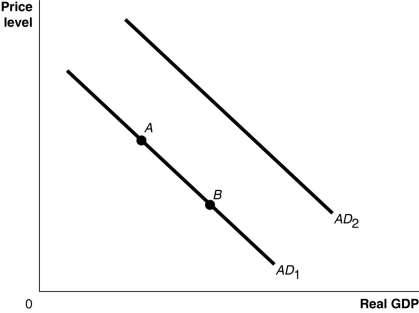 -Refer to Figure 24-1. Ceteris paribus, an increase in the price level would be represented by a movement from
 (Multiple Choice)
4.7/5 (81)
(81) Figure 24-1
-Refer to Figure 24-1. Ceteris paribus, an increase in firms' expectations of the future profitability of investment spending would be represented by a movement from
-Refer to Figure 24-1. Ceteris paribus, an increase in firms' expectations of the future profitability of investment spending would be represented by a movement from (Multiple Choice)
5.0/5 (75)
(75) Figure 24-2  -Refer to Figure 24-2. Ceteris paribus, an increase in the expected price of an important natural resource would be represented by a movement from
 (Multiple Choice)
4.9/5 (82)
(82) If, due to a recession, foreign workers begin to leave the United States to search for temporary work in their home countries until the recession has ended, this will
(Multiple Choice)
4.8/5 (78)
(78) Explain how the static aggregate demand and aggregate supply model gives us misleading results about the price level, particularly with respect to decreases in aggregate demand. Describe how the aggregate demand curve is different in the dynamic model as compared to the static model. Describe how potential GDP is different in the dynamic model as compared to the static model.
(Essay)
4.9/5 (93)
(93) On average, in the recessions since 1950, it has taken ________ for real GDP to return to its cyclical peak.
(Multiple Choice)
4.9/5 (68)
(68) Using an aggregate demand graph, illustrate the impact of an increase in the growth rate of U.S. GDP relative to the growth rate of foreign GDP.
(Essay)
4.9/5 (89)
(89) How do changes in income tax policies affect aggregate demand?
(Multiple Choice)
4.8/5 (89)
(89) Where the aggregate demand curve and the short-run aggregate supply curve intersect
(Multiple Choice)
5.0/5 (77)
(77) When potential GDP increases, short-run aggregate supply also increases, but long-run aggregate supply does not change.
(True/False)
4.9/5 (71)
(71) Following the bursting of the housing bubble in 2005, KB Homes sold ________ new homes and its stock price ________ dramatically. The result was total losses of $2.4 billion between 2007 and 2010.
(Multiple Choice)
4.8/5 (85)
(85) An increase in investment causes the price level to ________ in the short run and ________ in the long run.
(Multiple Choice)
4.9/5 (85)
(85) Explain how menu costs affect the slope of the short-run aggregate supply curve.
(Essay)
4.9/5 (86)
(86) 
Filters
- Essay(0)
- Multiple Choice(0)
- Short Answer(0)
- True False(0)
- Matching(0)