



 Chat with AI
Exam 30: The International Financial System

Exam 1: Economics: Foundations and Models459 Questions
Exam 2: Trade-Offs, Comparative Advantage, and the Market System492 Questions
Exam 3: Where Prices Come From: the Interaction of Demand and Supply476 Questions
Exam 4: Economic Efficiency, Government Price Setting, and Taxes420 Questions
Exam 5: Externalities, Environmental Policy, and Public Goods262 Questions
Exam 6: Elasticity: the Responsiveness of Demand and Supply293 Questions
Exam 7: The Economics of Health Care337 Questions
Exam 8: Firms, the Stock Market, and Corporate Governance512 Questions
Exam 9: Comparative Advantage and the Gains From International Trade377 Questions
Exam 10: Consumer Choice and Behavioral Economics304 Questions
Exam 11: Technology, Production, and Costs326 Questions
Exam 12: Firms in Perfectly Competitive Markets296 Questions
Exam 13: Monopolistic Competition: the Competitive Model in a More Realistic Setting272 Questions
Exam 14: Oligopoly: Firms in Less Competitive Markets256 Questions
Exam 15: Monopoly and Antitrust Policy279 Questions
Exam 16: Pricing Strategy258 Questions
Exam 17: The Markets for Labor and Other Factors of Production279 Questions
Exam 18: Public Choice, Taxes, and the Distribution of Income258 Questions
Exam 19: Gdp: Measuring Total Production and Income260 Questions
Exam 20: Unemployment and Inflation290 Questions
Exam 21: Economic Growth, the Financial System, and Business Cycles251 Questions
Exam 22: Long-Run Economic Growth: Sources and Policies261 Questions
Exam 23: Aggregate Expenditure and Output in the Short Run305 Questions
Exam 24: Aggregate Demand and Aggregate Supply Analysis286 Questions
Exam 25: Money, Banks, and the Federal Reserve System278 Questions
Exam 26: Monetary Policy280 Questions
Exam 27: Fiscal Policy313 Questions
Exam 28: Inflation, Unemployment, and Federal Reserve Policy257 Questions
Exam 29: Macroeconomics in an Open Economy277 Questions
Exam 30: The International Financial System258 Questions
Select questions type


If a country's currency is "pegged" to the dollar, its exchange rate is
(Multiple Choice)
4.8/5  (89)
(89) Suppose the GDP deflator in the United States is 125 and the GDP deflator in Japan is 100. Also assume the United States has trade barriers on Japanese goods in the form of quotas. What does this imply about the exchange rate of yen per dollar under the theory of purchasing power parity in the long run?
(Multiple Choice)
4.8/5 (84)
(84) A Big Mac costs $4.93 in the United States and 9.6 zlotys in Poland. If the exchange rate is 3 zlotys per dollar, purchasing power parity predicts that
(Multiple Choice)
4.8/5 (97)
(97) If the U.S. government places tariffs on imports from countries that have been accused of deliberately undervaluing their currencies, the price of these imports will ________ and the demand for the undervalued currency will ________.
(Multiple Choice)
4.9/5 (84)
(84) The Bretton Woods system was established in 1944 and remained in place until the early 1970s.
(True/False)
4.8/5 (83)
(83) Investors in which two countries accounted for 20 percent of all foreign purchases of U.S. stocks and bonds in March 2017?
(Multiple Choice)
4.7/5 (93)
(93) China began pegging its currency, the yuan, to the dollar in 1994. Because the yuan was ________ at the pegged exchange rate, the level of Chinese exports remained ________ than they would have been if the exchange rate were allowed to float freely.
(Multiple Choice)
4.9/5 (87)
(87) Figure 30-11 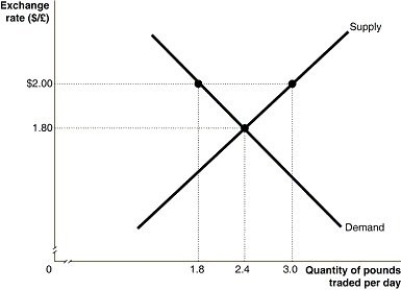 -Refer to Figure 30-11. The graph above depicts supply and demand for British pounds during a trading day, where the quantity is millions of pounds. In order to support a fixed exchange rate of $2.00 per pound, the British central bank must
 (Multiple Choice)
4.7/5 (72)
(72) In the United States today, how much gold will the Federal Reserve give you in exchange for $1?
(Multiple Choice)
4.7/5 (79)
(79) Figure 30-5  -Refer to Figure 30-5. Suppose the Chinese government decides to abandon pegging the yuan to the dollar at a rate which undervalues the yuan. Using the figure above, the equilibrium exchange rate would be ________ and Chinese exports to the United States would ________ in price.
 (Multiple Choice)
4.7/5 (81)
(81) Figure 30-5
-Refer to Figure 30-5. Suppose the pegged exchange rate is $0.14/yuan and U.S. consumers increase their demand for Chinese products. Using the figure above, this would
-Refer to Figure 30-5. Suppose the pegged exchange rate is $0.14/yuan and U.S. consumers increase their demand for Chinese products. Using the figure above, this would (Multiple Choice)
4.8/5 (79)
(79) Suppose the United States decides to go back on the gold standard. This should
(Multiple Choice)
4.9/5 (92)
(92) Actions taken by investors who sell a country's currency in anticipation of buying it back later at a lower price is known as
(Multiple Choice)
4.8/5 (81)
(81) Figure 30-12 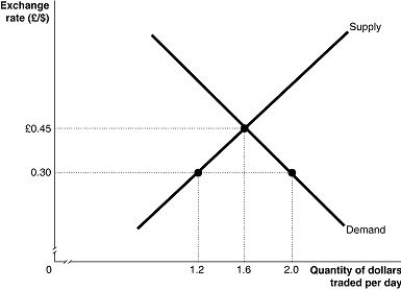 -Refer to Figure 30-12. The graph above, depicts supply and demand for U.S. dollars during a trading day. At a fixed exchange rate of 0.30 pounds per dollar, the dollar is ________ versus the pound. A ________ of the dollar would correct the fundamental disequilibrium that exists in this market.
 (Multiple Choice)
4.8/5 (79)
(79) What factors are most important for determining exchange rate fluctuations in the long run?
(Multiple Choice)
5.0/5 (83)
(83) Ariel is a Canadian citizen who works in Montreal, Canada and owns a winter home in Palm Beach, Florida. When Ariel spends the winters in Palm Beach, an increase in the value of the Canadian dollar relative to the U.S. dollar should
(Multiple Choice)
5.0/5 (87)
(87) When the value of a currency is determined mostly by demand and supply, but with occasional government intervention, the exchange rate system is defined as
(Multiple Choice)
4.9/5 (81)
(81) Which of the following statements about capital markets is true?
(Multiple Choice)
4.9/5 (83)
(83) 
Filters
- Essay(0)
- Multiple Choice(0)
- Short Answer(0)
- True False(0)
- Matching(0)