



 Chat with AI
Exam 30: The International Financial System

Exam 1: Economics: Foundations and Models459 Questions
Exam 2: Trade-Offs, Comparative Advantage, and the Market System492 Questions
Exam 3: Where Prices Come From: the Interaction of Demand and Supply476 Questions
Exam 4: Economic Efficiency, Government Price Setting, and Taxes420 Questions
Exam 5: Externalities, Environmental Policy, and Public Goods262 Questions
Exam 6: Elasticity: the Responsiveness of Demand and Supply293 Questions
Exam 7: The Economics of Health Care337 Questions
Exam 8: Firms, the Stock Market, and Corporate Governance512 Questions
Exam 9: Comparative Advantage and the Gains From International Trade377 Questions
Exam 10: Consumer Choice and Behavioral Economics304 Questions
Exam 11: Technology, Production, and Costs326 Questions
Exam 12: Firms in Perfectly Competitive Markets296 Questions
Exam 13: Monopolistic Competition: the Competitive Model in a More Realistic Setting272 Questions
Exam 14: Oligopoly: Firms in Less Competitive Markets256 Questions
Exam 15: Monopoly and Antitrust Policy279 Questions
Exam 16: Pricing Strategy258 Questions
Exam 17: The Markets for Labor and Other Factors of Production279 Questions
Exam 18: Public Choice, Taxes, and the Distribution of Income258 Questions
Exam 19: Gdp: Measuring Total Production and Income260 Questions
Exam 20: Unemployment and Inflation290 Questions
Exam 21: Economic Growth, the Financial System, and Business Cycles251 Questions
Exam 22: Long-Run Economic Growth: Sources and Policies261 Questions
Exam 23: Aggregate Expenditure and Output in the Short Run305 Questions
Exam 24: Aggregate Demand and Aggregate Supply Analysis286 Questions
Exam 25: Money, Banks, and the Federal Reserve System278 Questions
Exam 26: Monetary Policy280 Questions
Exam 27: Fiscal Policy313 Questions
Exam 28: Inflation, Unemployment, and Federal Reserve Policy257 Questions
Exam 29: Macroeconomics in an Open Economy277 Questions
Exam 30: The International Financial System258 Questions
Select questions type


Article Summary
According to Gautam Kalani, currency strategist at Deutsche Bank, the Chinese yuan is the most overvalued currency in the world. Kalani based his rankings on three valuation metrics, including purchasing power parity. Emerging market currencies dominate the most overvalued list, while many emerging market currencies are undervalued as well. For developed markets, the Swiss franc is the most overvalued currency, running a close second to the Chinese yuan, and the Japanese yen ranks as the world's most undervalued currency. The U.S. dollar falls toward the middle of the spectrum, ranking as slightly overvalued.
-Refer to the Article Summary. If, as the article claims, the Chinese yuan is the most overvalued currency in the world, how would you expect demand and supply in the foreign exchange markets to respond?
(Multiple Choice)
4.8/5  (92)
(92) Which of the following is not one of the four main determinants of exchange rates in the long run?
(Multiple Choice)
4.7/5 (71)
(71) Purchasing power parity is the theory that, in the long run, exchange rates should be at a level such that equivalent amounts of any country's currency
(Multiple Choice)
5.0/5 (87)
(87) Figure 30-7  -Refer to Figure 30-7. If the Indian government pegs its currency to the dollar at a value below $.02/rupee, we would say the currency is
 (Multiple Choice)
4.8/5 (91)
(91) Table 30-1
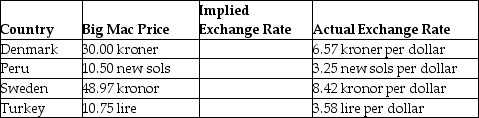 Source: "The Big Mac Index," Economist, July 13, 2017.
-Refer to Table 30-1. Fill in the missing values in the above table. Assume the Big Mac is selling for $5.30 in the United States. Explain whether the U.S. dollar is overvalued or undervalued relative to each of the other currencies and predict what will happen in the future to each exchange rate.
Source: "The Big Mac Index," Economist, July 13, 2017.
-Refer to Table 30-1. Fill in the missing values in the above table. Assume the Big Mac is selling for $5.30 in the United States. Explain whether the U.S. dollar is overvalued or undervalued relative to each of the other currencies and predict what will happen in the future to each exchange rate. (Essay)
4.7/5 (67)
(67) What explains the appreciation of the Japanese yen relative to the U.S. dollar from 1970 to the early 1990s?
(Multiple Choice)
4.8/5 (86)
(86) If two countries adhere to a gold standard, the exchange rate for their currencies is fixed.
(True/False)
4.8/5 (91)
(91) A persistent shortage of yen at a given fixed exchange rate (in dollars per yen) is evidence that the yen is ________ versus the dollar. This shortage can be reduced or eliminated through a ________ of the yen.
(Multiple Choice)
4.8/5 (74)
(74) South Korea, Indonesia, Malaysia, and Thailand all pegged their currencies to the dollar at one point in time. Because some of these currencies were overvalued at the pegged rate, speculators anticipated these countries would abandon the peg and speculators began selling those currencies. Explain how this speculation would affect the ability of a country to maintain a pegged exchange rate.
(Essay)
4.8/5 (60)
(60) If one U.S. dollar could be exchanged for one Australian dollar in 1970, and one U.S. dollar can now be exchanged for 0.98 Australian dollars, which of the following is true?
(Multiple Choice)
4.8/5 (98)
(98) What are the three main exchange rate systems, and how do they operate?
(Essay)
4.7/5 (86)
(86) If, at the current exchange rate between the dollar and the Norwegian kroner of 5.78 kroner per dollar, the dollar is "overvalued," how do you expect demand and supply in the foreign exchange markets to respond?
(Multiple Choice)
4.8/5 (83)
(83) A Big Mac costs $4.00 in the United States and 9.00 reals in Brazil. If the exchange rate is 2 reals per dollar, what is the dollar cost of a Big Mac in Brazil?
(Multiple Choice)
4.8/5 (84)
(84) Foreign portfolio investment in the United States has continually declined since 1995.
(True/False)
4.9/5 (76)
(76) The fact that the prices for McDonald's Big Mac sandwich are not the same around the world illustrates one reason why purchasing power does not hold: Many goods are not traded internationally.
(True/False)
4.8/5 (70)
(70) An increase in a fixed exchange rate from $2.00 per pound to $2.10 per pound is called a(n) ________ of the pound.
(Multiple Choice)
4.8/5 (77)
(77) Fluctuating exchange rates can alter a multinational firm's profits and losses. German company Bayer produces products in Germany and sells them in the United States. If the dollar depreciates against the euro, then Bayer's sales in the United States should ________ because it will take ________ U.S. dollars to purchase the German-made products.
(Multiple Choice)
4.9/5 (89)
(89) 
Filters
- Essay(0)
- Multiple Choice(0)
- Short Answer(0)
- True False(0)
- Matching(0)