



 Chat with AI
Exam 30: The International Financial System

Exam 1: Economics: Foundations and Models459 Questions
Exam 2: Trade-Offs, Comparative Advantage, and the Market System492 Questions
Exam 3: Where Prices Come From: the Interaction of Demand and Supply476 Questions
Exam 4: Economic Efficiency, Government Price Setting, and Taxes420 Questions
Exam 5: Externalities, Environmental Policy, and Public Goods262 Questions
Exam 6: Elasticity: the Responsiveness of Demand and Supply293 Questions
Exam 7: The Economics of Health Care337 Questions
Exam 8: Firms, the Stock Market, and Corporate Governance512 Questions
Exam 9: Comparative Advantage and the Gains From International Trade377 Questions
Exam 10: Consumer Choice and Behavioral Economics304 Questions
Exam 11: Technology, Production, and Costs326 Questions
Exam 12: Firms in Perfectly Competitive Markets296 Questions
Exam 13: Monopolistic Competition: the Competitive Model in a More Realistic Setting272 Questions
Exam 14: Oligopoly: Firms in Less Competitive Markets256 Questions
Exam 15: Monopoly and Antitrust Policy279 Questions
Exam 16: Pricing Strategy258 Questions
Exam 17: The Markets for Labor and Other Factors of Production279 Questions
Exam 18: Public Choice, Taxes, and the Distribution of Income258 Questions
Exam 19: Gdp: Measuring Total Production and Income260 Questions
Exam 20: Unemployment and Inflation290 Questions
Exam 21: Economic Growth, the Financial System, and Business Cycles251 Questions
Exam 22: Long-Run Economic Growth: Sources and Policies261 Questions
Exam 23: Aggregate Expenditure and Output in the Short Run305 Questions
Exam 24: Aggregate Demand and Aggregate Supply Analysis286 Questions
Exam 25: Money, Banks, and the Federal Reserve System278 Questions
Exam 26: Monetary Policy280 Questions
Exam 27: Fiscal Policy313 Questions
Exam 28: Inflation, Unemployment, and Federal Reserve Policy257 Questions
Exam 29: Macroeconomics in an Open Economy277 Questions
Exam 30: The International Financial System258 Questions
Select questions type


Article Summary
According to Gautam Kalani, currency strategist at Deutsche Bank, the Chinese yuan is the most overvalued currency in the world. Kalani based his rankings on three valuation metrics, including purchasing power parity. Emerging market currencies dominate the most overvalued list, while many emerging market currencies are undervalued as well. For developed markets, the Swiss franc is the most overvalued currency, running a close second to the Chinese yuan, and the Japanese yen ranks as the world's most undervalued currency. The U.S. dollar falls toward the middle of the spectrum, ranking as slightly overvalued.
-Refer to the Article Summary. If, as the article claims, the Japanese yen is the most undervalued currency in the world, how would you expect demand and supply in the foreign exchange markets to respond?
(Multiple Choice)
4.9/5  (79)
(79) If the U.S. government removes tariffs it had placed on imports from countries that have been accused of deliberately undervaluing their currencies, the price of these imports will ________ and the demand for the undervalued currency will ________.
(Multiple Choice)
4.7/5 (85)
(85) What do reports that the dollar is "undervalued" mean? How will foreign exchange markets respond to this information? Support your answer graphically.
(Essay)
4.8/5 (82)
(82) If the GDP deflator in the United States is 114, and the GDP deflator in Ukraine is 142, which of the following changes would the theory of purchasing power parity predict? (The Ukrainian currency is the hryvnia.)
(Multiple Choice)
4.8/5 (83)
(83) Exchange rates under the Bretton Woods system were determined by relative supplies of gold held by countries within the system.
(True/False)
4.8/5 (80)
(80) In 1991, Argentina decided to peg its currency (the Argentinean peso) to the U.S. dollar. To maintain the peg, Argentina had to purchase surplus pesos on the foreign exchange market, depleting its reserves of dollars to such an extent that it eventually had to abandon the peg. Show graphically what this implies about the peg relative to the equilibrium exchange rate in the market for the Argentinean peso.
(Essay)
4.9/5 (74)
(74) During the Chinese experience with pegging the yuan to the dollar, the yuan was undervalued. As a result
(Multiple Choice)
4.8/5 (80)
(80) If a firm in Thailand borrows dollars from a U.S. bank, its interest payments on the loan in bahts will decrease if the baht appreciates against the dollar.
(True/False)
4.9/5 (83)
(83) All of the following explain why purchasing power parity does not completely explain long-run fluctuations in exchange rates except
(Multiple Choice)
4.9/5 (80)
(80) What determined the exchange rates among currencies under the gold standard, and what caused the gold standard to collapse?
(Essay)
4.9/5 (76)
(76) Figure 30-10  -Refer to Figure 30-10. Under the Bretton Woods System of exchange rates, if the par exchange rate was $4 per pound in the figure above, then which of the following is true?
 (Multiple Choice)
4.9/5 (71)
(71) According to the theory of purchasing power parity, if the inflation rate in the United States is greater than the inflation rate in Canada, explain what should happen to the exchange rate between the U.S. dollar and the Canadian dollar.
(Essay)
4.9/5 (85)
(85) Figure 30-6 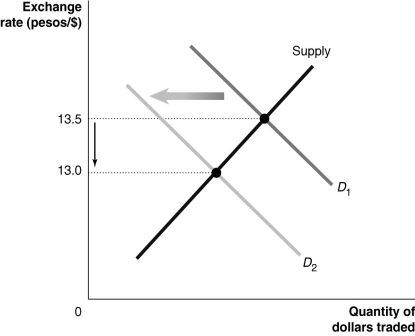 -Refer to Figure 30-6. Which of the following would cause the change depicted in the figure above?
 (Multiple Choice)
4.8/5 (76)
(76) China began pegging its currency, the yuan, to the dollar in 1994. Because the yuan was ________ at the pegged exchange rate, the Chinese government increased its reserves of ________ as the government purchased more ________ to maintain the pegged exchange rate.
(Multiple Choice)
4.9/5 (76)
(76) If, at the current exchange rate between the dollar and the South African rand of 6.92 rand per dollar, the rand is "undervalued," how do you expect demand and supply in the foreign exchange markets to respond?
(Multiple Choice)
4.8/5 (76)
(76) Expanding, contracting, and managing the money supply is easier for a central bank under the gold standard.
(True/False)
4.9/5 (73)
(73) The United States abandoned the Bretton Woods system of exchange rates in
(Multiple Choice)
4.7/5 (75)
(75) 
Filters
- Essay(0)
- Multiple Choice(0)
- Short Answer(0)
- True False(0)
- Matching(0)