



 Chat with AI
Exam 11: Ethers, Epoxides, and Sulfides

Exam 1: Covalent Bonding and Shapes of Molecules118 Questions
Exam 2: Alkanes and Cycloalkanes101 Questions
Exam 3: Stereoisomerism and Chirality95 Questions
Exam 4: Acids and Bases94 Questions
Exam 5: Alkenes: Bonding, Nomenclature, and Properties88 Questions
Exam 6: Reactions of Alkenes97 Questions
Exam 7: Alkynes100 Questions
Exam 8: Haloalkanes, Halogenation, and Radical Reactions75 Questions
Exam 9: Nucleophilic Substitution and Beta-Elimination104 Questions
Exam 10: Alcohols102 Questions
Exam 11: Ethers, Epoxides, and Sulfides102 Questions
Exam 12: Infrared Spectroscopy74 Questions
Exam 13: Nuclear Magnetic Resonance Spectroscopy99 Questions
Exam 14: Mass Spectrometry75 Questions
Exam 15: An Introduction to Organometallic Compounds73 Questions
Exam 16: Aldehydes and Ketones122 Questions
Exam 17: Carboxylic Acids76 Questions
Exam 18: Functional Derivatives of Carboxylic Acids117 Questions
Exam 19: Enolate Anions and Enamines96 Questions
Exam 20: Dienes, Conjugated Systems, and Pericyclic Reactions75 Questions
Exam 21: Benzene and the Concept of Aromaticity77 Questions
Exam 22: Reactions of Benzene and Its Derivatives109 Questions
Exam 23: Amines92 Questions
Exam 24: Catalytic Carbon-Carbon Bond Formation84 Questions
Exam 25: Carbohydrates69 Questions
Exam 26: Lipids65 Questions
Exam 27: Amino Acids and Proteins77 Questions
Exam 28: Nucleic Acids58 Questions
Exam 29: Organic Polymer Chemistry68 Questions
Select questions type


What is the major organic product obtained from the following reaction? 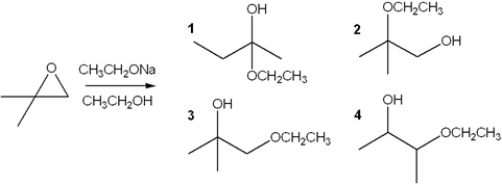
(Multiple Choice)
4.9/5  (85)
(85) What are the major products obtained upon treatment of anisole, PhOCH3, with excess HBr?
(Multiple Choice)
4.8/5 (76)
(76) What is the major organic product obtained from the following reaction? 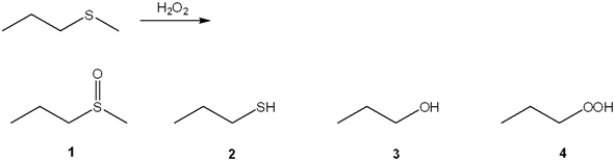
(Multiple Choice)
4.9/5 (77)
(77) What is the major organic product obtained from the following sequence of reactions? 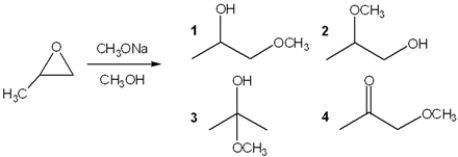
(Multiple Choice)
4.8/5 (71)
(71) What would be the best choice of reagent(s) to perform the following transformation? 
(Multiple Choice)
4.9/5 (84)
(84) What would be the best choice of reagent(s) to perform the following transformation? 
(Multiple Choice)
5.0/5 (71)
(71) The structure shown below can be named as either ethylene oxide or oxirane. 
(True/False)
4.8/5 (86)
(86) The first step in the following conversion should be the addition of (CH3)3SiCl, (CH3CH2)3N. 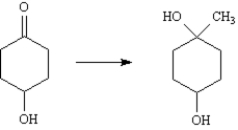
(True/False)
4.8/5 (83)
(83) Match the organic compounds in the with their boiling points.
-−24oC
(Multiple Choice)
4.9/5 (84)
(84) What is the major organic product obtained from the following reaction? 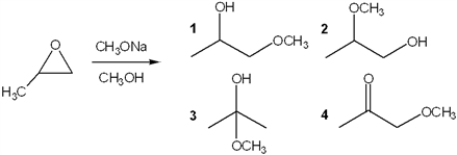
(Multiple Choice)
4.7/5 (79)
(79) Consider the cleavage of the following ether with H2O and H+. | |
Cleavage of the following ether will be a slower process.
|
(True/False)
4.9/5 (81)
(81) What is the major organic product obtained from the following reaction? 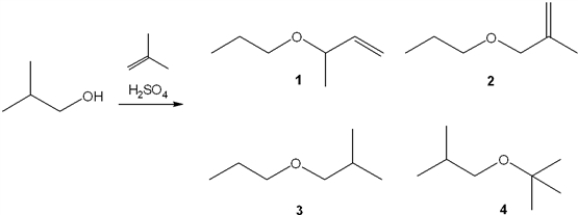
(Multiple Choice)
4.9/5 (68)
(68) What is the major organic product obtained from the following reaction? 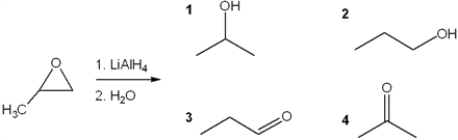
(Multiple Choice)
4.8/5 (89)
(89) A protecting group changes the reactivity of a functional group to one that is inert to reaction conditions without becoming a permanent part of the molecule.
(True/False)
4.9/5 (86)
(86) Match the organic compounds in the with their boiling points.
-71oC
(Multiple Choice)
4.8/5 (72)
(72) What is the best choice of reagent(s) to perform the following transformation? 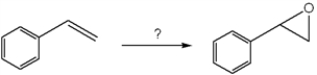
(Multiple Choice)
4.8/5 (87)
(87) What type of reactive intermediate is formed in the reaction of tert-butyl methyl ether with HBr to give tert-butyl bromide?
(Multiple Choice)
4.9/5 (74)
(74) The name of the alkene that reacts with methanol in an acid catalyzed reaction to produce t-butyl methyl ether is ________________.
(Short Answer)
5.0/5 (81)
(81) What is the major organic product obtained from the following reaction? 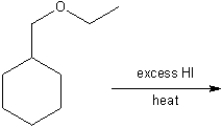
(Essay)
4.8/5 (88)
(88) What is the major organic product obtained from the following reaction? 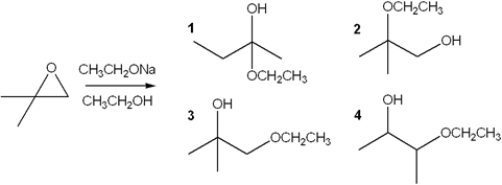
(Multiple Choice)
4.7/5 (85)
(85) 
Filters
- Essay(0)
- Multiple Choice(0)
- Short Answer(0)
- True False(0)
- Matching(0)