



 Chat with AI
Exam 11: Ethers, Epoxides, and Sulfides

Exam 1: Covalent Bonding and Shapes of Molecules118 Questions
Exam 2: Alkanes and Cycloalkanes101 Questions
Exam 3: Stereoisomerism and Chirality95 Questions
Exam 4: Acids and Bases94 Questions
Exam 5: Alkenes: Bonding, Nomenclature, and Properties88 Questions
Exam 6: Reactions of Alkenes97 Questions
Exam 7: Alkynes100 Questions
Exam 8: Haloalkanes, Halogenation, and Radical Reactions75 Questions
Exam 9: Nucleophilic Substitution and Beta-Elimination104 Questions
Exam 10: Alcohols102 Questions
Exam 11: Ethers, Epoxides, and Sulfides102 Questions
Exam 12: Infrared Spectroscopy74 Questions
Exam 13: Nuclear Magnetic Resonance Spectroscopy99 Questions
Exam 14: Mass Spectrometry75 Questions
Exam 15: An Introduction to Organometallic Compounds73 Questions
Exam 16: Aldehydes and Ketones122 Questions
Exam 17: Carboxylic Acids76 Questions
Exam 18: Functional Derivatives of Carboxylic Acids117 Questions
Exam 19: Enolate Anions and Enamines96 Questions
Exam 20: Dienes, Conjugated Systems, and Pericyclic Reactions75 Questions
Exam 21: Benzene and the Concept of Aromaticity77 Questions
Exam 22: Reactions of Benzene and Its Derivatives109 Questions
Exam 23: Amines92 Questions
Exam 24: Catalytic Carbon-Carbon Bond Formation84 Questions
Exam 25: Carbohydrates69 Questions
Exam 26: Lipids65 Questions
Exam 27: Amino Acids and Proteins77 Questions
Exam 28: Nucleic Acids58 Questions
Exam 29: Organic Polymer Chemistry68 Questions
Select questions type


What is the correct assignment of the names of the following ethers? 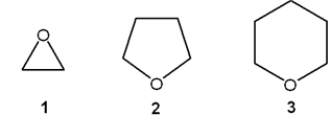
(Multiple Choice)
5.0/5  (92)
(92) What is the correct assignment of the names of the following ethers? 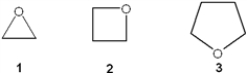
(Multiple Choice)
4.8/5 (65)
(65) What is the major organic product obtained from the following sequence of reactions? 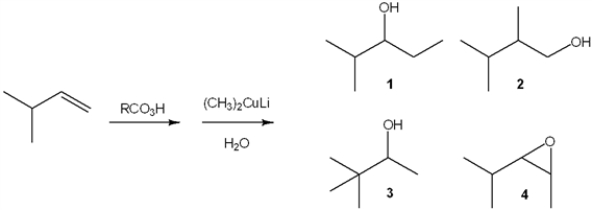
(Multiple Choice)
4.8/5 (87)
(87) The correct name for the following substance is cis-1,2-dimethyloxirane. 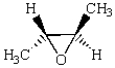
(True/False)
4.9/5 (61)
(61) An oxirane reacts with methylamine to give a product "A". Then, "A" reacts with an oxirane to give "B", which further reacts with SOCl2 to give a product "C". Identify product "C".
(Multiple Choice)
4.9/5 (79)
(79) The following reaction would result in the formation of a ____________group. | - |
(Short Answer)
4.8/5 (89)
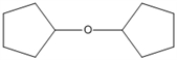
(89) 
What is the major organic product obtained from the following reaction? 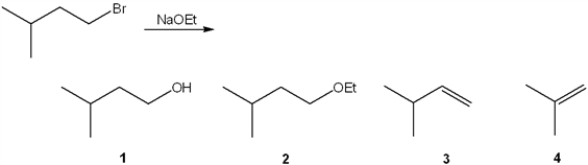
(Multiple Choice)
4.9/5 (71)
(71) What is the best choice of reagent(s) to perform the following transformation? 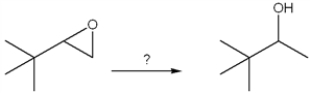
(Multiple Choice)
4.8/5 (79)
(79) What is the major organic product obtained from the following reaction? 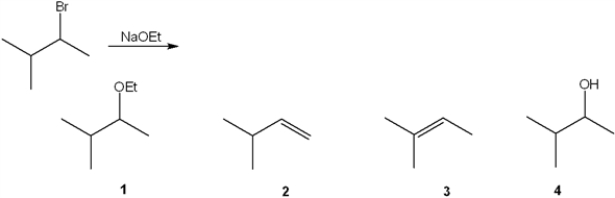
(Multiple Choice)
4.8/5 (76)
(76) The following reaction would be best accomplished by the addition of _______________. (Assume that CH3CO2H is also produced.) 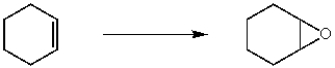
(Short Answer)
4.8/5 (84)
(84) Consider the reaction below to answer the following questions.  -The reaction shown here is an example of a ______________ ________synthesis
 (Short Answer)
4.7/5 (89)
(89) What is the best choice of reagent(s) to perform the following transformation? 
(Multiple Choice)
4.8/5 (82)
(82) Consider the following reaction.  The name of the aromatic product is __________________.
 (Short Answer)
4.8/5 (80)
(80) What is the major organic product obtained from the following reaction? 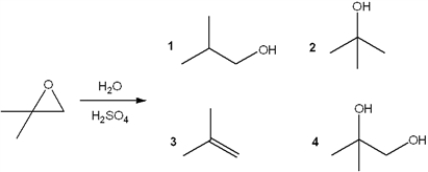
(Multiple Choice)
4.8/5 (88)
(88) 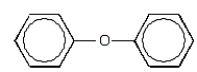
Consider the reaction below to answer the following questions.
-The reaction shown here proceeds by a(n) _______ mechanism.
-The reaction shown here proceeds by a(n) _______ mechanism. (Short Answer)
4.8/5 (81)
(81) 
What is the major organic product obtained from the following reaction? 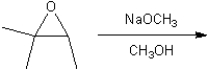
(Essay)
4.8/5 (91)
(91) What type of mechanism accounts for the cleavage of tert-butyl methyl ether upon treatment with HBr?
(Multiple Choice)
4.8/5 (83)
(83) 
Filters
- Essay(0)
- Multiple Choice(0)
- Short Answer(0)
- True False(0)
- Matching(0)