



 Chat with AI
Exam 14: Mass Spectrometry

Exam 1: Covalent Bonding and Shapes of Molecules118 Questions
Exam 2: Alkanes and Cycloalkanes101 Questions
Exam 3: Stereoisomerism and Chirality95 Questions
Exam 4: Acids and Bases94 Questions
Exam 5: Alkenes: Bonding, Nomenclature, and Properties88 Questions
Exam 6: Reactions of Alkenes97 Questions
Exam 7: Alkynes100 Questions
Exam 8: Haloalkanes, Halogenation, and Radical Reactions75 Questions
Exam 9: Nucleophilic Substitution and Beta-Elimination104 Questions
Exam 10: Alcohols102 Questions
Exam 11: Ethers, Epoxides, and Sulfides102 Questions
Exam 12: Infrared Spectroscopy74 Questions
Exam 13: Nuclear Magnetic Resonance Spectroscopy99 Questions
Exam 14: Mass Spectrometry75 Questions
Exam 15: An Introduction to Organometallic Compounds73 Questions
Exam 16: Aldehydes and Ketones122 Questions
Exam 17: Carboxylic Acids76 Questions
Exam 18: Functional Derivatives of Carboxylic Acids117 Questions
Exam 19: Enolate Anions and Enamines96 Questions
Exam 20: Dienes, Conjugated Systems, and Pericyclic Reactions75 Questions
Exam 21: Benzene and the Concept of Aromaticity77 Questions
Exam 22: Reactions of Benzene and Its Derivatives109 Questions
Exam 23: Amines92 Questions
Exam 24: Catalytic Carbon-Carbon Bond Formation84 Questions
Exam 25: Carbohydrates69 Questions
Exam 26: Lipids65 Questions
Exam 27: Amino Acids and Proteins77 Questions
Exam 28: Nucleic Acids58 Questions
Exam 29: Organic Polymer Chemistry68 Questions
Select questions type


Which of the following gives rise to a prominent peak in the mass spectrum with m/z of 91?
(Multiple Choice)
4.8/5  (74)
(74) Which of the following sets of molecular ions does an alkyl chloride possess?
(Multiple Choice)
4.9/5 (83)
(83) In mass spectrometry, which of the following phrases is shortened to the acronym "MALDI"?
(Multiple Choice)
4.8/5 (80)
(80) Which of the following is the definition of the base peak of a mass spectrum?
(Multiple Choice)
4.8/5 (70)
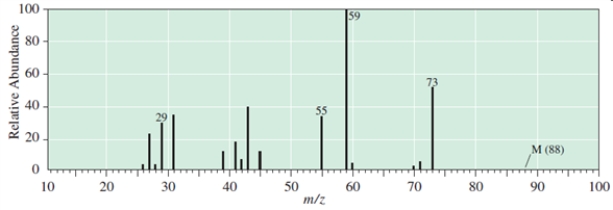
(70) 
Both mass spectrometry and infrared spectroscopy involve the interaction of molecules with electromagnetic energy.
(True/False)
5.0/5 (80)
(80) The mass spectrum of 1-pentanol shows an intense daughter ion peak at m/z = 31. This peak could be due to the formation of CH3O+.
(True/False)
4.8/5 (59)
(59) Which of the following is not prominent in the mass spectrum of 2-methyl-2-butanol?
(Multiple Choice)
4.9/5 (86)
(86) Which of the molecules gives rise to a molecular ion with an odd value of m/z?
(Multiple Choice)
5.0/5 (68)
(68) Which C6H12O carbonyl-containing compound shows a molecular ion peak at m/z 100 and significant fragment peaks at m/z 71, 58, 57, 43 and 29 in the EI mass spectrum?
(Short Answer)
4.9/5 (95)
(95) Refer to the mass spectrum of 2-methylbutane shown below to answer the following question(s).  Spectrum obtained from: SDBSWeb: http://www.aist.go.jp/RIODB/SDBS/
-The peak at a m/z of _____ represents the following species.
+CH2CH3
Spectrum obtained from: SDBSWeb: http://www.aist.go.jp/RIODB/SDBS/
-The peak at a m/z of _____ represents the following species.
+CH2CH3 (Short Answer)
5.0/5 (73)
(73) Refer to the mass spectrum of 2-methylbutane shown below to answer the following question(s). Spectrum obtained from: SDBSWeb: http://www.aist.go.jp/RIODB/SDBS/
-The peak at a m/z of _____ represents the following species.
Spectrum obtained from: SDBSWeb: http://www.aist.go.jp/RIODB/SDBS/
-The peak at a m/z of _____ represents the following species. (Short Answer)
4.9/5 (79)
(79) Cyclohexene and hex-2-yne both have the molecular formula, C6H10. The mass spectrum below belongs to ___________________. 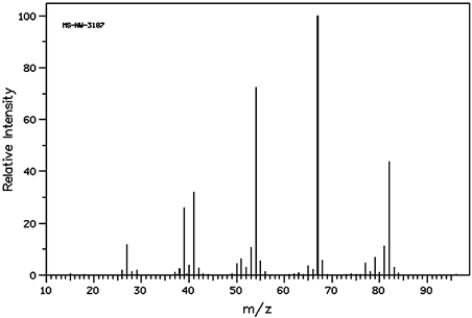
(Short Answer)
4.9/5 (75)
(75) Which of the following gives rise to a prominent M − 15 peak in the mass spectrum?
(Multiple Choice)
4.8/5 (92)
(92) 
Filters
- Essay(0)
- Multiple Choice(0)
- Short Answer(0)
- True False(0)
- Matching(0)