



 Chat with AI
Exam 25: Carbohydrates

Exam 1: Covalent Bonding and Shapes of Molecules118 Questions
Exam 2: Alkanes and Cycloalkanes101 Questions
Exam 3: Stereoisomerism and Chirality95 Questions
Exam 4: Acids and Bases94 Questions
Exam 5: Alkenes: Bonding, Nomenclature, and Properties88 Questions
Exam 6: Reactions of Alkenes97 Questions
Exam 7: Alkynes100 Questions
Exam 8: Haloalkanes, Halogenation, and Radical Reactions75 Questions
Exam 9: Nucleophilic Substitution and Beta-Elimination104 Questions
Exam 10: Alcohols102 Questions
Exam 11: Ethers, Epoxides, and Sulfides102 Questions
Exam 12: Infrared Spectroscopy74 Questions
Exam 13: Nuclear Magnetic Resonance Spectroscopy99 Questions
Exam 14: Mass Spectrometry75 Questions
Exam 15: An Introduction to Organometallic Compounds73 Questions
Exam 16: Aldehydes and Ketones122 Questions
Exam 17: Carboxylic Acids76 Questions
Exam 18: Functional Derivatives of Carboxylic Acids117 Questions
Exam 19: Enolate Anions and Enamines96 Questions
Exam 20: Dienes, Conjugated Systems, and Pericyclic Reactions75 Questions
Exam 21: Benzene and the Concept of Aromaticity77 Questions
Exam 22: Reactions of Benzene and Its Derivatives109 Questions
Exam 23: Amines92 Questions
Exam 24: Catalytic Carbon-Carbon Bond Formation84 Questions
Exam 25: Carbohydrates69 Questions
Exam 26: Lipids65 Questions
Exam 27: Amino Acids and Proteins77 Questions
Exam 28: Nucleic Acids58 Questions
Exam 29: Organic Polymer Chemistry68 Questions
Select questions type


Match the following compounds used to produce rayon and acetate rayon with the most appropriate roles.
-Treats materials containing cellulose
(Multiple Choice)
4.8/5  (84)
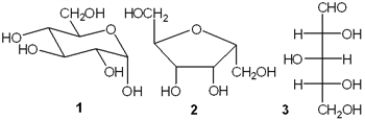
(84) 
What are the major organic products obtained from treatment of a methyl glycoside with periodic acid in water? 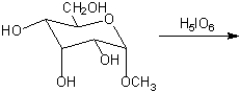
(Essay)
4.8/5 (75)
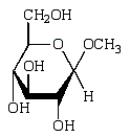
(75) 
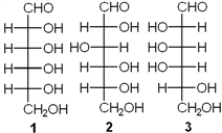
What are the R/S stereochemical designations of C2 and C3 of L-threose? 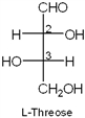
(Multiple Choice)
4.9/5 (86)
(86) What is the major organic product obtained from the following reaction? 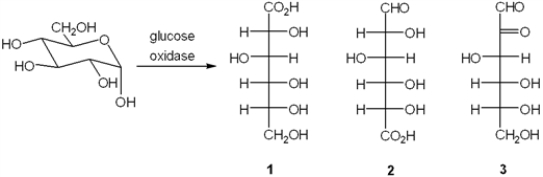
(Multiple Choice)
4.8/5 (78)
(78) Match the following compounds used to produce rayon and acetate rayon with the most appropriate roles.
-Forms acetate rayon on precipitation
(Multiple Choice)
4.9/5 (85)
(85) The fundamental difference between the monosaccharide, disaccharide, and polysaccharide classifications of carbohydrates is the number of _________________present.
(Short Answer)
4.8/5 (73)
(73) Starch, cellulose, and surcrose are all classified as polysaccharides.
(True/False)
4.8/5 (83)
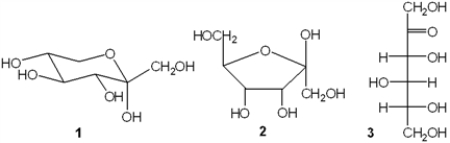
(83) 
The textile cellulose acetate is produced by treatment of cellulose with acetic anhydride. What type of functional group is introduced on the cellulose under these conditions? 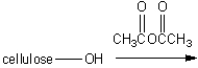
(Essay)
4.8/5 (81)
(81) What are the two major organic products obtained from treatment of an α-hydroxyketone with periodic acid in water? 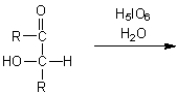
(Essay)
4.9/5 (88)
(88) Match the following compounds used to produce rayon and acetate rayon with the most appropriate roles.
-Hydrolyzes the xanthate ester group
(Multiple Choice)
5.0/5 (80)
(80) The number of hydroxyl groups in the pyranose form of glucose is _____.
(Short Answer)
4.9/5 (72)
(72) The following structure shows the correct assignment of the R or S configuration to each chirality center in sorbose. 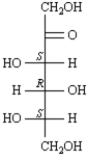
(True/False)
4.7/5 (81)
(81) What are the major organic products obtained from treatment of a 1,2,3-triol with periodic acid in water? 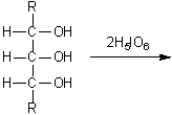
(Essay)
4.8/5 (81)
(81) What are the two major organic products obtained from the following reaction? What is the relationship between them? (What type of isomers are they?) 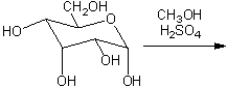
(Essay)
4.8/5 (88)
(88) _____ is the change in specific rotation that accompanies the interconversion of α and β anomers in an aqueous solution.
(Short Answer)
4.8/5 (78)
(78) 
Filters
- Essay(0)
- Multiple Choice(0)
- Short Answer(0)
- True False(0)
- Matching(0)