



 Chat with AI
Exam 25: Carbohydrates

Exam 1: Covalent Bonding and Shapes of Molecules118 Questions
Exam 2: Alkanes and Cycloalkanes101 Questions
Exam 3: Stereoisomerism and Chirality95 Questions
Exam 4: Acids and Bases94 Questions
Exam 5: Alkenes: Bonding, Nomenclature, and Properties88 Questions
Exam 6: Reactions of Alkenes97 Questions
Exam 7: Alkynes100 Questions
Exam 8: Haloalkanes, Halogenation, and Radical Reactions75 Questions
Exam 9: Nucleophilic Substitution and Beta-Elimination104 Questions
Exam 10: Alcohols102 Questions
Exam 11: Ethers, Epoxides, and Sulfides102 Questions
Exam 12: Infrared Spectroscopy74 Questions
Exam 13: Nuclear Magnetic Resonance Spectroscopy99 Questions
Exam 14: Mass Spectrometry75 Questions
Exam 15: An Introduction to Organometallic Compounds73 Questions
Exam 16: Aldehydes and Ketones122 Questions
Exam 17: Carboxylic Acids76 Questions
Exam 18: Functional Derivatives of Carboxylic Acids117 Questions
Exam 19: Enolate Anions and Enamines96 Questions
Exam 20: Dienes, Conjugated Systems, and Pericyclic Reactions75 Questions
Exam 21: Benzene and the Concept of Aromaticity77 Questions
Exam 22: Reactions of Benzene and Its Derivatives109 Questions
Exam 23: Amines92 Questions
Exam 24: Catalytic Carbon-Carbon Bond Formation84 Questions
Exam 25: Carbohydrates69 Questions
Exam 26: Lipids65 Questions
Exam 27: Amino Acids and Proteins77 Questions
Exam 28: Nucleic Acids58 Questions
Exam 29: Organic Polymer Chemistry68 Questions
Select questions type


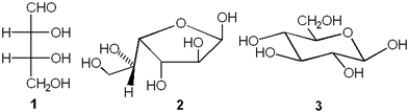

Consider the following Fisher projections. 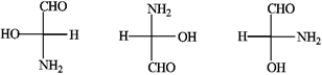 They all convert to the same tetrahedral representation as shown below..

They all convert to the same tetrahedral representation as shown below.. (True/False)
5.0/5  (89)
(89) Consider the following structures. 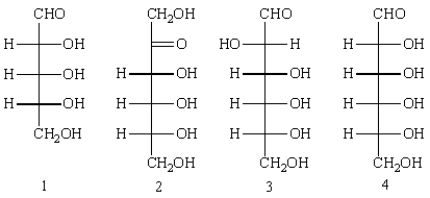 Answer the following questions by placing the appropriate number or indicated letter in the blank.
-Structure ____ represents a aldopentose.
Answer the following questions by placing the appropriate number or indicated letter in the blank.
-Structure ____ represents a aldopentose. (Short Answer)
5.0/5 (71)
(71) 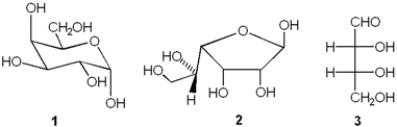
Which of the following structures represent the same carbohydrate? 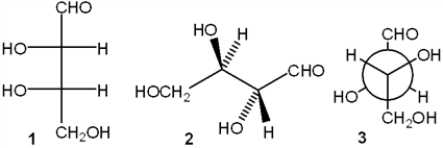
(Multiple Choice)
4.8/5 (82)
(82) The difference between the pyranose and furanose forms of a given aldohexose is the ring size.
(True/False)
4.9/5 (68)
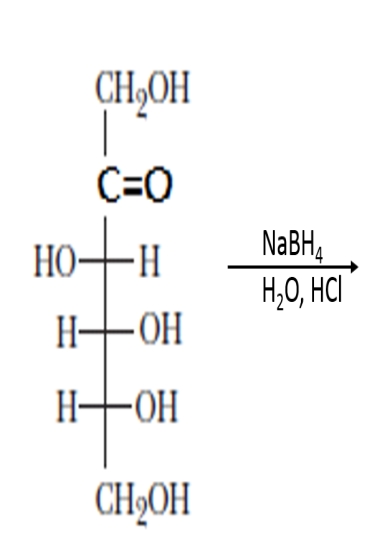
(68) 
Oxidation of optically active D-erythrose with nitric acid produces optically inactive meso-tartaric acid (below). 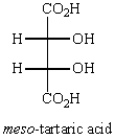 The structure of D-erythrose is shown below.
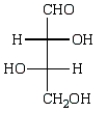
The structure of D-erythrose is shown below. (True/False)
4.8/5 (85)
(85) Consider the following structures. Answer the following questions by placing the appropriate number or indicated letter in the blank.
-Structure ____ represents a ketohexose.
Answer the following questions by placing the appropriate number or indicated letter in the blank.
-Structure ____ represents a ketohexose. (Short Answer)
5.0/5 (81)
(81) The number of the anomeric carbon in the following structure is _____. 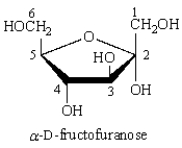
(Short Answer)
4.8/5 (85)
(85) 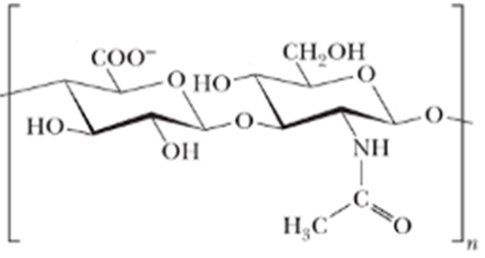
The textile rayon is produced by treatment of cellulose with carbon disulfide in aqueous sodium hydroxide. What type of functional group is introduced on the cellulose under these conditions? 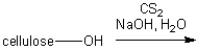
(Essay)
4.8/5 (73)
(73) 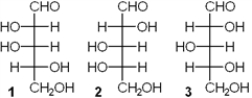
From the sugars below, choose the one that best fits each description below. Place the letter of the sugar in the blank to the left of the description. There is only one correct answer for each question.  -_____ is a sugar with three chirality centers.
 (Short Answer)
4.8/5 (82)
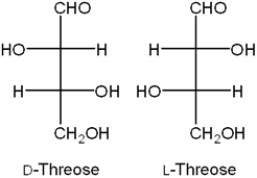
(82) 
The name of the following Fischer projection including stereochemistry is _____________________. 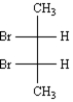
(Short Answer)
4.8/5 (87)
(87) A 1,4-α-linkage between two glucose units produces a disaccharide called maltose.
(True/False)
4.9/5 (78)
(78) There are only 2 trioses: the aldotriose 2,3-dihydroxypropanal and the ketotriose _____.
(Short Answer)
4.9/5 (91)
(91) 
Filters
- Essay(0)
- Multiple Choice(0)
- Short Answer(0)
- True False(0)
- Matching(0)