



 Chat with AI
Exam 8: Market Failure Versus Government Failure

Exam 1: Economics and Economic Reasoning121 Questions
Exam 2: The Production Possibility Model, Trade, and Globalization111 Questions
Exam 3: Economic Institutions144 Questions
Exam 4: Supply and Demand151 Questions
Exam 5: Using Supply and Demand136 Questions
Exam 6: Describing Supply and Demand: Elasticities176 Questions
Exam 7: Taxation and Government Intervention169 Questions
Exam 8: Market Failure Versus Government Failure160 Questions
Exam 9: Comparative Advantage, Exchange Rates, and Globalization107 Questions
Exam 10: International Trade Policy82 Questions
Exam 11: Production and Cost Analysis I160 Questions
Exam 12: Production and Cost Analysis II129 Questions
Exam 13: Perfect Competition137 Questions
Exam 14: Monopoly and Monopolistic Competition231 Questions
Exam 15: Oligopoly and Antitrust Policy111 Questions
Exam 16: Real-World Competition and Technology86 Questions
Exam 17: Work and the Labor Market130 Questions
Exam 18: Who Gets What the Distribution of Income100 Questions
Exam 19: The Logic of Individual Choice: the Foundation of Supply and Demand134 Questions
Exam 20: Game Theory, Strategic Decision Making, and Behavioral Economics76 Questions
Exam 21: Thinking Like a Modern Economist67 Questions
Exam 22: Behavioral Economics and Modern Economic Policy87 Questions
Exam 23: Microeconomic Policy, Economic Reasoning, and Beyond111 Questions
Select questions type


At one time many economists were suspicious of brand names. They saw them as a barrier to entry with no benefits to consumers. In the 1970s economists began to see a possible benefit of brand names to consumers. They discovered that brand names were a way to:
(Multiple Choice)
4.9/5  (84)
(84) Refer to the graph shown. The price and quantity that would prevail if all social costs and benefits were taken into account is: 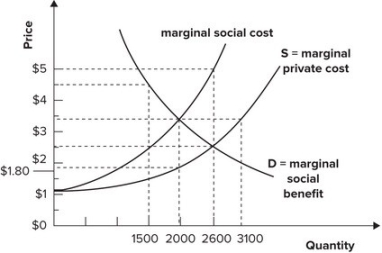
(Multiple Choice)
4.7/5 (90)
(90) The rule for making optimal decisions is that an activity should be increased until:
(Multiple Choice)
4.8/5 (94)
(94) This table shows the marginal benefits from widgets obtained by the only three people who value them. 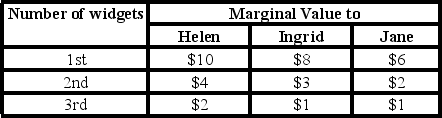 Suppose widgets cost $8.50 to produce. If widgets are a public good, how many will be produced by market incentives, and is that the right (efficient) number?
 (Multiple Choice)
4.7/5 (76)
(76) The optimal quantity of pollution control occurs at the point where the:
(Multiple Choice)
4.8/5 (81)
(81) If buyers cannot distinguish between "lemons" and "cherries" in the used car market but sellers can, the price buyers are willing to pay for used cars will be:
(Multiple Choice)
4.9/5 (73)
(73) If government action is likely to do some good, it is always best for government to intervene in the marketplace.
(True/False)
5.0/5 (78)
(78) Economists are most likely to suggest that societies address the inefficiencies created by negative externalities by:
(Multiple Choice)
4.8/5 (78)
(78) In economics, the term "signaling" refers to a way of lessening the problem of:
(Multiple Choice)
4.9/5 (88)
(88) If once vaccinated, a person cannot catch a cold or give a cold to someone else, the marginal social benefit resulting from consumption of the vaccine:
(Multiple Choice)
4.9/5 (81)
(81) The following table shows four firms, the amount each pollutes, the marginal cost for each firm to clean up pollution, and the total cost to each firm of eliminating all pollution. Firm Total Discharge (in tons) Marginal Cost of Cleanup (per ton) Total Cost of Cleanup A 60 \ 5.00 \ 300 B 70 \ 8.00 \ 560 C 80 \ 7.50 \ 600 D 90 \ 4.00 \ 360
The total discharge of these four companies is 300 tons. Assume there is no one else who pollutes. If the government establishes an effluent fee of $7.00 per ton, how much tax would firms pay to the government?
(Multiple Choice)
4.8/5 (75)
(75) Government attempts to offset market failures can prevent the market from dealing with a problem more effectively.
(True/False)
4.9/5 (85)
(85) The Environment Ministry in Japan proposed a new carbon tax to meet Japan's obligations to reduce carbon dioxide emissions under the Kyoto Treaty. The tax would be levied on producers and importers of fossil fuels, and the expectation is that it would be largely passed on to consumers. The rationale for this tax is that it will:
(Multiple Choice)
4.8/5 (82)
(82) Opponents of government intervention in the economy argue that government's attempts to correct informational problems:
(Multiple Choice)
4.8/5 (73)
(73) The following table shows four firms, the amount each pollutes, the marginal cost for each firm to clean up pollution, and the total cost to each firm of eliminating all pollution. Firm Total Discharge (in tons) Marginal Cost of Cleanup (per ton) Total Cost of Cleanup A 60 \ 5.00 \ 300 B 70 \ 8.00 \ 560 C 80 \ 7.50 \ 600 D 90 \ 4.00 \ 360
The total discharge of these four companies is 300 tons. Assume there is no one else who pollutes. If the government establishes a regulation requiring each company to reduce pollution by 50 percent, what will be spent on reducing pollution?
(Multiple Choice)
4.9/5 (69)
(69) All of the following are justifications for government intervention except:
(Multiple Choice)
4.8/5 (94)
(94) 
Filters
- Essay(0)
- Multiple Choice(0)
- Short Answer(0)
- True False(0)
- Matching(0)