



 Chat with AI
Exam 8: Market Failure Versus Government Failure

Exam 1: Economics and Economic Reasoning121 Questions
Exam 2: The Production Possibility Model, Trade, and Globalization111 Questions
Exam 3: Economic Institutions144 Questions
Exam 4: Supply and Demand151 Questions
Exam 5: Using Supply and Demand136 Questions
Exam 6: Describing Supply and Demand: Elasticities176 Questions
Exam 7: Taxation and Government Intervention169 Questions
Exam 8: Market Failure Versus Government Failure160 Questions
Exam 9: Comparative Advantage, Exchange Rates, and Globalization107 Questions
Exam 10: International Trade Policy82 Questions
Exam 11: Production and Cost Analysis I160 Questions
Exam 12: Production and Cost Analysis II129 Questions
Exam 13: Perfect Competition137 Questions
Exam 14: Monopoly and Monopolistic Competition231 Questions
Exam 15: Oligopoly and Antitrust Policy111 Questions
Exam 16: Real-World Competition and Technology86 Questions
Exam 17: Work and the Labor Market130 Questions
Exam 18: Who Gets What the Distribution of Income100 Questions
Exam 19: The Logic of Individual Choice: the Foundation of Supply and Demand134 Questions
Exam 20: Game Theory, Strategic Decision Making, and Behavioral Economics76 Questions
Exam 21: Thinking Like a Modern Economist67 Questions
Exam 22: Behavioral Economics and Modern Economic Policy87 Questions
Exam 23: Microeconomic Policy, Economic Reasoning, and Beyond111 Questions
Select questions type


This table shows the marginal benefits from widgets obtained by the only three people who value them. 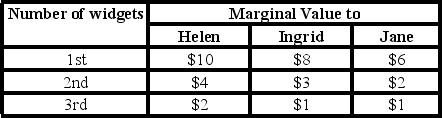 Suppose widgets cost $8.50 to produce. If widgets are a private good, how many will be produced by market incentives, and is that the right (efficient) number?
 (Multiple Choice)
4.8/5  (79)
(79) Refer to the graph shown. There is a negative externality associated with the production of the good depicted. The socially efficient level of output is: 
(Multiple Choice)
4.8/5 (73)
(73) If a consumer is willing to pay $5,000 for a used car that is a free of mechanical problems and $1,000 for a used car that will require extensive repairs, the consumer will offer:
(Multiple Choice)
4.9/5 (76)
(76) Under the Texas law known as "rule of capture," land owners "get to pump as much of the water under it as they want. . .. 'This means whoever sucks it out first, it's their water'-even if that means there isn't enough left for others." Under this law, pumping large amounts of water:
(Multiple Choice)
4.9/5 (74)
(74) The Environment Ministry in Japan proposed a new carbon tax to meet Japan's obligations to reduce carbon dioxide emissions under the Kyoto Treaty. The tax would be levied on producers and importers of fossil fuels and raise the cost of using fossil fuels. How do most economists view a tax such as this?
(Multiple Choice)
4.7/5 (86)
(86) Some economists believe that the market will not solve all problems. They are referring to:
(Multiple Choice)
4.9/5 (93)
(93) Carbon dioxide emissions are thought to contribute to global warming, and there is a concern that changes in climate will be costly. Emitting carbon dioxide is an example of:
(Multiple Choice)
4.9/5 (87)
(87) The following table shows four firms, the amount each pollutes, the marginal cost for each firm to clean up pollution, and the total cost to each firm of eliminating all pollution. Firm Total Discharge (in tons) Marginal Cost of Cleanup (per ton) Total Cost of Cleanup A 60 \ 5.00 \ 300 B 70 \ 8.00 \ 560 C 80 \ 7.50 \ 600 D 90 \ 4.00 \ 360
The total discharge of these four companies is 300 tons. Assume there is no one else who pollutes. Suppose that the government gives each company a pollution permit equal to 50 percent of its present discharge. However, companies are allowed to reduce pollution more than 50 percent and sell their permit or reduce less than 50 percent and buy a permit from another company. If firms maximize profits, what would happen?
(Multiple Choice)
4.8/5 (89)
(89) In the Flint Hills area of Kansas, proposals to build wind turbines to generate electricity have pitted environmentalist against environmentalist. Members of the Kansas Sierra Club support the turbines as a way to reduce use of fossil fuel, but local chapters of the Nature Conservancy say they will befoul the landscape. An argument that supports the Sierra Club position is that that wind turbines:
(Multiple Choice)
4.9/5 (88)
(88) A life insurance company is likely to require a health examination of a person applying for insurance. This helps reduce the informational problem through the process of:
(Multiple Choice)
5.0/5 (87)
(87) The basis of the argument favoring government intervention to correct informational and rationality problems is that:
(Multiple Choice)
4.9/5 (89)
(89) If a corrective tax on gasoline results in the efficient output of gasoline by internalizing negative externalities associated with pollution:
(Multiple Choice)
4.8/5 (82)
(82) Suppose that government wants a policy that will encourage people to use less oil. For this policy to be efficient, it must:
(Multiple Choice)
4.8/5 (82)
(82) Do economists tend to favor a system in which power plants buy and sell the right to pollute in the form of emission credits?
(Multiple Choice)
4.9/5 (74)
(74) The reason the Federal Trade Commission regulates advertising to prevent false and misleading claims is:
(Multiple Choice)
4.8/5 (94)
(94) Alex is playing his music at full volume in his dorm room. The other people living on his floor are enjoying his music, but Alex does not know or care. Alex's music playing is an example of a:
(Multiple Choice)
5.0/5 (91)
(91) Government may not have an incentive to correct a market failure because:
(Multiple Choice)
4.9/5 (77)
(77) The unwillingness of individuals to share in the cost of a public good is called the:
(Multiple Choice)
4.8/5 (91)
(91) Economists' attitude toward voluntary programs causes them to:
(Multiple Choice)
4.9/5 (81)
(81) Suppose Mary finds it easier to conserve than Jim does. The difference between a tax incentive program and a marketable certificate plan in this case is that:
(Multiple Choice)
4.9/5 (79)
(79) 
Filters
- Essay(0)
- Multiple Choice(0)
- Short Answer(0)
- True False(0)
- Matching(0)