



 Chat with AI
Exam 10: International Trade Policy

Exam 1: Economics and Economic Reasoning121 Questions
Exam 2: The Production Possibility Model, Trade, and Globalization111 Questions
Exam 3: Economic Institutions144 Questions
Exam 4: Supply and Demand151 Questions
Exam 5: Using Supply and Demand136 Questions
Exam 6: Describing Supply and Demand: Elasticities176 Questions
Exam 7: Taxation and Government Intervention169 Questions
Exam 8: Market Failure Versus Government Failure160 Questions
Exam 9: Comparative Advantage, Exchange Rates, and Globalization107 Questions
Exam 10: International Trade Policy82 Questions
Exam 11: Production and Cost Analysis I160 Questions
Exam 12: Production and Cost Analysis II129 Questions
Exam 13: Perfect Competition137 Questions
Exam 14: Monopoly and Monopolistic Competition231 Questions
Exam 15: Oligopoly and Antitrust Policy111 Questions
Exam 16: Real-World Competition and Technology86 Questions
Exam 17: Work and the Labor Market130 Questions
Exam 18: Who Gets What the Distribution of Income100 Questions
Exam 19: The Logic of Individual Choice: the Foundation of Supply and Demand134 Questions
Exam 20: Game Theory, Strategic Decision Making, and Behavioral Economics76 Questions
Exam 21: Thinking Like a Modern Economist67 Questions
Exam 22: Behavioral Economics and Modern Economic Policy87 Questions
Exam 23: Microeconomic Policy, Economic Reasoning, and Beyond111 Questions
Select questions type


Tariffs are taxes that governments place on internationally traded goods.
(True/False)
5.0/5  (75)
(75) Which of the following is not a regulatory trade restriction?
(Multiple Choice)
5.0/5 (78)
(78) Cuba is known for its tobacco products. Which of the following results would we expect to see from a U.S. sanction on Cuba?
(Multiple Choice)
4.8/5 (89)
(89) Quotas on imported automobiles cost jobs in the U.S. automobile industry but lower auto prices for domestic consumers.
(True/False)
4.8/5 (72)
(72) Most economists believe that the infant industry argument for protection, though theoretically justified, often keeps firms from becoming more competitive.
(True/False)
4.8/5 (74)
(74) A 50 percent tax on imports of Danish cheese is an example of:
(Multiple Choice)
5.0/5 (73)
(73) Germany's environmental policies restrict the sale of nonrefillable bottles and cans. This policy reduces the imports of these products. A foreign country that argues that this policy is really intended to protect German beverage makers from competition is arguing that the policy is an example of:
(Multiple Choice)
4.7/5 (81)
(81) The benefits of free trade tend to be highly concentrated whereas the costs are widely scattered.
(True/False)
4.9/5 (91)
(91) The United States has a trade deficit when the value of the goods and services we import exceeds the value of the goods and services we export.
(True/False)
4.9/5 (83)
(83) Which of the following groups would be most likely to benefit from a tariff on Japanese-manufactured light trucks (i.e., pickup trucks)?
(Multiple Choice)
4.9/5 (87)
(87) Refer to the graph shown for a small country that is a price taker internationally. 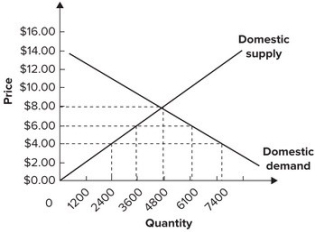 Assume the foreign supply of this product is perfectly elastic at a price of $4 per unit. Starting from a free trade equilibrium, an import quota of 2,500 would cause domestic production to:
 (Multiple Choice)
4.9/5 (64)
(64) The WTO authorized several countries to impose about $150 million in trade sanctions against the United States in retaliation for a U.S. import law that the WTO ruled to be illegal. The organization that issued this ruling against the United States is known as the:
(Multiple Choice)
4.8/5 (74)
(74) Refer to the graph shown for a small country that is a price taker internationally. 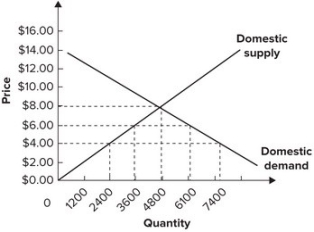 Assume the foreign supply of this product is perfectly elastic at a price of $4 per unit. If government imposes a tariff in the amount of $2 per unit, it will collect revenue in the amount of:
 (Multiple Choice)
4.8/5 (79)
(79) The limit that United States places on textile imports is an example of:
(Multiple Choice)
4.8/5 (85)
(85) 
Filters
- Essay(0)
- Multiple Choice(0)
- Short Answer(0)
- True False(0)
- Matching(0)