



 Chat with AI
Exam 10: International Trade Policy

Exam 1: Economics and Economic Reasoning121 Questions
Exam 2: The Production Possibility Model, Trade, and Globalization111 Questions
Exam 3: Economic Institutions144 Questions
Exam 4: Supply and Demand151 Questions
Exam 5: Using Supply and Demand136 Questions
Exam 6: Describing Supply and Demand: Elasticities176 Questions
Exam 7: Taxation and Government Intervention169 Questions
Exam 8: Market Failure Versus Government Failure160 Questions
Exam 9: Comparative Advantage, Exchange Rates, and Globalization107 Questions
Exam 10: International Trade Policy82 Questions
Exam 11: Production and Cost Analysis I160 Questions
Exam 12: Production and Cost Analysis II129 Questions
Exam 13: Perfect Competition137 Questions
Exam 14: Monopoly and Monopolistic Competition231 Questions
Exam 15: Oligopoly and Antitrust Policy111 Questions
Exam 16: Real-World Competition and Technology86 Questions
Exam 17: Work and the Labor Market130 Questions
Exam 18: Who Gets What the Distribution of Income100 Questions
Exam 19: The Logic of Individual Choice: the Foundation of Supply and Demand134 Questions
Exam 20: Game Theory, Strategic Decision Making, and Behavioral Economics76 Questions
Exam 21: Thinking Like a Modern Economist67 Questions
Exam 22: Behavioral Economics and Modern Economic Policy87 Questions
Exam 23: Microeconomic Policy, Economic Reasoning, and Beyond111 Questions
Select questions type


When the United States imposed restrictions on imported steel in the 1950s and 1960s, the U.S. steel industry responded by:
(Multiple Choice)
4.9/5  (76)
(76) Refer to the graph shown for a small country that is a price taker internationally. 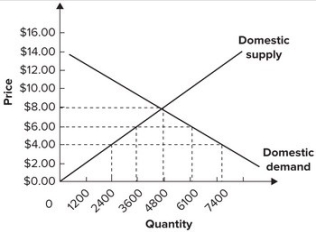 Assume the foreign supply of this product is perfectly elastic at a price of $4 per unit. Starting from a free trade equilibrium, a tariff in the amount of $2 per unit would be expected to cause domestic production to:
 (Multiple Choice)
4.9/5 (74)
(74) Transshipments, which are used commonly in international trade, tend to:
(Multiple Choice)
4.7/5 (76)
(76) After one cow in Alberta, Canada was found with mad cow disease, the United States banned all imports of Canadian cattle and beef. This action is an example of:
(Multiple Choice)
4.9/5 (71)
(71) The United States does not allow U.S. citizens to trade with Iraq. This is an example of:
(Multiple Choice)
4.8/5 (80)
(80) If the United States were to impose 100 percent tariffs on imports of Chinese shrimp, what would most economists conclude?
(Multiple Choice)
4.9/5 (82)
(82) The percentage of goods and services the United States has imported from China and India over the last 15 years:
(Multiple Choice)
4.9/5 (84)
(84) Refer to the graph shown. 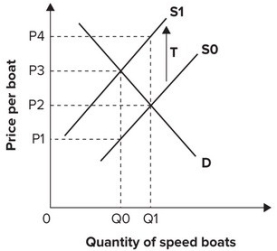 As a result of a tariff T imposed on speedboats, the price that foreign suppliers will receive probably will be:
 (Multiple Choice)
4.9/5 (84)
(84) Free trade associations can potentially be harmful to international trade.
(True/False)
5.0/5 (89)
(89) In strategic trade bargaining it is sometimes reasonable to be unreasonable.
(True/False)
4.9/5 (82)
(82) The type of goods being imported has changed from primarily low-tech goods to agricultural goods.
(True/False)
4.7/5 (78)
(78) A group of countries that allows free trade among its members and puts up common barriers against all other countries' goods is called:
(Multiple Choice)
4.8/5 (84)
(84) Countries restrict international trade for all of the following reasons except:
(Multiple Choice)
4.8/5 (86)
(86) Refer to the graph shown. 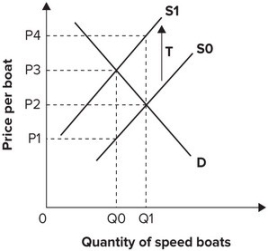 As a result of a tariff T imposed on speedboats, the price domestic consumers pay for speedboats probably will likely be:
 (Multiple Choice)
4.8/5 (78)
(78) The outsourcing of service jobs such as those in call centers has become a political issue. Do economists see any benefit to outsourcing?
(Multiple Choice)
4.9/5 (83)
(83) 
Filters
- Essay(0)
- Multiple Choice(0)
- Short Answer(0)
- True False(0)
- Matching(0)