



 Chat with AI
Exam 13: Perfect Competition

Exam 1: Economics and Economic Reasoning121 Questions
Exam 2: The Production Possibility Model, Trade, and Globalization111 Questions
Exam 3: Economic Institutions144 Questions
Exam 4: Supply and Demand151 Questions
Exam 5: Using Supply and Demand136 Questions
Exam 6: Describing Supply and Demand: Elasticities176 Questions
Exam 7: Taxation and Government Intervention169 Questions
Exam 8: Market Failure Versus Government Failure160 Questions
Exam 9: Comparative Advantage, Exchange Rates, and Globalization107 Questions
Exam 10: International Trade Policy82 Questions
Exam 11: Production and Cost Analysis I160 Questions
Exam 12: Production and Cost Analysis II129 Questions
Exam 13: Perfect Competition137 Questions
Exam 14: Monopoly and Monopolistic Competition231 Questions
Exam 15: Oligopoly and Antitrust Policy111 Questions
Exam 16: Real-World Competition and Technology86 Questions
Exam 17: Work and the Labor Market130 Questions
Exam 18: Who Gets What the Distribution of Income100 Questions
Exam 19: The Logic of Individual Choice: the Foundation of Supply and Demand134 Questions
Exam 20: Game Theory, Strategic Decision Making, and Behavioral Economics76 Questions
Exam 21: Thinking Like a Modern Economist67 Questions
Exam 22: Behavioral Economics and Modern Economic Policy87 Questions
Exam 23: Microeconomic Policy, Economic Reasoning, and Beyond111 Questions
Select questions type


A perfectly competitive firm facing a price of $10 decides to produce 100 units. If its marginal cost of producing the last unit is $12 and it is seeking to maximize profit, the firm should:
(Multiple Choice)
4.8/5  (85)
(85) Suppose the minimum possible price of constructing homes is $50 per square foot. As a result of a sharp drop in the demand for home construction, the equilibrium price of home construction falls to $40 per square foot. Assuming the home construction industry is perfectly competitive and there are no specialized inputs, firms will:
(Multiple Choice)
4.9/5 (91)
(91) Refer to the graph shown. If the firm increases output from 50 to 60, total revenue will increase: 
(Multiple Choice)
4.9/5 (78)
(78) In the wake of the 2008 recession, the electronics retailer Circuit City closed its stores. If we assume this was a short-run decision, the most likely explanation for it is that the price of a typical product sold at Circuit City stores was:
(Multiple Choice)
4.9/5 (84)
(84) Suppose a perfectly competitive firm can increase its profits by reducing its output. Then it must be the case that the firm's:
(Multiple Choice)
5.0/5 (82)
(82) Refer to the graph shown. If the market price is P4, the maximum profit the firm can earn is: 
(Multiple Choice)
4.8/5 (70)
(70) Which of the following is a requirement for a perfectly competitive market?
(Multiple Choice)
4.8/5 (78)
(78) For a perfectly competitive firm, the profit-maximizing output level occurs where marginal cost equals price.
(True/False)
5.0/5 (92)
(92) Because only competitive firms are price takers, only competitive firms have supply curves.
(True/False)
4.8/5 (78)
(78) As long as marginal cost is below marginal revenue, a perfectly competitive firm should:
(Multiple Choice)
4.7/5 (83)
(83) Refer to the graph shown. If market price is currently $7.00 per unit, this perfectly competitive firm will maximize profit by producing: 
(Multiple Choice)
4.8/5 (79)
(79) Refer to the graph shown, which depicts a perfectly competitive firm. If the price of the product is $3: 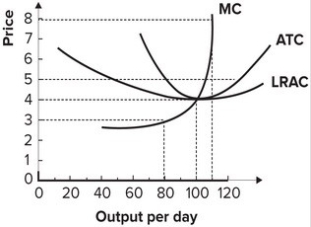
(Multiple Choice)
4.9/5 (77)
(77) In a perfectly competitive long-run constant-cost industry, an increase in market demand causes:
(Multiple Choice)
4.8/5 (85)
(85) Suppose that the firms in the perfectly competitive oat industry are currently receiving a price of $2 per bushel for their product and there are constant returns to scale. The minimum possible average total cost of producing oats in the long run is $1 per bushel. Other things being equal, it follows that:
(Multiple Choice)
4.8/5 (68)
(68) The long-run industry supply curve will be upward-sloping if:
(Multiple Choice)
4.9/5 (86)
(86) Refer to the graph shown. What area represents total economic profits? 
(Multiple Choice)
4.7/5 (67)
(67) If the long-run market supply curve is perfectly elastic, an increase in demand will cause the final equilibrium to be at:
(Multiple Choice)
4.7/5 (84)
(84) 
Filters
- Essay(0)
- Multiple Choice(0)
- Short Answer(0)
- True False(0)
- Matching(0)