



 Chat with AI
Exam 13: Perfect Competition

Exam 1: Economics and Economic Reasoning121 Questions
Exam 2: The Production Possibility Model, Trade, and Globalization111 Questions
Exam 3: Economic Institutions144 Questions
Exam 4: Supply and Demand151 Questions
Exam 5: Using Supply and Demand136 Questions
Exam 6: Describing Supply and Demand: Elasticities176 Questions
Exam 7: Taxation and Government Intervention169 Questions
Exam 8: Market Failure Versus Government Failure160 Questions
Exam 9: Comparative Advantage, Exchange Rates, and Globalization107 Questions
Exam 10: International Trade Policy82 Questions
Exam 11: Production and Cost Analysis I160 Questions
Exam 12: Production and Cost Analysis II129 Questions
Exam 13: Perfect Competition137 Questions
Exam 14: Monopoly and Monopolistic Competition231 Questions
Exam 15: Oligopoly and Antitrust Policy111 Questions
Exam 16: Real-World Competition and Technology86 Questions
Exam 17: Work and the Labor Market130 Questions
Exam 18: Who Gets What the Distribution of Income100 Questions
Exam 19: The Logic of Individual Choice: the Foundation of Supply and Demand134 Questions
Exam 20: Game Theory, Strategic Decision Making, and Behavioral Economics76 Questions
Exam 21: Thinking Like a Modern Economist67 Questions
Exam 22: Behavioral Economics and Modern Economic Policy87 Questions
Exam 23: Microeconomic Policy, Economic Reasoning, and Beyond111 Questions
Select questions type


The market demand curve for a product produced in a perfectly competitive industry is normally:
(Multiple Choice)
4.9/5  (86)
(86) Refer to the graph shown. What distance represents average profits? 
(Multiple Choice)
5.0/5 (77)
(77) Refer to the table shown. If the market price is $6, a perfectly competitive profit-maximizing firm will produce: Quantity Marginal Cast 1 \ 3 2 5 3 7 4 9
(Multiple Choice)
4.8/5 (94)
(94) Refer to the table shown. If the market price is $8, a perfectly competitive profit-maximizing firm will produce: Quantity Marginal Cast 1 \ 3 2 5 3 7 4 9
(Multiple Choice)
4.9/5 (68)
(68) Refer to the graph shown. What price represents the shutdown price? 
(Multiple Choice)
4.9/5 (79)
(79) To maximize profits, a perfectly competitive firm should do all the following except:
(Multiple Choice)
4.8/5 (77)
(77) A perfectly competitive firm facing a price of $50 decides to produce 500 widgets. Its marginal cost of producing the last widget is $50. If the firm's goal is maximize profit, it should:
(Multiple Choice)
4.8/5 (65)
(65) Suppose the dry cleaning industry is initially in long-run equilibrium but then experiences a sharp increase in the price of its inputs. Assuming that the industry is perfectly competitive, the increase in costs should:
(Multiple Choice)
4.8/5 (72)
(72) In a perfectly competitive market, many firms produce many different varieties of the same product.
(True/False)
4.9/5 (82)
(82) Suppose that the current equilibrium price of silver is $20 per ounce. If silver is produced under conditions of perfect competition and the industry is in long-run equilibrium, the average total cost of producing silver:
(Multiple Choice)
4.8/5 (82)
(82) The existence of positive economic profits in an industry attracts new entrants into the industry.
(True/False)
4.7/5 (71)
(71) In the short run when the number of firms in the market is fixed, the market supply curve is just the horizontal sum of all the firms' marginal cost curves.
(True/False)
4.8/5 (84)
(84) Assume that the home construction industry is perfectly competitive and is in long-run competitive equilibrium. It follows that:
(Multiple Choice)
5.0/5 (84)
(84) Assume that the t-shirt industry is perfectly competitive. If the industry is in long-run equilibrium when the market price of t-shirts is $10:
(Multiple Choice)
4.7/5 (75)
(75) In a perfectly competitive market, market prices are determined by:
(Multiple Choice)
4.8/5 (76)
(76) Refer to the graph shown. Currently, if this perfectly competitive firm is maximizing profit, the market price is: 
(Multiple Choice)
4.8/5 (80)
(80) If the long-run market supply curve is perfectly elastic, a fall in demand will cause the final equilibrium to be at:
(Multiple Choice)
4.9/5 (70)
(70) Refer to the graph shown. Assuming that the industry operates under conditions of perfect competition: 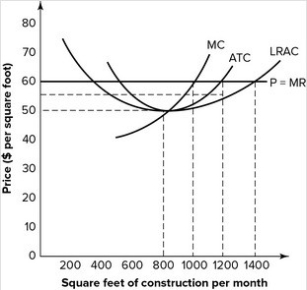
(Multiple Choice)
4.7/5 (76)
(76) An assumption of a competitive market is that both buyers and sellers are price takers. When we go to the mall to shop for clothing or to the grocery to buy food, what do we usually observe?
(Multiple Choice)
4.8/5 (88)
(88) 
Filters
- Essay(0)
- Multiple Choice(0)
- Short Answer(0)
- True False(0)
- Matching(0)