



 Chat with AI
Exam 8: Market Failure Versus Government Failure

Exam 1: Economics and Economic Reasoning37 Questions
Exam 2: The Production Possibility Model, Trade and Globalization22 Questions
Exam 3: Economic Institutions19 Questions
Exam 4: Supply and Demand31 Questions
Exam 5: Using Supply and Demand27 Questions
Exam 6: Describing Supply and Demand: Elasticities40 Questions
Exam 7: Taxation and Government Intervention32 Questions
Exam 8: Market Failure Versus Government Failure38 Questions
Exam 9: International Trade Policy, Comparative Advantage, and Outsourcing13 Questions
Exam 10: International Trade Policy24 Questions
Exam 11: Production and Cost Analysis I34 Questions
Exam 12: Production and Cost Analysis II23 Questions
Exam 13: Perfect Competition35 Questions
Exam 14: Monopoly47 Questions
Exam 15: Monopolistic Competition and Oligopoly33 Questions
Exam 16: Real-World Competition and Technology22 Questions
Exam 17: Work and the Labor Market38 Questions
Exam 18: Who Gets What the Distribution of Income34 Questions
Exam 19: The Logic of Individual Choice: the Foundation of Supply and Demand36 Questions
Exam 20: Game Theory, Strategic Decision Making, and Behavioral Economics27 Questions
Exam 21: Thinking Like a Modern Economist30 Questions
Exam 22: Behavioral Economic Policy39 Questions
Exam 23: Microeconomic Policy, Economic Reasoning, and Beyond23 Questions
Select questions type


What are the arguments for and against government intervention to deal with externalities?
(Essay)
4.8/5  (88)
(88) What are the arguments for and against government intervention to deal with information problems?
(Essay)
4.9/5 (84)
(84) The following table shows the marginal private cost (MPC) and the marginal social cost (MSC) of a chemical factory.
Tons af Chenicals MPC MSC 1 100 120 2 110 130 3 120 140 4 130 150 5 140 160 Answer the following questions:
(1) What is the marginal cost of the factory's externality? Is it constant at all quantities?
(2) If the factory is a perfectly competitive firm and is not required by the government to internalize its external cost, how many tons should the factory produce, given that the market price of a ton of chemicals is $130?
(3) If the factory is a perfectly competitive firm and is required by the government to internalize its external cost, how many tons should the factory produce, given that the market price of a ton of chemicals is $130?
(4) Draw a graph illustrating your answers.
(Essay)
4.7/5 (80)
(80) Why can imperfect information lead to market failure? Explain the adverse selection problem and give an example. How could markets for information resolve this problem?
(Essay)
4.7/5 (82)
(82) Demonstrate graphically and explain verbally the impact of a negative externality on a supply and demand market outcome.
(Essay)
4.8/5 (72)
(72) What is the difference between screening and signaling? How are they similar?
(Essay)
4.9/5 (88)
(88) Explain what a public good is and give an example. What problems are associated with determining what is a public good and how much of a public good should be provided?
(Essay)
4.9/5 (66)
(66) What problems are associated with determining how much of a public good should be provided?
(Essay)
4.8/5 (74)
(74) Demonstrate graphically and explain verbally the impact of a positive externality on a supply and demand market outcome.
(Essay)
4.9/5 (87)
(87) Information problems may be a problem of the lack of a market. Explain.
(Essay)
4.9/5 (96)
(96) The diagram below illustrates a negative externality. S is the marginal private cost and S1 is the marginal social cost. 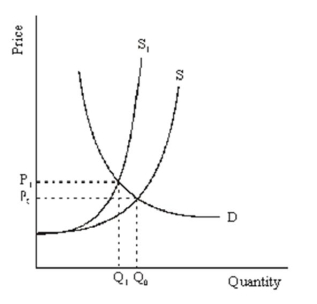 Referencing this diagram, describe how a government can use direct regulation to eliminate the problem caused by the negative externality. What is a potential problem with this approach?
 (Essay)
4.8/5 (76)
(76) Wearing a light long-sleeved sweater adds about 2 degrees of warmth to the wearer and allows such individuals to keep their homes at 2 degrees lower temperature. Such sweaters cost approximately $20, or three for $60. The 2-degree decrease in heat can save $200 a year in heating bills.
(a) Assuming that the government is committed to saving electricity, should it require people to wear such sweaters and keep their homes 2 degrees cooler?
(b) What are two alternatives to this regulation?
(c) If it is cheaper to keep warm with sweaters than with furnaces, why don't people voluntarily wear more sweaters?
(Essay)
4.7/5 (81)
(81) What is the difference between a negative and a positive externality? Give an example of each.
(Essay)
4.8/5 (84)
(84) What are the three alternative methods of dealing with externalities? Briefly explain each one.
(Essay)
4.9/5 (84)
(84) 
Filters
- Essay(0)
- Multiple Choice(0)
- Short Answer(0)
- True False(0)
- Matching(0)