



 Chat with AI
Exam 8: Market Failure Versus Government Failure


Big Construction Company wants to create a new housing development near Big City. Animal rights activists are adamantly opposed to the housing development since the proposed site would destroy the natural habitat of a rare spotted duck family. How would an economist analyze this situation and what would he suggest to rectify it? Illustrate your answer with a supply and demand diagram. What would be the most difficult part of implementing your plan?

 (65)
 Verified
An economist would point out that an externality exists: there is no market for the habitat of the spotted ducks. This externality means that the social costs of building the new houses exceed the costs figured into Big Construction Company's business plan. To rectify this situation, an economist would suggest devising a business plan that incorporates the price of destroying the spotted duck's habitat into Big Construction Company's development costs. The diagram: 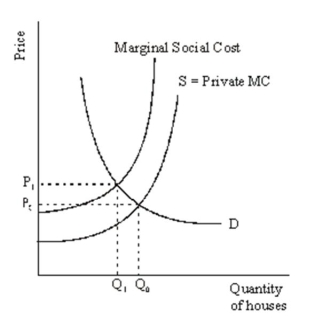 In the diagram it is clear that incorporating a price of destroying the duck's habitat results in higher costs and so reduces the number of houses (from Q0 to Q1) that it is profitable for Big Construction Company to build, and raises the cost of houses to those who buy them (from P0 to P1).
The most difficult part of implementing the plan is likely to be the determination of the appropriate cost to society for destroying the duck's habitat. Big Construction Company will argue that the destruction of the habitat has a low price while the animal rights group will argue that it has a high price.
The city of Spillsville is worried that its municipal landfill is going to fill up. As a result, the city's sanitation engineer has proposed two solutions:
Solution 1: Require each household to reduce its garbage disposal by 100 pounds per month.
Solution 2: Impose a tax of $.05 per pound of garbage that will overall result in the same decline in garbage disposal as Solution 1.
Which of the two solutions would an economist prefer to have implemented? Explain.
(73) VerifiedAn economist would prefer the second solution because it is a market incentive program whereas the first solution is a direct regulation program. Economists prefer market solutions because they lead to the most efficient ways to conserve resources (where efficient refers to achieving an outcome with the lowest cost possible in total resource use without consideration as to who pays those costs). Note that in Solution 2, those who conserve the most will pay the least amount of the tax. They are likely to be the ones who will find it least costly to conserve.
Should all professionals be licensed? Or only some? Discuss the argument for licensing and for the information alternative for one of these professions: 1. medical doctors, 2. college professors, 3. lawyers, 4. auto mechanics, 5. beauticians. Then choose one other profession, and briefly indicate how (if at all) the weight of the arguments would change.
(73) Verified(This response uses the example of medical doctors. The argument for licensing has the same elements in all cases, but the relative weight is different.)
Licensure: Pro
The purpose of licensing medical doctors is to insure that persons in this profession have appropriate training and skills. Consumers of medical services are not in a very good position to evaluate the training or competency of doctors. Persons not trained in a profession do not have the basis for a sound judgment of the professional training of those who are professionals. This is a classic information problem. Licensure can address this problem by determining the minimum qualifications for medical competence, and mandating these requirements as a condition for practice. Unless persons meet this minimum, they do not qualify for licenses. With licensure, persons who otherwise would have no basis to judge competency will now have a simple one: Does my doctor have a license to practice medicine?
Licensure: Con
There are at least three questions to be considered with respect to medical licensure. 1. If the training mandated by the licensing authorities is really better (produces doctors who are able to get better results) than that of those persons who would not qualify for a license, why won't the market for medical services select in favor of the better training? People don't have to be car experts to buy cars, because companies who make bad cars go out of business. Is the license really any sort of guarantee of quality? 2. Who do these licensure restrictions really benefit, the consumers or the licensed doctors? Isn't licensing really a device to limit entry and therefore competition, and allow high prices to continue? 3. In the long run, isn't the effect of licensure to drive up the price and deny any care to those who can't afford the high price of licensed doctors, and are prevented from obtaining care from anyone else (at least legally)?
If the purpose of licensing is to provide information, is it really effective? Why not just make the information itself available? Require doctors to provide certain sorts of information to patients-information such as: college grades, medical school grades, success rates for various procedures, references, medical philosophy, and fees. Then let people decide.
What is the adverse selection problem? Give an example in the market for used cars or health insurance.
(96) Three methods of dealing with externalities are direct regulation, incentive policies, and voluntary restrictions. Explain and evaluate each of these options.
(78) One of the solutions to pollution that economists advocate more often than non-economists is a marketable certificate program. Explain how such a program would work, and why economists tend to favor such an approach.
(81) Explain what a public good is and give an example. What problems are associated with determining how much of a public good should be provided?
(90) Demonstrate graphically and explain verbally how constructing the market demand for a public good is different than constructing the market demand for a private good.
(92) The diagram below illustrates a positive externality. D is the marginal private benefit and D1 is the marginal social benefit. 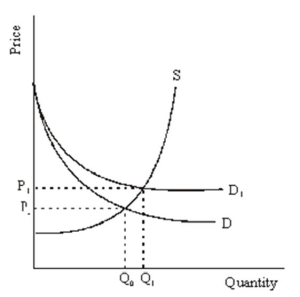 Referencing this diagram describe how a government can use direct regulation to eliminate the problem caused by the positive externality. What is a potential problem with this approach?
 (72) What is Pareto optimality? What are the three criticisms of using perfect competition as a benchmark to evaluate the society's goals?
(82) The following table shows the quantity demanded of a public good at different price levels by John and Elizabeth. Price \ Quantity Demanded John Elizabeth 0 100 100 0.5 90 80 1 80 60 1.5 70 40 2 60 20 2.5 50 0 3 40 0 3.5 30 0 4 20 0 4.5 10 0 5 0 0 Answer the following questions:
(1) Draw the demand curve for both John and Elizabeth.
(2) Draw the market demand for this public good.
(3) If the marginal cost of providing one unit of the good is $3 per unit, what is the socially optimal amount of the public good (show this on the same graph)?
(4) In this case, how much will each individual be willing to pay?
(79) Give the definition of "externality" and indicate why externalities can result in a failure to achieve equality between social marginal cost and social marginal benefit. Demonstrate your answer graphically with a negative externality.
(80) What is an optimal policy? If a policy is not optimal, what does it imply in terms of utilization of resources?
(78) A government failure occurs when the government intervention in the market that was intended to correct a market failure actually makes the situation worse. Such a failure could occur for one or more of the following reasons:
(75) Problems that involve an externality (such as pollution) may be addressed by a number of alternative means. The most obvious is direct regulation, in which the use of some resource is directly limited by government. For example, pollution might be prohibited or limited to some fixed amount by direct regulation. Economists generally prefer some alternative solution to direct regulation, because regulation will not generally get persons to act so as to equate marginal social costs and marginal social benefits. Suppose it has been decided to implement a social policy to reduce electricity consumption by 10%, because the production of electricity results in pollution and consumes valuable resources.
(a) Give an example of how this goal could be achieved by direct regulation. What effect on incentives will the direct regulation you propose have? Will it equate the marginal benefits and marginal costs of electricity consumption? Why or why not?
(b) Now suggest two alternative methods to achieve the goal of 10% reduction in electricity consumption. What effect will these alternatives have on incentives? Will they result in the marginal benefits and marginal costs of electricity consumption being made equal?
(83) Explain why incentive programs are more efficient than direct regulation as a means of eliminating the problems of externalities.
(92) Describe how voluntary restrictions can be used to address externalities. What problem tends to arise with this method?
(72) 
Filters
- Essay(0)
- Multiple Choice(0)
- Short Answer(0)
- True False(0)
- Matching(0)