



 Chat with AI
Exam 12: Production and Cost Analysis II


Suppose you can produce 50 gourmet pizzas using either one worker and one oven or two workers and one oven. Which input combination is technically efficient?

 (80)
 Verified
Technical efficiency refers to producing a given amount of output with the fewest inputs, thus producing 50 pizzas with one worker and one oven is the technically efficient input combination.
In this problem you will demonstrate your understanding of the relationship between short-run and long run average cost curves.
(a) Draw an example of a long-run average cost curve. Find the minimum point of the long run average cost curve and label that point "A" for reference. What is the slope of the LRATC curve to the left of point A? Why does it have this slope? What is the slope of the LRATC curve to the right of point A? Why does it have this slope?
(b) Choose a point to the left of point A on the LRATC curve, and label it point B for reference. Choose a point to the right of point A on the LRATC curve. Label it point C for reference. Draw the SRATC curve associated with point A and label it SRATCa. Is point A the minimum point of SRATCa? Why does SRATCa have the slope that it does at points to the left and right of point A?
(c) Draw SRATC curves associated with points B and C and label them SRATCb and SRATCc. Are points B and C minimum points for SRATCb and SRATCc? Explain.
(68) VerifiedSee the graph below.
(a) Points to the left of A (the minimum point) on the LRATC curve will be on the downward sloping portion of the curve. To the left of point A, LRATC slopes downward because of economies of scale. Points to the right of point A are on the upward sloping portion of the LRATC curve. To the right of A, LRATC slopes upward because of diseconomies of scale.
(b) Point A is the minimum point for SRATCa. To the left of point A, SRATCa will be downward sloping. The downward slope of that portion of SRATC is a result of declining average fixed cost (AFC) and increasing returns to a variable factor (both of which cause SRATC to fall). The upward sloping portion of the curve (to the right of point A) is upward sloping because of diminishing returns to a variable factor.
(c) SRATCb and SRATCc are not tangent to LRATC at their minimum points. Why? In the short run, at least one input is fixed and its costs are part of average fixed costs. In the long run all costs are variable and all inputs can be changed, allowing for a more efficient (lower cost) combination of inputs. 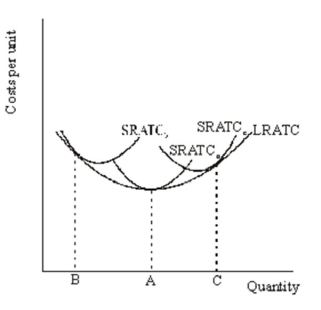
What is an indivisible setup cost? Give an example.
(76) VerifiedAn indivisible setup cost is the cost of an indivisible input for which a certain minimum amount of production must be undertaken before the input becomes economically profitable to use. Examples include: purchasing a riding lawn mower before you can open a lawn care service; purchasing a Macintosh and a laser printer before you can open a desktop publishing business.
Demonstrate graphically and explain verbally the concept of minimum efficient level of production.
(77) As an employee of the Grelb Corporation (a manufacturer of gas powered generators) you have been asked to determine the nature of their long-run cost structure. Some cost data has been collected for you and appears in the table below. Quantity of generators Total costs of labor Total costs of tools Total Costs Average Total Costs 11 \ 192 \ 127 12 200 136 13 206 145 14 210 150 15 220 155 16 240 160 17 255 170 18 280 188 19 320 212 20 365 235 (a) Fill in the missing values in the table.
(b) Determine the range of output levels over which there exists economies and diseconomies of scale.
(c) Graph the firm's average total cost curve and
(d) Describe how your answer to part (b) above relates to the shape of this curve.
(79) How does the envelope relationship relate short run average cost and long run average cost?
(76) The Edge Corporation manufactures gas powered water pumps. Each pump can be produced in two hours using either of two production processes: with one worker and 10 tools or with 2 workers and 6 tools. Each worker earns $12.00 per hour and each tool has an implicit rental rate of $1.50 per hour. Could both combinations of inputs be technically efficient? What is the economically efficient input combination? Explain.
(86) Are diminishing marginal productivity and diseconomies of scale the same thing? Explain why or why not.
(73) Why is it that a technically efficient method of producing may not be an economically efficient method of production?
(68) The SRATC and LRATC curves are both typically U-shaped for different reasons. Explain why.
(94) Consider the following Long Run Average Total Cost (LRATC) curve diagram:  How will this diagram change (if at all) if the firm's workers "learn by doing"? Illustrate your answer with a diagram.
 (87) What is an entrepreneur and what are the things that the entrepreneur must do to translate the cost of production into supply? Why is there a scarcity of entrepreneurial talent?
(88) In the simple microeconomic models, the only dimension over which variation takes place is level of output (TC, AC, and MC curves, for example, relate these costs to the level of output only). Are there other important dimensions over which entrepreneurs may chose in the real world? Give some examples of other dimensions over which important choices may be made.
(70) What cost considerations other than "how much to produce" do real world firms face? Give some examples.
(91) If all production relationships were technical relationships, there wouldn't be diminishing marginal productivity. Evaluate this statement.
(79) What are economies of scale? How do economies and diseconomies of scale influence the shape of the long run cost curves? How do economies of scale relate to indivisible setup costs? What are diseconomies of scale and how do they arise?
(73) Demonstrate graphically the effects of returns to scale on the Long Run Average Total Cost (LRATC) curve and explain verbally the concepts of economies of scale, constant return to scale, and diseconomies of scale.
(73) What concept is important in determining the shape of short run cost curves (marginal cost, average cost) but plays no role in determining the shape of long-run cost curves? What are the most important factors in determining the shape of the long-run cost curves? Explain.
(89) 
Filters
- Essay(0)
- Multiple Choice(0)
- Short Answer(0)
- True False(0)
- Matching(0)