



 Chat with AI
Exam 7: Taxation and Government Intervention


What are the three costs of taxation? What is the deadweight loss of taxation? What causes deadweight loss?

 (86)
 Verified
The costs of taxation to society include the direct cost to taxpayers of the revenue they pay to government. It also includes the loss of consumer and producer surplus caused by the tax. Finally, it includes the cost of administering the tax codes. A tax raises the equilibrium price and reduces the equilibrium quantity. The higher price to consumer reduces the consumer surplus by more than the amount transferred to government. The lower price received by producers reduces producer surplus by more than the amount of revenue transferred to the government. The excess is called the deadweight loss. It arises because a misallocation of resources was caused by a deviation from supply/demand equilibrium.
Demonstrate graphically and explain verbally how a price floor may be viewed as essentially a tax and subsidy scheme.
(67) VerifiedThe key to the story is that a price floor will create a dead weight loss just as a tax does. Furthermore, the price floor involves a transfer of consumer surplus to producer surplus that is essentially a tax on consumers and a subsidy for producers. All of this is illustrated in the diagram below: 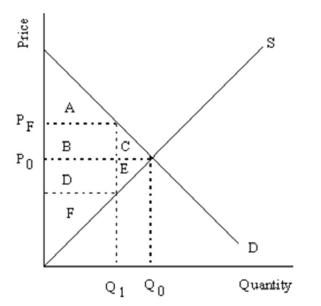 The market outcome is P0 and Q0 with consumer surplus of A + B + C and producer surplus of D + E + F. When a price floor of PF is imposed the new quantity exchanged is Q1 (< Q0). This results in a consumer surplus of A; a producer surplus of B + D + F; and a dead weight loss of C + E. Area B is a transfer of consumer to producer surplus that is effectively a tax on consumers and a subsidy to producers.
Demonstrate graphically and explain verbally the cost to consumers of a tax of t per carton imposed on the sellers of cigarettes. Where does the lost producer surplus go?
(82) VerifiedImposing a tax will result in an upward shift of the supply curve, a decrease in supply (S0 to S1 in the diagram). The cost to the consumers is a loss of consumer surplus of areas B + C. (Before tax consumer surplus is A + B + C whereas after tax consumer surplus is A.) The area B goes to the government. Area C is a deadweight loss. 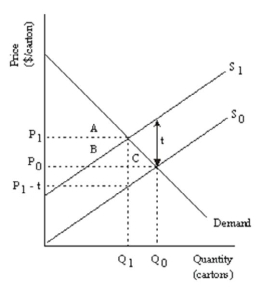
Demonstrate graphically and explain verbally the concept of producer surplus.
(83) Explain why the person who physically pays the tax is not necessarily the person who bears the tax. Who is most likely to bear the greater proportion of the tax burden? How does this apply to Social Security taxes?
(69) Demonstrate graphically and explain verbally why the equilibrium values of price and quantity in a supply and demand model lead to the maximum combination of consumer and producer surplus.
(74) Demonstrate graphically and explain verbally how the size of a surplus created by a price floor is related to the elasticity of the supply and demand curves.
(88) When the Federal government reinstated a 10% excise tax on airline tickets, the industry wanted to pass on the full 10% ticket tax but was only able to boost fares by 4%.
(a) What can you conclude regarding the elasticity of demand for airline tickets?
(b) If you know that elasticity of demand is 2 and the elasticity of supply is 1, who bears the larger burden of the tax?
(c) Show the incidence of the tax graphically.
(67) Demonstrate graphically and explain verbally the cost to producers of a tax of t per carton imposed on the sellers of cigarettes. Where does the lost producer surplus go?
(76) Demonstrate graphically and explain verbally that the buyers bear the entire burden of a tax when demand is perfectly inelastic.
(84) Suppose the price elasticity of demand is 1.5 and the price elasticity of supply is 0.5, what is the percentage of a tax borne by the consumer, and what is the percentage of the same tax borne by the producer?
(76) What is the deadweight loss of taxation? What causes deadweight loss?
(82) Suppose the current equilibrium price of a good is $10, the elasticity of demand is 0, and the elasticity of supply is 2. If the government levies a $1 tax on the supplier, calculate the new equilibrium price and the percentage of the tax borne by both the demander and the supplier of the good.
(64) Demonstrate graphically and explain verbally that the welfare loss of a tax on suppliers will be smaller the less elastic is demand.
(65) Demonstrate graphically and explain verbally how a price ceiling may be viewed as essentially a tax and subsidy scheme.
(91) Suppose you are a seller of an item that is about to have a tax imposed upon it. Would you rather have the demand for your product be elastic or inelastic? Explain verbally and demonstrate graphically.
(78) Demonstrate graphically and explain verbally the concept of consumer surplus.
(78) Compute the dollar amount of the welfare loss from the imposition of the tax t in the diagram below. 
(70) 
Filters
- Essay(0)
- Multiple Choice(0)
- Short Answer(0)
- True False(0)
- Matching(0)