



 Chat with AI
Exam 6: Describing Supply and Demand: Elasticities


What will happen to total revenue of a firm if it raises its price and its demand is elastic (or inelastic)?

 (90)
 Verified
If demand is elastic, the percentage change in quantity demanded is greater than the percentage change in price. Thus with a price increase, the quantity demanded drops by a greater percentage than price rises, so total revenue (price times quantity) goes down.
If demand is inelastic, this means the percentage change in quantity demanded is less than the percentage change in price. Thus with a price decrease, the quantity demanded increases by a smaller percentage than price drops, so total revenue (price times quantity) goes down.
How can the income elasticity of demand be used to determine whether a good is a normal good or an inferior good?
(72) VerifiedThe income elasticity of demand is the percentage change in demand divided by the percentage change in income. Thus, if the income elasticity of demand is greater than zero, the good is a normal good-demand and income change in the same direction. If the income elasticity of demand is negative, the good is an inferior good-demand and income change in opposite directions.
Consider the following demand curve for Starbucks coffee. 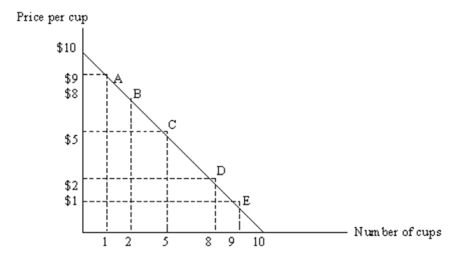 (a) Suppose the current price is $8 per cup. Using elasticity of demand, explain why Starbucks should not increase the price in order to increase total revenue.
(b) Suppose the current price is $2 per cup. Using elasticity of demand, explain why Starbucks should not lower the price in order to increase total revenue.
(a) Suppose the current price is $8 per cup. Using elasticity of demand, explain why Starbucks should not increase the price in order to increase total revenue.
(b) Suppose the current price is $2 per cup. Using elasticity of demand, explain why Starbucks should not lower the price in order to increase total revenue. (82) Verified(a) At this range on the demand curve, demand is elastic. Demand elasticity between points A and B is (1/1.5)/(1/8.5) = 5.67. If demand is elastic, Starbucks must lower the price in order to increase total revenue. Note that total revenue at $8 a cup is $16. If price increases to $9 a cup, total revenue decreases to only $9.
(b) At this range on the demand curve, demand is inelastic. Demand elasticity between points D and E is (1/8.5)/(1/1.5) = 0.17. If demand is inelastic, Starbucks must increase the price in order to increase total revenue. Note that total revenue at $2 a cup is $16. If price decreases to $1 a cup, total revenue decreases to only $9.
What is the difference between elastic and inelastic demand and supply?
(82) Demonstrate graphically and explain verbally a perfectly inelastic demand curve.
(83) Are the elasticities of demand and supply the same as the slopes of demand and supply curves? Explain.
(100) Under which of the following two scenarios would demand for hot dogs be more elastic? Explain.
(a) You are at a baseball game at Wrigley Field and want to eat a hot dog.
(b) It's Tuesday, you are planning the menu for a picnic you are going to have on Saturday and you decide to serve hot dogs.
(85) What is the income elasticity of demand? How can it be used to determine whether a good is a normal good or an inferior good? What is the cross-price elasticity of demand? How can it be used to determine whether two goods are substitutes or complements?
(77) Suppose you own two Domino's Pizza franchises in your town. After reading the latest issue of Pizza Monthly, you have concluded that both of your locations are generating below average revenue. You hire a local economics professor to conduct a pricing experiment. Here is her report:
Location 1: A 10% increase in price resulted in a 5% drop in the quantity demanded.
Location 2: A 10% increase in the price resulted in a 20% drop in the quantity demanded.
Using this information, how should you alter your pricing policy to increase your revenue at each location?
(78) Define the price elasticity of demand and the price elasticity of supply. What is the difference between elastic and inelastic demand?
(87) What is the key factor in determining how elastic or inelastic a demand curve will be? Explain.
(82) Five brief scenarios are presented below. Apply the correct elasticity term to each scenario and explain your answer.
(a) John must have an appendectomy. Upon arriving at the hospital he is told that for this week only they are doing abdominal operations at half price. Even in the face of a 50 percent price cut, John insists that he wants only one operation.
(b) Apple announces that it is willing to sell as many model 3000 computers as are ordered at a fixed price of $500 per unit.
(c) Northwest Airlines increased all its fares by 25 percent. As a result the number of passengers declined by 25 percent and the total revenue of Northwest Airlines remained the same.
(d) Newsweek magazine raised its price to annual subscribers by 50 percent. As a result annual subscriptions fell by 30 percent. Although it lost some readership, Newsweek significantly increased its revenues.
(e) The price of soybeans went up by 60 percent. In response farmers planted more soybeans and output increase by 70 percent.
(78) What happens to total revenue if a firm lowers its price and its demand is inelastic?
(80) Consider the following supply curve: 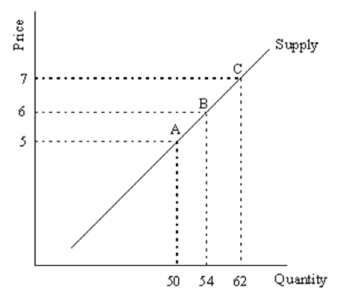 (a) Calculate the elasticity of supply between points A and B.
(b) Calculate the elasticity of supply between points B and C.
(a) Calculate the elasticity of supply between points A and B.
(b) Calculate the elasticity of supply between points B and C. (72) Why is substitution the key factor in determining how elastic or inelastic a demand curve will be? Under what conditions will demand be more elastic?
(79) If two goods have a cross-price elasticity value of +3, are they substitutes or complements?
(96) Both the slope of the demand curve and the elasticity of demand are measures of how consumers alter their quantities demanded in response to changes in price. How are the two concepts different from each other? Given a negatively sloped straight-line demand curve, how will slope and elasticity differ? Given a vertical or horizontal demand curve, how will they differ?
(79) The elasticity of demand for fitbits is 3 and the elasticity of supply is 1.5. Suppose that a breakthrough in the technology used in the production of fitbits increased the supply of fitbits by 20%. Calculate the percentage change in the equilibrium price of fitbits.
(83) You started a pajama business four years ago and it is now becoming quite successful. You are thinking of hiring an economic consultant to help you rise to the next level in your industry. One consultant is familiar with the concept of elasticity; one is not. Which one would you hire? Explain your reasoning.
(81) 
Filters
- Essay(0)
- Multiple Choice(0)
- Short Answer(0)
- True False(0)
- Matching(0)