



 Chat with AI
Exam 14: Monopoly

Exam 1: Economics and Economic Reasoning37 Questions
Exam 2: The Production Possibility Model, Trade and Globalization22 Questions
Exam 3: Economic Institutions19 Questions
Exam 4: Supply and Demand31 Questions
Exam 5: Using Supply and Demand27 Questions
Exam 6: Describing Supply and Demand: Elasticities40 Questions
Exam 7: Taxation and Government Intervention32 Questions
Exam 8: Market Failure Versus Government Failure38 Questions
Exam 9: International Trade Policy, Comparative Advantage, and Outsourcing13 Questions
Exam 10: International Trade Policy24 Questions
Exam 11: Production and Cost Analysis I34 Questions
Exam 12: Production and Cost Analysis II23 Questions
Exam 13: Perfect Competition35 Questions
Exam 14: Monopoly47 Questions
Exam 15: Monopolistic Competition and Oligopoly33 Questions
Exam 16: Real-World Competition and Technology22 Questions
Exam 17: Work and the Labor Market38 Questions
Exam 18: Who Gets What the Distribution of Income34 Questions
Exam 19: The Logic of Individual Choice: the Foundation of Supply and Demand36 Questions
Exam 20: Game Theory, Strategic Decision Making, and Behavioral Economics27 Questions
Exam 21: Thinking Like a Modern Economist30 Questions
Exam 22: Behavioral Economic Policy39 Questions
Exam 23: Microeconomic Policy, Economic Reasoning, and Beyond23 Questions
Select questions type


(a) Complete the following table: P Q TR MR \ 10 1 9 2 8 3 7 4 6 5 5 6 4 7 3 8 2 9 1 10 Note: Marginal values are values between levels of output.
(b) Suppose the firm's variable costs are as given in the accompanying table. What is the firm's profit-maximizing level of output? Q VC 1 5 2 9 3 12 4 16 5 21 6 27 7 34 8 42 9 51 10 61 (c) What would the profit-maximizing output be if the government offered to pay the firm's variable costs of production?
(d) What would profit-maximizing output be if instead the government decided to levy a tax of $100 on the firm, independent of its output decision?
(e) Do we know whether the firm will exit the industry in the short run? How about in the long run? Why or why not?
(Essay)
5.0/5  (71)
(71) What does it mean to say that a monopolist is practicing price discrimination?
(Essay)
5.0/5 (79)
(79) Consider the following diagram: 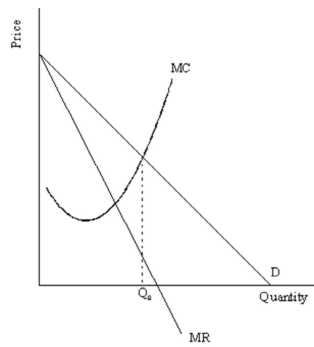 Explain why producing output level Q0 is not the monopolist's profit-maximizing output level. How much output should the firm produce? Illustrate as Q1 in the diagram below.
 (Essay)
5.0/5 (72)
(72) Demonstrate graphically and explain verbally how forcing a natural monopoly to produce at the competitive market solution (P = MC) results in a loss for the monopolist.
(Essay)
4.8/5 (82)
(82) What is a platform monopoly, and why does it often provide services for free?
(Essay)
5.0/5 (66)
(66) Demonstrate graphically and explain verbally the difference between long-run equilibrium for a perfectly competitive firm and a monopolistically competitive firm.
(Essay)
4.9/5 (78)
(78) At one time, the FCC auctioned off the rights to use public airwaves for wireless communications devices, receiving $23 billion dollars in bids for 4,249 licenses. More than $10 billion was turned over to the U.S. Treasury. These auctions may be thought of as a government sale of a monopoly since one company's use of a particular frequency prevents another from using it. Who gains and who loses when the government sells a monopoly, compared to the case where monopolies don't require licenses to operate? Explain.
(Essay)
4.8/5 (83)
(83) Why are barriers to entry important to maintaining a monopoly? Discuss the three most important types of barriers to entry.
(Essay)
4.7/5 (80)
(80) Economists may prefer a competitive outcome to a monopoly outcome due to the "welfare loss" associated with the latter. Draw a picture to illustrate the welfare loss associated with the monopoly outcome.
(Essay)
4.9/5 (83)
(83) Why is marginal revenue always less than price for a monopolist? Construct an example to illustrate your answer.
(Essay)
4.8/5 (83)
(83) Why does a price-discriminating monopolist earn more profit than a monopolist who does not price-discriminate? What must a monopolist do in order to successfully price discriminate? Give three real world examples of price discrimination practices
(Essay)
4.9/5 (93)
(93) Demonstrate graphically the price and quantity a natural monopolist would choose in the absence of regulation. Shade the area representing profit. In a diagram show what happens to that profit if the monopolist is required to charge a price equal to marginal cost, PC.
(Essay)
4.8/5 (73)
(73) Why does a price-discriminating monopolist earn more profit than a monopolist who does not price-discriminate?
(Essay)
4.9/5 (80)
(80) Does the following diagram illustrate a monopolistically competitive firm in a long-run equilibrium? If yes, explain why. If no, explain why not and redraw the diagram so that it is a long-run equilibrium. (Extra Credit: What forces move a monopolistically competitive industry to equilibrium?) 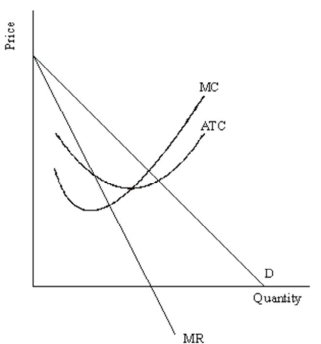
(Essay)
4.8/5 (90)
(90) How and why are the decisions facing a monopolist different from the collective decisions of firms in a perfectly competitive market?
(Essay)
4.8/5 (97)
(97) Consider the following table, which represents demand and cost conditions for a monopoly firm.
(a) Fill in the missing values.
(b) What output level should the firm produce? Explain. Quantity Price Total Revenue Marginal Revenue Total Cost Marginal Cost Average Total Cost Profit 0 \ 50 \ -60 1 45 \ 3 2 40 5 3 35 11 4 30 13 5 25 21 6 20 39 7 15 45 8 10 60 (NOTE: Marginal values should be interpreted as values between levels of output.)
(Essay)
4.7/5 (89)
(89) What are the four distinguishing characteristics of monopolistic competition?
(Essay)
4.8/5 (85)
(85) 
Filters
- Essay(0)
- Multiple Choice(0)
- Short Answer(0)
- True False(0)
- Matching(0)