



 Chat with AI
Exam 17: Work and the Labor Market

Exam 1: Economics and Economic Reasoning37 Questions
Exam 2: The Production Possibility Model, Trade and Globalization22 Questions
Exam 3: Economic Institutions19 Questions
Exam 4: Supply and Demand31 Questions
Exam 5: Using Supply and Demand27 Questions
Exam 6: Describing Supply and Demand: Elasticities40 Questions
Exam 7: Taxation and Government Intervention32 Questions
Exam 8: Market Failure Versus Government Failure38 Questions
Exam 9: International Trade Policy, Comparative Advantage, and Outsourcing13 Questions
Exam 10: International Trade Policy24 Questions
Exam 11: Production and Cost Analysis I34 Questions
Exam 12: Production and Cost Analysis II23 Questions
Exam 13: Perfect Competition35 Questions
Exam 14: Monopoly47 Questions
Exam 15: Monopolistic Competition and Oligopoly33 Questions
Exam 16: Real-World Competition and Technology22 Questions
Exam 17: Work and the Labor Market38 Questions
Exam 18: Who Gets What the Distribution of Income34 Questions
Exam 19: The Logic of Individual Choice: the Foundation of Supply and Demand36 Questions
Exam 20: Game Theory, Strategic Decision Making, and Behavioral Economics27 Questions
Exam 21: Thinking Like a Modern Economist30 Questions
Exam 22: Behavioral Economic Policy39 Questions
Exam 23: Microeconomic Policy, Economic Reasoning, and Beyond23 Questions
Select questions type


A firm notices that wages in another country are lower than it currently pays its employees. What are three reasons why the firm may choose not to relocate?
(Essay)
4.9/5  (69)
(69) Four factors that influence the elasticity of market labor demand are: (1) the elasticity of demand for a firm's good, (2) the relative importance of the factor in the production process, (3) the possibility of, and cost of, substitution in production, and (4) the degree to which the marginal productivity falls with an increase in the factor. How does each affect market labor demand?
(Essay)
4.7/5 (77)
(77) Define a monopsony, and explain why in this case the marginal factor cost and the supply are not the same. What is the relationship between a monopsony and a bilateral monopoly? How is the wage rate determined in a situation of bilateral monopoly?
(Essay)
4.9/5 (88)
(88) What government programs, other than income taxes, have a negative incentive effect on individuals' work effort?
(Essay)
4.8/5 (74)
(74) What does it mean to say that the demand for labor is a derived demand?
(Essay)
4.8/5 (83)
(83) What is a monopsony? Why in this case are the marginal factor cost and the supply not the same?
(Essay)
4.9/5 (96)
(96) List three general principles concerning the factors that influence a firm's demand for labor.
(Essay)
4.9/5 (67)
(67) What are efficiency wages and comparable worth laws? How does each impact the labor market?
(Essay)
4.9/5 (73)
(73) What is the income effect and the substitution effect in the context of the supply of labor?
(Essay)
4.7/5 (77)
(77) Describe the three types of demand-side discrimination in the labor market and give an example of each. Which of these types of discrimination is the most easily eliminated?
(Essay)
4.9/5 (71)
(71) Suppose you are considering two possible summer jobs. One is with an outdoor painting company as a painter, the other is as a sales associate in an up-scale department store (please assume that you are in this strictly for the money, so ignore whether one job sounds inherently more or less attractive to you personally). Both jobs are union jobs, and both unions are presently negotiating for significant wage increases. You can't afford to get laid off half way through the summer, and the last people hired will be the first laid off if there is a layoff, so you are concerned about the elasticity of demand for labor for both employers. Which would probably be more elastic, and why?
(Essay)
4.9/5 (87)
(87) You are the owner of an auto body shop. Due to a recent hailstorm you have a twofold increase in the number of cars to repair. What is the short-term impact that this hailstorm will have on your demand for auto body technicians? What will be the results in the market for these technicians with respect to wages and the number employed? What will be the long-term results in the market for these technicians with respect to wages and the number employed? (NOTE: Your answer should include two diagrams.)
(Essay)
4.9/5 (67)
(67) What is the difference between the marginal revenue product and the value of the marginal product?
(Essay)
4.9/5 (75)
(75) Suppose that you are unemployed and collecting unemployment insurance benefits of $200 per week, and suppose that your income is tax-free. Your employment counselor calls you and reports that she has found you a job that offers 40 hours of work per week at $12.50 per hour. You do some quick calculations and discover that your after-tax earnings from this job would be $360 per week. If unemployment benefits are cut off as soon as you regain employment, what is the real take-home wage rate from your new job offer? What does that make the tax rate on your earnings? (Hint: the loss of benefits is an implicit tax.)
(Essay)
4.8/5 (66)
(66) Explain how each of the following events affects the equilibrium wage and the equilibrium quantity of labor (assume all else is constant with each event). Be sure to explain whether demand for or supply of labor has changed.
(1) The price of output a firm produces rises.
(2) A leisure-hour provides greater marginal benefit.
(3) The marginal income tax rate rises.
(4) New immigration laws restrict the hiring of illegal workers.
(5) A reduction in welfare benefits.
(6) The cost of machines falls (labor and machines are substitutes).
(7) Technology makes labor more productive.
(8) The industry becomes more monopolistic.
(9) The price of the product a firm produced falls.
(Essay)
4.9/5 (69)
(69) Demonstrate graphically and explain verbally a bilateral monopoly labor market. What will happen to wages and quantity of labor employed in comparison to a competitive market?
(Essay)
4.9/5 (87)
(87) You have been asked to evaluate the pay of English Professors and Economics Professors at a small liberal arts college. The college's personnel department has generated some supply and demand information from similar colleges, which is presented in the diagrams below. 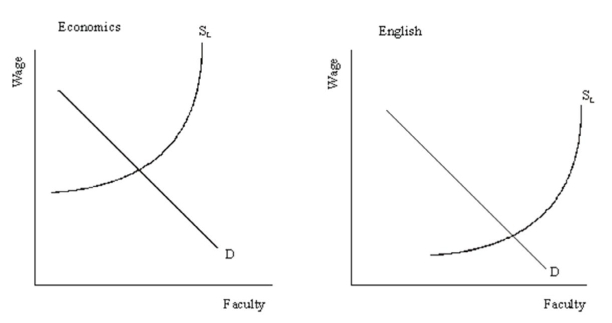 (a) Illustrate a market-based pay scale for each type of professor.
(b) Illustrate a pay scale based upon the principle that "a faculty member is a faculty member: they are all teachers, the only difference is the subject that they teach. They should receive equal pay for equal work."
(c) Describe what difficulty the college might have in its recruiting process if it follows the pay system in (b) rather than that in (a).
(a) Illustrate a market-based pay scale for each type of professor.
(b) Illustrate a pay scale based upon the principle that "a faculty member is a faculty member: they are all teachers, the only difference is the subject that they teach. They should receive equal pay for equal work."
(c) Describe what difficulty the college might have in its recruiting process if it follows the pay system in (b) rather than that in (a). (Essay)
4.9/5 (84)
(84) 
Filters
- Essay(0)
- Multiple Choice(0)
- Short Answer(0)
- True False(0)
- Matching(0)