



 Chat with AI
Exam 10: Environmental Health and Toxicology

Exam 1: Science and Sustainability: an Introduction to Environmental Science61 Questions
Exam 2: Environmental Systems: Matter, Energy, and Ecosystems58 Questions
Exam 3: Evolution, Biodiversity, and Population Ecology52 Questions
Exam 4: Species Interactions and Community Ecology55 Questions
Exam 5: Economics, Policy, and Sustainable Development54 Questions
Exam 6: Human Population62 Questions
Exam 7: Soil, Agriculture, and the Future of Food64 Questions
Exam 8: Biodiversity and Conservation Biology49 Questions
Exam 9: Forests, Forest Management, and Protected Areas51 Questions
Exam 10: Environmental Health and Toxicology62 Questions
Exam 11: Geology, Minerals, and Mining52 Questions
Exam 12: Fresh Water, Oceans, and Coasts70 Questions
Exam 13: Atmospheric Science, Air Quality, and Pollution Control53 Questions
Exam 14: Global Climate Change53 Questions
Exam 15: Nonrenewable Energy Sources, Their Impacts, and Energy Conservation64 Questions
Exam 16: Renewable Energy Alternatives61 Questions
Exam 17: Managing Our Waste56 Questions
Exam 18: The Urban Environment: Creating Sustainable Cities60 Questions
Exam 19: Epilogue45 Questions
Select questions type


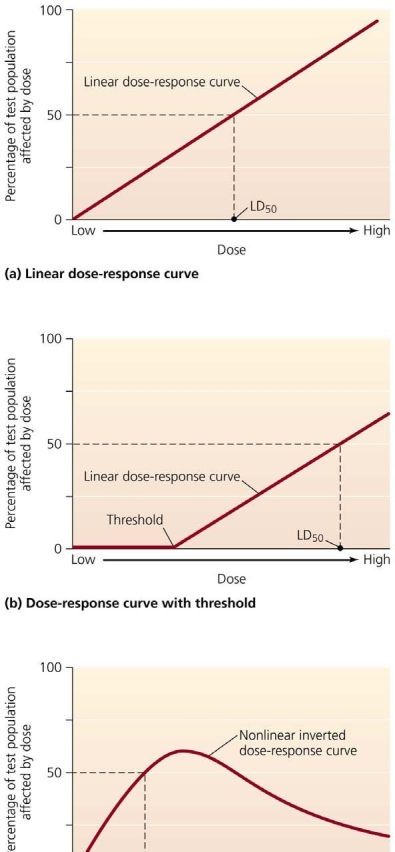
 Choose the one alternative that best completes the statement or answers the question.
-The flat line at the left in (b) probably represents ________________.
Choose the one alternative that best completes the statement or answers the question.
-The flat line at the left in (b) probably represents ________________. (Multiple Choice)
4.8/5  (73)
(73) Choose the item that best matches each item in the following:
-Toxicant used as a flame retardant and insulator; carcinogen and scars the lungs when inhaled
(Multiple Choice)
4.9/5 (66)
(66) Read the following scenario and answer the question below.
Mercury is a heavy metal that occurs naturally in minerals and rocks. Release of mercury from natural sources has been relatively constant over time. However, anthropogenic release of mercury has increased significantly in recent years primarily due to increased fossil fuel mining and combustion. Mercury that is released into the air eventually ends up in soils or surface water. Once in water, microbes convert mercury into methyl mercury, which is absorbed quickly and concentrated in the tissues of predatory fish such as shark and swordfish. Large fish typically concentrate more mercury than small fish. People who eat fish with high methyl mercury concentrations can show tremors, deafness, muscle dysfunction, and attention deficits. Pregnant women and children are especially sensitive to methyl mercuryʹs toxic effects. Learning disabilities and developmental delays are common in children who have been exposed to significant levels of methyl mercury.
-Of the following U.S. agencies, ______________ is primarily responsible for addressing issues regarding mercury pollution.
(Multiple Choice)
4.9/5 (72)
(72) The effect of toxicants on fetuses and young children ______________
(Multiple Choice)
4.9/5 (87)
(87) The European Unionʹs REACH (Registration, Evaluation, Authorization and restriction of chemicals) program ______________.
(Multiple Choice)
4.8/5 (102)
(102) Choose the item that best matches each item in the following:
-Widely used as a lining in metal food and drink cans and to make polycarbonate plastic, a hard, clear plastic found in water bottles and many other products. Mimics the female sex hormone estrogen
(Multiple Choice)
4.8/5 (79)
(79) Choose the item that best matches each item in the following:
-Neurotoxin that magnifies within food webs; typically found in polluted bodies of water; it poisoned
thousands of people when it was dumped into the waters off Japan; people who ate contaminated fish from the waters exhibited convulsions, slurred speech, loss of muscle control, and sudden fits of laughter; some people died
(Multiple Choice)
4.8/5 (67)
(67) Briefly comment on the research to determine the toxicity of bisphenol A (BPA). Also, explain why this topic represents a challenge to scientific integrity and credibility and the implications for national and international policies on this compound that depend on the research.
(Essay)
4.9/5 (74)
(74) An organism, such as a mosquito, that transmits a disease-causing organism to a host is called a ______________
(Multiple Choice)
4.8/5 (99)
(99) ______________ are best defined as substances that cause cancer.
(Multiple Choice)
4.8/5 (83)
(83) Pesticides in the United States are registered through the ______________.
(Multiple Choice)
4.8/5 (64)
(64) Define risk assessment and risk management. Discuss how risk management combines science and other social factors.
(Essay)
4.9/5 (76)
(76)
Choose the one alternative that best completes the statement or answers the question.
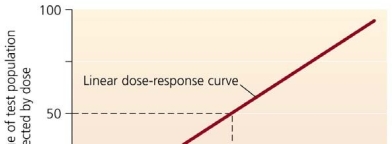
-The LD50 indicates the _______________.
Choose the one alternative that best completes the statement or answers the question.
-The LD50 indicates the _______________. (Multiple Choice)
4.8/5 (81)
(81) Infectious diseases are a much greater problem in developing countries than in developed nations. In developing countries, such diseases account for nearly half of all deaths. This is because ______________
(Multiple Choice)
4.9/5 (74)
(74) What are endocrine disruptors? How do they work on pests? Why are they a problem for humans? Have they been banned? Why or why not?
(Essay)
4.9/5 (80)
(80) 
Filters
- Essay(0)
- Multiple Choice(0)
- Short Answer(0)
- True False(0)
- Matching(0)