



 Chat with AI
Exam 5: Economics, Policy, and Sustainable Development

Exam 1: Science and Sustainability: an Introduction to Environmental Science61 Questions
Exam 2: Environmental Systems: Matter, Energy, and Ecosystems58 Questions
Exam 3: Evolution, Biodiversity, and Population Ecology52 Questions
Exam 4: Species Interactions and Community Ecology55 Questions
Exam 5: Economics, Policy, and Sustainable Development54 Questions
Exam 6: Human Population62 Questions
Exam 7: Soil, Agriculture, and the Future of Food64 Questions
Exam 8: Biodiversity and Conservation Biology49 Questions
Exam 9: Forests, Forest Management, and Protected Areas51 Questions
Exam 10: Environmental Health and Toxicology62 Questions
Exam 11: Geology, Minerals, and Mining52 Questions
Exam 12: Fresh Water, Oceans, and Coasts70 Questions
Exam 13: Atmospheric Science, Air Quality, and Pollution Control53 Questions
Exam 14: Global Climate Change53 Questions
Exam 15: Nonrenewable Energy Sources, Their Impacts, and Energy Conservation64 Questions
Exam 16: Renewable Energy Alternatives61 Questions
Exam 17: Managing Our Waste56 Questions
Exam 18: The Urban Environment: Creating Sustainable Cities60 Questions
Exam 19: Epilogue45 Questions
Select questions type


The primary role of the United Nations is to _______________.

Free
(Multiple Choice)
4.9/5  (67)
(67) Correct Answer: Verified
E
Political boundaries do not always match environmental boundaries. What does this mean for environmental protection in each country?
Free
(Essay)
4.8/5 (83)
(83) Correct Answer:Verified
VerifiedCountries are often dependent upon each other to solve environmental problems because the pollution that is of concern may originate in another country. In such cases, international cooperation is required to correct the problem. The resolution can be exacerbated by the varying enforcement of, or even enactment of, environmental regulations in the countries involved.
Choose the item that best matches each item in the following:
-Specific rules based on more broadly written statutory law passed by Congress
Free
(Multiple Choice)
4.9/5 (77)
(77) Correct Answer:Verified
VerifiedK
Read the following scenario and answer the question(s) below.
Wetlands provide a multitude of ecological, economic, and social benefits. They provide habitat for many organisms and are nurseries for many saltwater and freshwater fishes and shellfish. Wetlands also hold and slowly release floodwater and snow melt, recharge groundwater, act as cleansing filters, recycle nutrients, and provide recreation. As of 2000, the contiguous United States was estimated to have about 105 million acres of wetlands remaining. Over the past 60 years, it has lost over 16 million acres of wetlands, and the loss continues at about 58,000 acres annually. Nearly one -third of the loss is due to urban development, with the rest being nearly equally divided between rural development, agriculture, and silviculture (predominantly logging). The southeastern United States is experiencing the greatest losses. The Emergency Wetlands Resources Act of 1986 requires the Fish and Wildlife Service to conduct status and trend studies of the nationʹs wetlands and to report the results to Congress each decade. The overall goal is to have no more net loss of wetlands. In the past 5 years, money for flood control projects in Louisiana has been cut dramatically. During that time, two simulations, one of a category 4 hurricane and one of a category 5 hurricane, indicated catastrophic damage and loss of life along the Gulf Coast. The levees were predicted to break, and massive flooding to occur, in part due to the loss of the sheltering wetlands.
-In the United States, wetlands are primarily considered to be ______________.
(Multiple Choice)
4.8/5 (88)
(88) Lobbying, legal action, and campaign funding are all means used by _______________ to influence governmental environmental policies.
(Multiple Choice)
5.0/5 (69)
(69) The social changes in the United States in the 20th century gave rise to environmental laws concerned primarily with _______________.
(Multiple Choice)
4.9/5 (95)
(95) 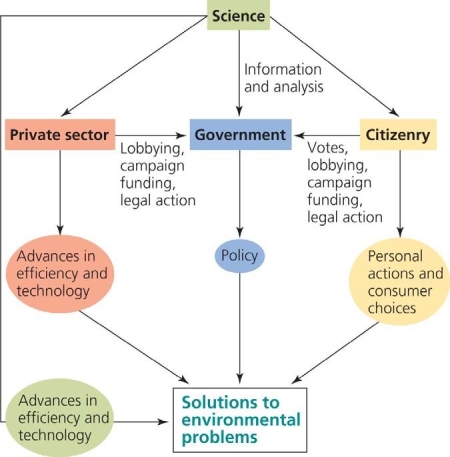 Use the figure above to answer the following question.
-Regarding the issue of global warming, until the hurricane season of 2005, the federal governmentʹs official stance was that the information available from the scientific community was neither conclusive nor persuasive. This governmental position was probably due to ______________.
Use the figure above to answer the following question.
-Regarding the issue of global warming, until the hurricane season of 2005, the federal governmentʹs official stance was that the information available from the scientific community was neither conclusive nor persuasive. This governmental position was probably due to ______________. (Multiple Choice)
4.8/5 (70)
(70) Read the following scenario and answer the question(s) below.
Wetlands provide a multitude of ecological, economic, and social benefits. They provide habitat for many organisms and are nurseries for many saltwater and freshwater fishes and shellfish. Wetlands also hold and slowly release floodwater and snow melt, recharge groundwater, act as cleansing filters, recycle nutrients, and provide recreation. As of 2000, the contiguous United States was estimated to have about 105 million acres of wetlands remaining. Over the past 60 years, it has lost over 16 million acres of wetlands, and the loss continues at about 58,000 acres annually. Nearly one -third of the loss is due to urban development, with the rest being nearly equally divided between rural development, agriculture, and silviculture (predominantly logging). The southeastern United States is experiencing the greatest losses. The Emergency Wetlands Resources Act of 1986 requires the Fish and Wildlife Service to conduct status and trend studies of the nationʹs wetlands and to report the results to Congress each decade. The overall goal is to have no more net loss of wetlands. In the past 5 years, money for flood control projects in Louisiana has been cut dramatically. During that time, two simulations, one of a category 4 hurricane and one of a category 5 hurricane, indicated catastrophic damage and loss of life along the Gulf Coast. The levees were predicted to break, and massive flooding to occur, in part due to the loss of the sheltering wetlands.
-The economic principles in play with the fate of U.S. wetlands have been governed by _______________.
(Multiple Choice)
4.9/5 (83)
(83) International environmental policies arise from _______________.
(Multiple Choice)
4.9/5 (74)
(74) Use the figure above to answer the following question.
-According to the figure, the basis for government policy regarding environmental issues _____________
Use the figure above to answer the following question.
-According to the figure, the basis for government policy regarding environmental issues _____________ (Multiple Choice)
4.8/5 (77)
(77) Discuss the differences between neoclassical, ecological, and environmental economics.
(Essay)
4.9/5 (83)
(83) Rising per capita consumption of goods and rising population growth lead to _______________.
(Multiple Choice)
4.8/5 (67)
(67) Rachel Carsonʹs book Silent Spring, published in the 1960s,_______________ .
(Multiple Choice)
4.8/5 (86)
(86) Read the following scenario and answer the question(s) below.
Wetlands provide a multitude of ecological, economic, and social benefits. They provide habitat for many organisms and are nurseries for many saltwater and freshwater fishes and shellfish. Wetlands also hold and slowly release floodwater and snow melt, recharge groundwater, act as cleansing filters, recycle nutrients, and provide recreation. As of 2000, the contiguous United States was estimated to have about 105 million acres of wetlands remaining. Over the past 60 years, it has lost over 16 million acres of wetlands, and the loss continues at about 58,000 acres annually. Nearly one -third of the loss is due to urban development, with the rest being nearly equally divided between rural development, agriculture, and silviculture (predominantly logging). The southeastern United States is experiencing the greatest losses. The Emergency Wetlands Resources Act of 1986 requires the Fish and Wildlife Service to conduct status and trend studies of the nationʹs wetlands and to report the results to Congress each decade. The overall goal is to have no more net loss of wetlands. In the past 5 years, money for flood control projects in Louisiana has been cut dramatically. During that time, two simulations, one of a category 4 hurricane and one of a category 5 hurricane, indicated catastrophic damage and loss of life along the Gulf Coast. The levees were predicted to break, and massive flooding to occur, in part due to the loss of the sheltering wetlands.
-From the scenario above, one conclusion regarding the Gulf Coast damage from the hurricane season of 2005 is that _______________.
(Multiple Choice)
4.8/5 (80)
(80) Robert Constanza and his colleagues have shown that _______________.
(Multiple Choice)
4.8/5 (76)
(76) Read the following scenario and answer the question(s) below.
Wetlands provide a multitude of ecological, economic, and social benefits. They provide habitat for many organisms and are nurseries for many saltwater and freshwater fishes and shellfish. Wetlands also hold and slowly release floodwater and snow melt, recharge groundwater, act as cleansing filters, recycle nutrients, and provide recreation. As of 2000, the contiguous United States was estimated to have about 105 million acres of wetlands remaining. Over the past 60 years, it has lost over 16 million acres of wetlands, and the loss continues at about 58,000 acres annually. Nearly one -third of the loss is due to urban development, with the rest being nearly equally divided between rural development, agriculture, and silviculture (predominantly logging). The southeastern United States is experiencing the greatest losses. The Emergency Wetlands Resources Act of 1986 requires the Fish and Wildlife Service to conduct status and trend studies of the nationʹs wetlands and to report the results to Congress each decade. The overall goal is to have no more net loss of wetlands. In the past 5 years, money for flood control projects in Louisiana has been cut dramatically. During that time, two simulations, one of a category 4 hurricane and one of a category 5 hurricane, indicated catastrophic damage and loss of life along the Gulf Coast. The levees were predicted to break, and massive flooding to occur, in part due to the loss of the sheltering wetlands.
-Wetlands in the United States _______________.
(Multiple Choice)
4.8/5 (92)
(92) Choose the item that best matches each item in the following:
-Responsible for U.S. water quality, air pollution, and solid waste management
(Multiple Choice)
4.7/5 (76)
(76) Read the following scenario and answer the question(s) below.
Wetlands provide a multitude of ecological, economic, and social benefits. They provide habitat for many organisms and are nurseries for many saltwater and freshwater fishes and shellfish. Wetlands also hold and slowly release floodwater and snow melt, recharge groundwater, act as cleansing filters, recycle nutrients, and provide recreation. As of 2000, the contiguous United States was estimated to have about 105 million acres of wetlands remaining. Over the past 60 years, it has lost over 16 million acres of wetlands, and the loss continues at about 58,000 acres annually. Nearly one -third of the loss is due to urban development, with the rest being nearly equally divided between rural development, agriculture, and silviculture (predominantly logging). The southeastern United States is experiencing the greatest losses. The Emergency Wetlands Resources Act of 1986 requires the Fish and Wildlife Service to conduct status and trend studies of the nationʹs wetlands and to report the results to Congress each decade. The overall goal is to have no more net loss of wetlands. In the past 5 years, money for flood control projects in Louisiana has been cut dramatically. During that time, two simulations, one of a category 4 hurricane and one of a category 5 hurricane, indicated catastrophic damage and loss of life along the Gulf Coast. The levees were predicted to break, and massive flooding to occur, in part due to the loss of the sheltering wetlands.
-There has been legislation designed to encourage protection of wetlands, but funding has been greatly reduced, because _______________.
(Multiple Choice)
4.7/5 (100)
(100) 
Filters
- Essay(0)
- Multiple Choice(0)
- Short Answer(0)
- True False(0)
- Matching(0)