



 Chat with AI
Exam 12: Fresh Water, Oceans, and Coasts

Exam 1: Science and Sustainability: an Introduction to Environmental Science61 Questions
Exam 2: Environmental Systems: Matter, Energy, and Ecosystems58 Questions
Exam 3: Evolution, Biodiversity, and Population Ecology52 Questions
Exam 4: Species Interactions and Community Ecology55 Questions
Exam 5: Economics, Policy, and Sustainable Development54 Questions
Exam 6: Human Population62 Questions
Exam 7: Soil, Agriculture, and the Future of Food64 Questions
Exam 8: Biodiversity and Conservation Biology49 Questions
Exam 9: Forests, Forest Management, and Protected Areas51 Questions
Exam 10: Environmental Health and Toxicology62 Questions
Exam 11: Geology, Minerals, and Mining52 Questions
Exam 12: Fresh Water, Oceans, and Coasts70 Questions
Exam 13: Atmospheric Science, Air Quality, and Pollution Control53 Questions
Exam 14: Global Climate Change53 Questions
Exam 15: Nonrenewable Energy Sources, Their Impacts, and Energy Conservation64 Questions
Exam 16: Renewable Energy Alternatives61 Questions
Exam 17: Managing Our Waste56 Questions
Exam 18: The Urban Environment: Creating Sustainable Cities60 Questions
Exam 19: Epilogue45 Questions
Select questions type


Zooxanthellae are ________________.

Free
(Multiple Choice)
4.8/5  (80)
(80) Correct Answer: Verified
A
Read the following scenario and answer the question below.
On a September day in 1999, folks began to notice that Lake Jackson in the panhandle region of northern Florida was shrinking. Within a few days, it was almost gone. A sinkhole had opened beneath the lake and drained it, along with all of the fish and alligators.
As aquifers lose water, their substrates can become weaker and less capable of supporting overlying strata and any human structures built upon them. In such cases, the land surface above may subside. Sometimes subsidence can occur locally and suddenly, in the form of sinkholes, areas where the ground gives way with little warning. Once the ground subsides, soil becomes compacted, losing the porosity that enabled it to hold water. Recharging a depleted aquifer may therefore become more difficult.
-One reasonable way to prevent sinkholes might be to ________________.
Free
(Multiple Choice)
4.8/5 (72)
(72) Correct Answer:Verified
VerifiedD
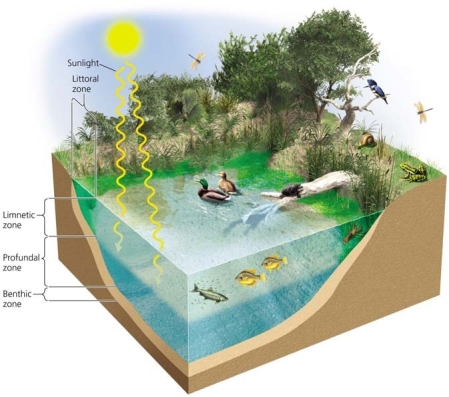 Use the figure above to answer the following question
-Frog eggs are usually attached to vegetation or rocks near the surface of a pond. Tadpoles can use essentially all areas of a shallow pond, or the top few feet of a deeper pond or lake. Adult frogs can live on land or in the water. A frogʹs life would be least likely to be disrupted by a change in the ___________________.
Use the figure above to answer the following question
-Frog eggs are usually attached to vegetation or rocks near the surface of a pond. Tadpoles can use essentially all areas of a shallow pond, or the top few feet of a deeper pond or lake. Adult frogs can live on land or in the water. A frogʹs life would be least likely to be disrupted by a change in the ___________________.Free
(Multiple Choice)
4.9/5 (82)
(82) Correct Answer:Verified
VerifiedC
Recent research that analyzed the content of commercial bottled water indicates that ________________.
(Multiple Choice)
4.7/5 (65)
(65) Explain how warmer coastal waters resulting from global climate change may affect coral reefs.
(Essay)
4.8/5 (91)
(91) The exceptionally strong warming of the eastern Pacific is referred to as ________________.
(Multiple Choice)
4.8/5 (96)
(96) Humans allocate approximately 70% of their annual freshwater use for ________________.
(Multiple Choice)
4.7/5 (74)
(74) Choose the item that best matches each item in the following:
-Porous, sponge-like layers of rock, sand, or gravel that are capable of holding water
(Multiple Choice)
4.9/5 (79)
(79) The initial consequence of falling water tables would be the loss of ________________.
(Multiple Choice)
4.7/5 (77)
(77) Use the figure above to answer the following question
-Rooted freshwater plants cannot live below __________.
Use the figure above to answer the following question
-Rooted freshwater plants cannot live below __________. (Multiple Choice)
4.9/5 (82)
(82) Read the following scenario and answer the question below.
On a September day in 1999, folks began to notice that Lake Jackson in the panhandle region of northern Florida was shrinking. Within a few days, it was almost gone. A sinkhole had opened beneath the lake and drained it, along with all of the fish and alligators.
As aquifers lose water, their substrates can become weaker and less capable of supporting overlying strata and any human structures built upon them. In such cases, the land surface above may subside. Sometimes subsidence can occur locally and suddenly, in the form of sinkholes, areas where the ground gives way with little warning. Once the ground subsides, soil becomes compacted, losing the porosity that enabled it to hold water. Recharging a depleted aquifer may therefore become more difficult.
-You have been hired by a small town on the Florida coast to give its residents advice about avoiding further sinkholes. You tell them that ________________.
(Multiple Choice)
4.7/5 (85)
(85) Read the following scenario and answer the question below.
On a September day in 1999, folks began to notice that Lake Jackson in the panhandle region of northern Florida was shrinking. Within a few days, it was almost gone. A sinkhole had opened beneath the lake and drained it, along with all of the fish and alligators.
As aquifers lose water, their substrates can become weaker and less capable of supporting overlying strata and any human structures built upon them. In such cases, the land surface above may subside. Sometimes subsidence can occur locally and suddenly, in the form of sinkholes, areas where the ground gives way with little warning. Once the ground subsides, soil becomes compacted, losing the porosity that enabled it to hold water. Recharging a depleted aquifer may therefore become more difficult.
-Sinkholes can occur when ________________.
(Multiple Choice)
4.8/5 (71)
(71) Overpumping groundwater in coastal areas can cause ________________ to move into aquifers, making the water undrinkable.
(Multiple Choice)
4.8/5 (66)
(66) All of the following are examples of point sources of pollution except ________________.
(Multiple Choice)
4.7/5 (87)
(87) A 2003 study reported that ________________% of large -bodied fish and sharks were lost in the first decade of industrialized fishing.
(Multiple Choice)
4.8/5 (80)
(80) Which of the following will contribute to water conservation?
(Multiple Choice)
4.8/5 (79)
(79) 
Filters
- Essay(0)
- Multiple Choice(0)
- Short Answer(0)
- True False(0)
- Matching(0)