



 Chat with AI
Exam 10: Environmental Health and Toxicology

Exam 1: Science and Sustainability: an Introduction to Environmental Science61 Questions
Exam 2: Environmental Systems: Matter, Energy, and Ecosystems58 Questions
Exam 3: Evolution, Biodiversity, and Population Ecology52 Questions
Exam 4: Species Interactions and Community Ecology55 Questions
Exam 5: Economics, Policy, and Sustainable Development54 Questions
Exam 6: Human Population62 Questions
Exam 7: Soil, Agriculture, and the Future of Food64 Questions
Exam 8: Biodiversity and Conservation Biology49 Questions
Exam 9: Forests, Forest Management, and Protected Areas51 Questions
Exam 10: Environmental Health and Toxicology62 Questions
Exam 11: Geology, Minerals, and Mining52 Questions
Exam 12: Fresh Water, Oceans, and Coasts70 Questions
Exam 13: Atmospheric Science, Air Quality, and Pollution Control53 Questions
Exam 14: Global Climate Change53 Questions
Exam 15: Nonrenewable Energy Sources, Their Impacts, and Energy Conservation64 Questions
Exam 16: Renewable Energy Alternatives61 Questions
Exam 17: Managing Our Waste56 Questions
Exam 18: The Urban Environment: Creating Sustainable Cities60 Questions
Exam 19: Epilogue45 Questions
Select questions type


Studies of endocrine disruptors have shown that they are closely associated with all of the following except ______________

Free
(Multiple Choice)
4.8/5  (83)
(83) Correct Answer: Verified
E
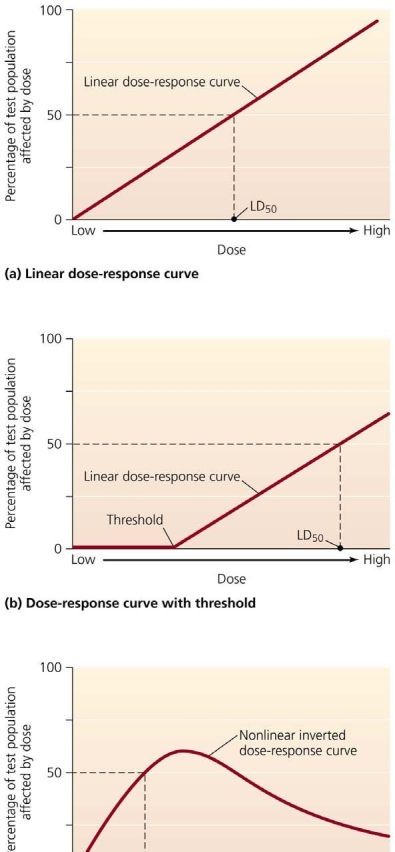
 Choose the one alternative that best completes the statement or answers the question.
-The graph in (c) is one type that may occur when a test animal is exposed to a(n) ___________.
Choose the one alternative that best completes the statement or answers the question.
-The graph in (c) is one type that may occur when a test animal is exposed to a(n) ___________.Free
(Multiple Choice)
4.7/5 (76)
(76) Correct Answer:Verified
VerifiedE
______________ is/are biodegradable and known to have (a) short persistence time(s).
Free
(Multiple Choice)
5.0/5 (74)
(74) Correct Answer:Verified
VerifiedC
Read the following scenario and answer the question below.
Mercury is a heavy metal that occurs naturally in minerals and rocks. Release of mercury from natural sources has been relatively constant over time. However, anthropogenic release of mercury has increased significantly in recent years primarily due to increased fossil fuel mining and combustion. Mercury that is released into the air eventually ends up in soils or surface water. Once in water, microbes convert mercury into methyl mercury, which is absorbed quickly and concentrated in the tissues of predatory fish such as shark and swordfish. Large fish typically concentrate more mercury than small fish. People who eat fish with high methyl mercury concentrations can show tremors, deafness, muscle dysfunction, and attention deficits. Pregnant women and children are especially sensitive to methyl mercuryʹs toxic effects. Learning disabilities and developmental delays are common in children who have been exposed to significant levels of methyl mercury.
-Concentrations of methyl mercury are higher in large fish relative to concentrations in the air. This is best described as ______________.
(Multiple Choice)
4.9/5 (82)
(82) Choose the item that best matches each item in the following:
-Toxicant present in paint; damages the brain, liver, kidney, and stomach when ingested
(Multiple Choice)
4.9/5 (100)
(100) Choose the item that best matches each item in the following:
-Used as a sleeping pill for pregnant women; teratogen that now is banned
(Multiple Choice)
4.8/5 (71)
(71) Properties of toxicants likely to build up in animals through bioaccumulation are ______________
(Multiple Choice)
4.8/5 (77)
(77) Read the following scenario and answer the question below.
Mercury is a heavy metal that occurs naturally in minerals and rocks. Release of mercury from natural sources has been relatively constant over time. However, anthropogenic release of mercury has increased significantly in recent years primarily due to increased fossil fuel mining and combustion. Mercury that is released into the air eventually ends up in soils or surface water. Once in water, microbes convert mercury into methyl mercury, which is absorbed quickly and concentrated in the tissues of predatory fish such as shark and swordfish. Large fish typically concentrate more mercury than small fish. People who eat fish with high methyl mercury concentrations can show tremors, deafness, muscle dysfunction, and attention deficits. Pregnant women and children are especially sensitive to methyl mercuryʹs toxic effects. Learning disabilities and developmental delays are common in children who have been exposed to significant levels of methyl mercury.
-Mercury is not readily excreted; it is stored in mammalian body tissues. This is best described as ______________.
(Multiple Choice)
4.9/5 (86)
(86) How is the precautionary principle used in environmental health? What is an alternative philosophical approach?
(Essay)
4.9/5 (73)
(73) According to the Precautionary Principle we should ______________
(Multiple Choice)
5.0/5 (81)
(81) Transport of airborne toxicants, a specific problem in agricultural environments, is called pesticide ______________.
(Multiple Choice)
4.8/5 (66)
(66) Explain how response to hazards can vary based upon individual differences and type of exposure. Give examples, where appropriate.
(Essay)
4.8/5 (78)
(78) Synergistic effects of toxicants that are mixed together ______________
(Multiple Choice)
4.8/5 (70)
(70) What are epidemiological studies, and what is their value? Are there any disadvantages to epidemiological studies?
(Essay)
4.8/5 (88)
(88) Choose the item that best matches each item in the following:
-Insecticide used to kill mosquitoes; banned in the United States in 1973 due to its toxicity
(Multiple Choice)
4.7/5 (70)
(70) Read the following scenario and answer the question below.
Mercury is a heavy metal that occurs naturally in minerals and rocks. Release of mercury from natural sources has been relatively constant over time. However, anthropogenic release of mercury has increased significantly in recent years primarily due to increased fossil fuel mining and combustion. Mercury that is released into the air eventually ends up in soils or surface water. Once in water, microbes convert mercury into methyl mercury, which is absorbed quickly and concentrated in the tissues of predatory fish such as shark and swordfish. Large fish typically concentrate more mercury than small fish. People who eat fish with high methyl mercury concentrations can show tremors, deafness, muscle dysfunction, and attention deficits. Pregnant women and children are especially sensitive to methyl mercuryʹs toxic effects. Learning disabilities and developmental delays are common in children who have been exposed to significant levels of methyl mercury.
-Based upon the specific health effects described above, mercury would be best classified as a(n) ______________ .
(Multiple Choice)
4.7/5 (105)
(105) Louis Guillette is most famous for his studies ______________
(Multiple Choice)
5.0/5 (90)
(90) Read the following scenario and answer the question below.
Mercury is a heavy metal that occurs naturally in minerals and rocks. Release of mercury from natural sources has been relatively constant over time. However, anthropogenic release of mercury has increased significantly in recent years primarily due to increased fossil fuel mining and combustion. Mercury that is released into the air eventually ends up in soils or surface water. Once in water, microbes convert mercury into methyl mercury, which is absorbed quickly and concentrated in the tissues of predatory fish such as shark and swordfish. Large fish typically concentrate more mercury than small fish. People who eat fish with high methyl mercury concentrations can show tremors, deafness, muscle dysfunction, and attention deficits. Pregnant women and children are especially sensitive to methyl mercuryʹs toxic effects. Learning disabilities and developmental delays are common in children who have been exposed to significant levels of methyl mercury.
-Mercury is to methylmercury as DDT is to ______________
(Multiple Choice)
4.7/5 (75)
(75) 
Filters
- Essay(0)
- Multiple Choice(0)
- Short Answer(0)
- True False(0)
- Matching(0)