



 Chat with AI
Exam 10: Environmental Health and Toxicology

Exam 1: Science and Sustainability: an Introduction to Environmental Science61 Questions
Exam 2: Environmental Systems: Matter, Energy, and Ecosystems58 Questions
Exam 3: Evolution, Biodiversity, and Population Ecology52 Questions
Exam 4: Species Interactions and Community Ecology55 Questions
Exam 5: Economics, Policy, and Sustainable Development54 Questions
Exam 6: Human Population62 Questions
Exam 7: Soil, Agriculture, and the Future of Food64 Questions
Exam 8: Biodiversity and Conservation Biology49 Questions
Exam 9: Forests, Forest Management, and Protected Areas51 Questions
Exam 10: Environmental Health and Toxicology62 Questions
Exam 11: Geology, Minerals, and Mining52 Questions
Exam 12: Fresh Water, Oceans, and Coasts70 Questions
Exam 13: Atmospheric Science, Air Quality, and Pollution Control53 Questions
Exam 14: Global Climate Change53 Questions
Exam 15: Nonrenewable Energy Sources, Their Impacts, and Energy Conservation64 Questions
Exam 16: Renewable Energy Alternatives61 Questions
Exam 17: Managing Our Waste56 Questions
Exam 18: The Urban Environment: Creating Sustainable Cities60 Questions
Exam 19: Epilogue45 Questions
Select questions type


Toxicants that cause harm by affecting the immune system include ______________.
(Multiple Choice)
4.9/5  (77)
(77) Toxicants that interrupt essential biochemical processes in organisms by blocking one or steps in important biochemical reactions are known as ______________ .
(Multiple Choice)
5.0/5 (92)
(92) A naturally occurring substance that seeps up from the ground and that is potentially toxic to people is ______________.
(Multiple Choice)
4.8/5 (89)
(89) Carcinogens may be difficult to identify because ______________.
(Multiple Choice)
4.7/5 (82)
(82) 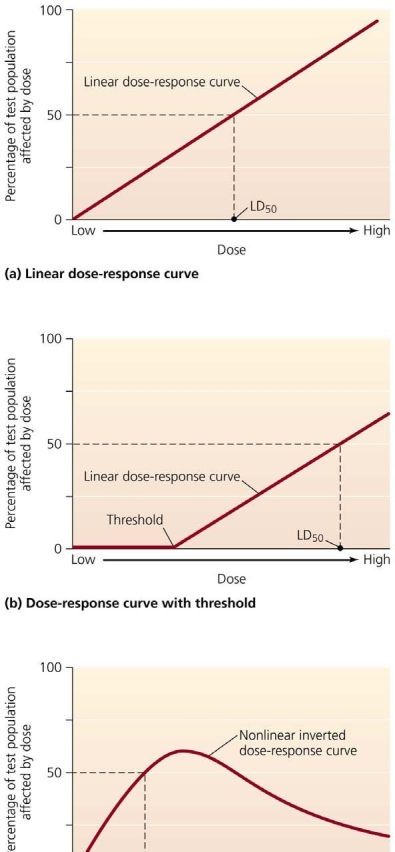
 Choose the one alternative that best completes the statement or answers the question.
-Assume that the scales for graphs (a) and (b) are identical. Compare the graphs. Which of the following statements is true?
Choose the one alternative that best completes the statement or answers the question.
-Assume that the scales for graphs (a) and (b) are identical. Compare the graphs. Which of the following statements is true? (Multiple Choice)
4.9/5 (77)
(77) Read the following scenario and answer the question below.
Mercury is a heavy metal that occurs naturally in minerals and rocks. Release of mercury from natural sources has been relatively constant over time. However, anthropogenic release of mercury has increased significantly in recent years primarily due to increased fossil fuel mining and combustion. Mercury that is released into the air eventually ends up in soils or surface water. Once in water, microbes convert mercury into methyl mercury, which is absorbed quickly and concentrated in the tissues of predatory fish such as shark and swordfish. Large fish typically concentrate more mercury than small fish. People who eat fish with high methyl mercury concentrations can show tremors, deafness, muscle dysfunction, and attention deficits. Pregnant women and children are especially sensitive to methyl mercuryʹs toxic effects. Learning disabilities and developmental delays are common in children who have been exposed to significant levels of methyl mercury.
-Prior to 2005, no rules regulating mercury emissions from coal-fired power plants existed in the United States. This represents the ______________
(Multiple Choice)
4.8/5 (73)
(73) Of the chemicals that fall under the TSCA ______________% have been tested for toxicity and ______________ have been tested for endocrine, nervous, or immune system damage.
(Multiple Choice)
4.8/5 (72)
(72) Rachel Carsonʹs book Silent Spring primarily focuses on the environmental problems associated with ______________.
(Multiple Choice)
4.8/5 (94)
(94) Infectious disease accounts for % of deaths globally ______________
(Multiple Choice)
4.9/5 (79)
(79) The book Our Stolen Future was important because it ______________.
(Multiple Choice)
5.0/5 (68)
(68) Choose the item that best matches each item in the following:
-Most widely used herbicide in the United States; an endocrine disruptor
(Multiple Choice)
4.8/5 (60)
(60)
Choose the one alternative that best completes the statement or answers the question.
-Figures such as these ___________.
Choose the one alternative that best completes the statement or answers the question.
-Figures such as these ___________. (Multiple Choice)
4.9/5 (85)
(85) ______________ are best defined as substances that cause birth defects.
(Multiple Choice)
4.9/5 (82)
(82) The bald eagle, osprey, and peregrine falcon all are ______________.
(Multiple Choice)
4.8/5 (75)
(75) Aquatic animals such as fish and frogs are especially good indicators of water pollution because ______________.
(Multiple Choice)
4.8/5 (81)
(81) Suppose that the concentration of DDT in a lake is 0.0000003 ppm (parts per million) and the concentration of DDT in the tissues of an osprey (a fish-eating bird) is 25 ppm. This is an example of ______________.
(Multiple Choice)
4.8/5 (84)
(84) List the properties that determine the rate of degradation of toxicants.
(Essay)
4.9/5 (80)
(80) 
Filters
- Essay(0)
- Multiple Choice(0)
- Short Answer(0)
- True False(0)
- Matching(0)