



 Chat with AI
Exam 5: Economics, Policy, and Sustainable Development

Exam 1: Science and Sustainability: an Introduction to Environmental Science61 Questions
Exam 2: Environmental Systems: Matter, Energy, and Ecosystems58 Questions
Exam 3: Evolution, Biodiversity, and Population Ecology52 Questions
Exam 4: Species Interactions and Community Ecology55 Questions
Exam 5: Economics, Policy, and Sustainable Development54 Questions
Exam 6: Human Population62 Questions
Exam 7: Soil, Agriculture, and the Future of Food64 Questions
Exam 8: Biodiversity and Conservation Biology49 Questions
Exam 9: Forests, Forest Management, and Protected Areas51 Questions
Exam 10: Environmental Health and Toxicology62 Questions
Exam 11: Geology, Minerals, and Mining52 Questions
Exam 12: Fresh Water, Oceans, and Coasts70 Questions
Exam 13: Atmospheric Science, Air Quality, and Pollution Control53 Questions
Exam 14: Global Climate Change53 Questions
Exam 15: Nonrenewable Energy Sources, Their Impacts, and Energy Conservation64 Questions
Exam 16: Renewable Energy Alternatives61 Questions
Exam 17: Managing Our Waste56 Questions
Exam 18: The Urban Environment: Creating Sustainable Cities60 Questions
Exam 19: Epilogue45 Questions
Select questions type


Read the following scenario and answer the question(s) below.
Wetlands provide a multitude of ecological, economic, and social benefits. They provide habitat for many organisms and are nurseries for many saltwater and freshwater fishes and shellfish. Wetlands also hold and slowly release floodwater and snow melt, recharge groundwater, act as cleansing filters, recycle nutrients, and provide recreation. As of 2000, the contiguous United States was estimated to have about 105 million acres of wetlands remaining. Over the past 60 years, it has lost over 16 million acres of wetlands, and the loss continues at about 58,000 acres annually. Nearly one -third of the loss is due to urban development, with the rest being nearly equally divided between rural development, agriculture, and silviculture (predominantly logging). The southeastern United States is experiencing the greatest losses. The Emergency Wetlands Resources Act of 1986 requires the Fish and Wildlife Service to conduct status and trend studies of the nationʹs wetlands and to report the results to Congress each decade. The overall goal is to have no more net loss of wetlands. In the past 5 years, money for flood control projects in Louisiana has been cut dramatically. During that time, two simulations, one of a category 4 hurricane and one of a category 5 hurricane, indicated catastrophic damage and loss of life along the Gulf Coast. The levees were predicted to break, and massive flooding to occur, in part due to the loss of the sheltering wetlands.
-If you were a resident of southern Louisiana in 2009-2012, your most effective political response, to try to lessen future hurricane damage, might be to _______________.
(Multiple Choice)
4.9/5  (98)
(98) Legislation passed by Congress is known as _______________.
(Multiple Choice)
4.9/5 (72)
(72) Differentiate between a green tax and marketable emission permits. Which is superior for U.S. markets?
(Essay)
5.0/5 (74)
(74) To control pollution, industry has been given limits and been threatened with punishment if these limits are violated. This approach is called _______________.
(Multiple Choice)
4.9/5 (72)
(72) Read the following scenario and answer the question(s) below.
Wetlands provide a multitude of ecological, economic, and social benefits. They provide habitat for many organisms and are nurseries for many saltwater and freshwater fishes and shellfish. Wetlands also hold and slowly release floodwater and snow melt, recharge groundwater, act as cleansing filters, recycle nutrients, and provide recreation. As of 2000, the contiguous United States was estimated to have about 105 million acres of wetlands remaining. Over the past 60 years, it has lost over 16 million acres of wetlands, and the loss continues at about 58,000 acres annually. Nearly one -third of the loss is due to urban development, with the rest being nearly equally divided between rural development, agriculture, and silviculture (predominantly logging). The southeastern United States is experiencing the greatest losses. The Emergency Wetlands Resources Act of 1986 requires the Fish and Wildlife Service to conduct status and trend studies of the nationʹs wetlands and to report the results to Congress each decade. The overall goal is to have no more net loss of wetlands. In the past 5 years, money for flood control projects in Louisiana has been cut dramatically. During that time, two simulations, one of a category 4 hurricane and one of a category 5 hurricane, indicated catastrophic damage and loss of life along the Gulf Coast. The levees were predicted to break, and massive flooding to occur, in part due to the loss of the sheltering wetlands.
-Part of the reason for the lack of good flood control in the United States is that _______________.
(Multiple Choice)
4.9/5 (78)
(78) Enumerate the steps of developing environmental policy and explain how each is achieved.
(Essay)
4.8/5 (81)
(81) What is an environmental impact statement (EIS)? What is the role of an environmental impact statement, and who is required to prepare it?
(Essay)
4.8/5 (90)
(90) The National Environmental Policy Act (NEPA) _______________.
(Multiple Choice)
4.7/5 (75)
(75) 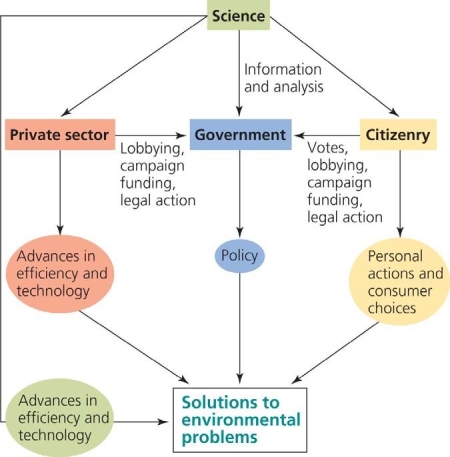 Use the figure above to answer the following question.
-In recent decades a great deal of scientific research and observation has been funded and published by commercial and corporate interests. Since this science may not have to pass the peer review process and may have motives for biased reporting, it could be included in the diagram as _____________.
Use the figure above to answer the following question.
-In recent decades a great deal of scientific research and observation has been funded and published by commercial and corporate interests. Since this science may not have to pass the peer review process and may have motives for biased reporting, it could be included in the diagram as _____________. (Multiple Choice)
4.7/5 (67)
(67) ʺIf domestic gas prices rise to $5 per gallon, conservation will increase, alternative fuels will be developed, and energy efficiency and our quality of life will improve.ʺ This view is consistent with _______________ economics.
(Multiple Choice)
4.8/5 (92)
(92) Choose the item that best matches each item in the following:
-Agreements with foreign countries
(Multiple Choice)
4.8/5 (79)
(79) A distinguishing feature of ecological economics is the concept of _______________.
(Multiple Choice)
5.0/5 (87)
(87) What is the main goal of environmental policy? Describe the tragedy of the commons and externalities, and explain why environmental policy would focus on these problems.
(Essay)
5.0/5 (89)
(89) 
Filters
- Essay(0)
- Multiple Choice(0)
- Short Answer(0)
- True False(0)
- Matching(0)