



 Chat with AI
Exam 14: Global Climate Change

Exam 1: Science and Sustainability: an Introduction to Environmental Science61 Questions
Exam 2: Environmental Systems: Matter, Energy, and Ecosystems58 Questions
Exam 3: Evolution, Biodiversity, and Population Ecology52 Questions
Exam 4: Species Interactions and Community Ecology55 Questions
Exam 5: Economics, Policy, and Sustainable Development54 Questions
Exam 6: Human Population62 Questions
Exam 7: Soil, Agriculture, and the Future of Food64 Questions
Exam 8: Biodiversity and Conservation Biology49 Questions
Exam 9: Forests, Forest Management, and Protected Areas51 Questions
Exam 10: Environmental Health and Toxicology62 Questions
Exam 11: Geology, Minerals, and Mining52 Questions
Exam 12: Fresh Water, Oceans, and Coasts70 Questions
Exam 13: Atmospheric Science, Air Quality, and Pollution Control53 Questions
Exam 14: Global Climate Change53 Questions
Exam 15: Nonrenewable Energy Sources, Their Impacts, and Energy Conservation64 Questions
Exam 16: Renewable Energy Alternatives61 Questions
Exam 17: Managing Our Waste56 Questions
Exam 18: The Urban Environment: Creating Sustainable Cities60 Questions
Exam 19: Epilogue45 Questions
Select questions type


Read the following scenario and answer the question below.
The Intergovernmental Panel on Climate Change reports that physical, biological, and economic evidence exists confirming global climate change due to human -produced greenhouse gases. Although the United States emits most of Earthʹs carbon dioxide, its policies do not reflect concern over its environmental effects. The United States failed to ratify the Kyoto Protocol, an international agreement signed by other developed nations to reduce carbon dioxide emissions. Requested voluntary reductions of carbon dioxide emissions have not been effective in reducing greenhouse gases. Revisions to the 1970 Clean Air Act, called the ʺClear Skies Initiative,ʺ were proposed to limit mercury, nitric oxides, and sulfur oxide emissions from power plants. Nicknamed by Robert F. Kennedy, Jr., as the ʺClear Lies Initiative,ʺ this proposal did not specifically address emission of carbon dioxide, and its loopholes precluded older power plants from modernizing, seemingly supporting polluting industries with political influence. Environmentalists are arguing for immediate action, including stricter laws to limit power plant carbon dioxide emissions and provide subsidies for renewable energy. They favor ʺportfolio standards,ʺ requiring electric companies to provide clean energy alternatives to consumers and ʺgreen tags,ʺ
ʺwind certificates,ʺ and ʺgreen pricingʺ to support the use of alternative fuels.
-The United States should enact laws slowing global climate change because ______________.
(Multiple Choice)
4.8/5  (82)
(82) 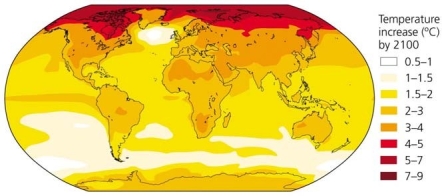 Use the figure above to answer the following question.
-According to the map, the area that will experience the greatest increase in temperatures is ______________.
Use the figure above to answer the following question.
-According to the map, the area that will experience the greatest increase in temperatures is ______________. (Multiple Choice)
5.0/5 (97)
(97) The atmosphere around Earth can cause global warming because ______________.
(Multiple Choice)
4.8/5 (72)
(72) The greenhouse effect involves warming of Earthʹs surface and the ______________.
(Multiple Choice)
4.8/5 (85)
(85) Soot particles (ʺblack carbon aerosolsʺ) generally cause ______________ of Earthʹs atmosphere by ______________ solar energy.
(Multiple Choice)
4.8/5 (80)
(80) Carbon-based fuels from lithospheric reservoirs ______________.
(Multiple Choice)
4.9/5 (60)
(60) Choose the item that best matches each item in the following:
-By-product of feedlots, chemical manufacturing, and fertilizer use
(Multiple Choice)
4.8/5 (74)
(74) In the wake of the U.S. failure to ratify the Kyoto Protocol ______________.
(Multiple Choice)
4.9/5 (85)
(85) Tuvalu and the Maldives are in the international spotlight because they ______________.
(Multiple Choice)
4.8/5 (84)
(84) The Kyoto Protocol is to carbon dioxide as the Montreal Protocol is to ______________.
(Multiple Choice)
4.9/5 (84)
(84) 
Filters
- Essay(0)
- Multiple Choice(0)
- Short Answer(0)
- True False(0)
- Matching(0)