



 Chat with AI
Exam 14: Global Climate Change

Exam 1: Science and Sustainability: an Introduction to Environmental Science61 Questions
Exam 2: Environmental Systems: Matter, Energy, and Ecosystems58 Questions
Exam 3: Evolution, Biodiversity, and Population Ecology52 Questions
Exam 4: Species Interactions and Community Ecology55 Questions
Exam 5: Economics, Policy, and Sustainable Development54 Questions
Exam 6: Human Population62 Questions
Exam 7: Soil, Agriculture, and the Future of Food64 Questions
Exam 8: Biodiversity and Conservation Biology49 Questions
Exam 9: Forests, Forest Management, and Protected Areas51 Questions
Exam 10: Environmental Health and Toxicology62 Questions
Exam 11: Geology, Minerals, and Mining52 Questions
Exam 12: Fresh Water, Oceans, and Coasts70 Questions
Exam 13: Atmospheric Science, Air Quality, and Pollution Control53 Questions
Exam 14: Global Climate Change53 Questions
Exam 15: Nonrenewable Energy Sources, Their Impacts, and Energy Conservation64 Questions
Exam 16: Renewable Energy Alternatives61 Questions
Exam 17: Managing Our Waste56 Questions
Exam 18: The Urban Environment: Creating Sustainable Cities60 Questions
Exam 19: Epilogue45 Questions
Select questions type


Distinguish between the terms weather and climate, and briefly discuss how each affects species distribution within ecosystems.
(Essay)
4.9/5  (80)
(80) Briefly explain why water vapor may either contribute to or slow global warming.
(Essay)
4.8/5 (76)
(76) Read the following scenario and answer the question below.
The Intergovernmental Panel on Climate Change reports that physical, biological, and economic evidence exists confirming global climate change due to human -produced greenhouse gases. Although the United States emits most of Earthʹs carbon dioxide, its policies do not reflect concern over its environmental effects. The United States failed to ratify the Kyoto Protocol, an international agreement signed by other developed nations to reduce carbon dioxide emissions. Requested voluntary reductions of carbon dioxide emissions have not been effective in reducing greenhouse gases. Revisions to the 1970 Clean Air Act, called the ʺClear Skies Initiative,ʺ were proposed to limit mercury, nitric oxides, and sulfur oxide emissions from power plants. Nicknamed by Robert F. Kennedy, Jr., as the ʺClear Lies Initiative,ʺ this proposal did not specifically address emission of carbon dioxide, and its loopholes precluded older power plants from modernizing, seemingly supporting polluting industries with political influence. Environmentalists are arguing for immediate action, including stricter laws to limit power plant carbon dioxide emissions and provide subsidies for renewable energy. They favor ʺportfolio standards,ʺ requiring electric companies to provide clean energy alternatives to consumers and ʺgreen tags,ʺ
ʺwind certificates,ʺ and ʺgreen pricingʺ to support the use of alternative fuels.
-Why do environmentalists and scientists advocate immediate action, including stricter laws to limit power plant carbon dioxide emissions and subsidies for renewable energy?
(Multiple Choice)
4.9/5 (73)
(73) Describe how freshwater ecosystems face challenges of global climate change. Give an example from the text.
(Essay)
4.9/5 (75)
(75) Read the following scenario and answer the question below.
The Intergovernmental Panel on Climate Change reports that physical, biological, and economic evidence exists confirming global climate change due to human -produced greenhouse gases. Although the United States emits most of Earthʹs carbon dioxide, its policies do not reflect concern over its environmental effects. The United States failed to ratify the Kyoto Protocol, an international agreement signed by other developed nations to reduce carbon dioxide emissions. Requested voluntary reductions of carbon dioxide emissions have not been effective in reducing greenhouse gases. Revisions to the 1970 Clean Air Act, called the ʺClear Skies Initiative,ʺ were proposed to limit mercury, nitric oxides, and sulfur oxide emissions from power plants. Nicknamed by Robert F. Kennedy, Jr., as the ʺClear Lies Initiative,ʺ this proposal did not specifically address emission of carbon dioxide, and its loopholes precluded older power plants from modernizing, seemingly supporting polluting industries with political influence. Environmentalists are arguing for immediate action, including stricter laws to limit power plant carbon dioxide emissions and provide subsidies for renewable energy. They favor ʺportfolio standards,ʺ requiring electric companies to provide clean energy alternatives to consumers and ʺgreen tags,ʺ
ʺwind certificates,ʺ and ʺgreen pricingʺ to support the use of alternative fuels.
-Environmentalists advocate immediate intervention regarding global climate change because ______________.
(Multiple Choice)
4.9/5 (82)
(82) Keelingʹs reports from Mauna Loa demonstrated ______________.
(Multiple Choice)
4.8/5 (76)
(76) Over ______________ % of the fuel you pump into your automobile does something other than move your vehicle down the road.
(Multiple Choice)
4.9/5 (64)
(64) 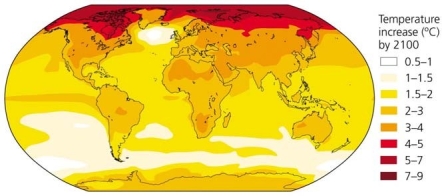 Use the figure above to answer the following question.
-The temperature change over most of Asia is predicted to be _________________ °C.
Use the figure above to answer the following question.
-The temperature change over most of Asia is predicted to be _________________ °C. (Multiple Choice)
4.9/5 (83)
(83) Choose the item that best matches each item in the following:
-Produced by microbes decomposing matter in landfills and as a metabolic byproduct of livestock
(Multiple Choice)
4.7/5 (77)
(77) Recent research indicates that the variation in solar output ______________.
(Multiple Choice)
4.9/5 (77)
(77) In legislation, the precautionary principle applied to climate change states that ______________.
(Multiple Choice)
4.8/5 (75)
(75) How certain are scientists that humans are causing global climate change? Describe the language used by scientists and some of the particular climate trends they have identified as changing. If the scientific community is convinced of the evidence, why is there still debate?
(Essay)
4.7/5 (72)
(72) Explain how human health may suffer or benefit from global climate change.
(Essay)
4.9/5 (64)
(64) Use the figure above to answer the following question.
-Compared to Antarctica, the percent increase in temperature in the Arctic will be ________________
Use the figure above to answer the following question.
-Compared to Antarctica, the percent increase in temperature in the Arctic will be ________________ (Multiple Choice)
4.9/5 (77)
(77) Read the following scenario and answer the question below.
The Intergovernmental Panel on Climate Change reports that physical, biological, and economic evidence exists confirming global climate change due to human -produced greenhouse gases. Although the United States emits most of Earthʹs carbon dioxide, its policies do not reflect concern over its environmental effects. The United States failed to ratify the Kyoto Protocol, an international agreement signed by other developed nations to reduce carbon dioxide emissions. Requested voluntary reductions of carbon dioxide emissions have not been effective in reducing greenhouse gases. Revisions to the 1970 Clean Air Act, called the ʺClear Skies Initiative,ʺ were proposed to limit mercury, nitric oxides, and sulfur oxide emissions from power plants. Nicknamed by Robert F. Kennedy, Jr., as the ʺClear Lies Initiative,ʺ this proposal did not specifically address emission of carbon dioxide, and its loopholes precluded older power plants from modernizing, seemingly supporting polluting industries with political influence. Environmentalists are arguing for immediate action, including stricter laws to limit power plant carbon dioxide emissions and provide subsidies for renewable energy. They favor ʺportfolio standards,ʺ requiring electric companies to provide clean energy alternatives to consumers and ʺgreen tags,ʺ
ʺwind certificates,ʺ and ʺgreen pricingʺ to support the use of alternative fuels.
-The Clear Skies Initiative may have helped somewhat with the problem of global climate change because it would have ______________.
(Multiple Choice)
4.8/5 (65)
(65) 
Filters
- Essay(0)
- Multiple Choice(0)
- Short Answer(0)
- True False(0)
- Matching(0)